


At first glance, Pixels feels easy to settle into. You don’t need to overthink it. You show up, do a few things, see progress move, and over time it starts to feel like your effort is being recognized in a steady, almost predictable way. That sense of rhythm is what draws people in. It gives the impression that the system is fair, or at least understandable, and that if you put in time, something proportional comes back to you.
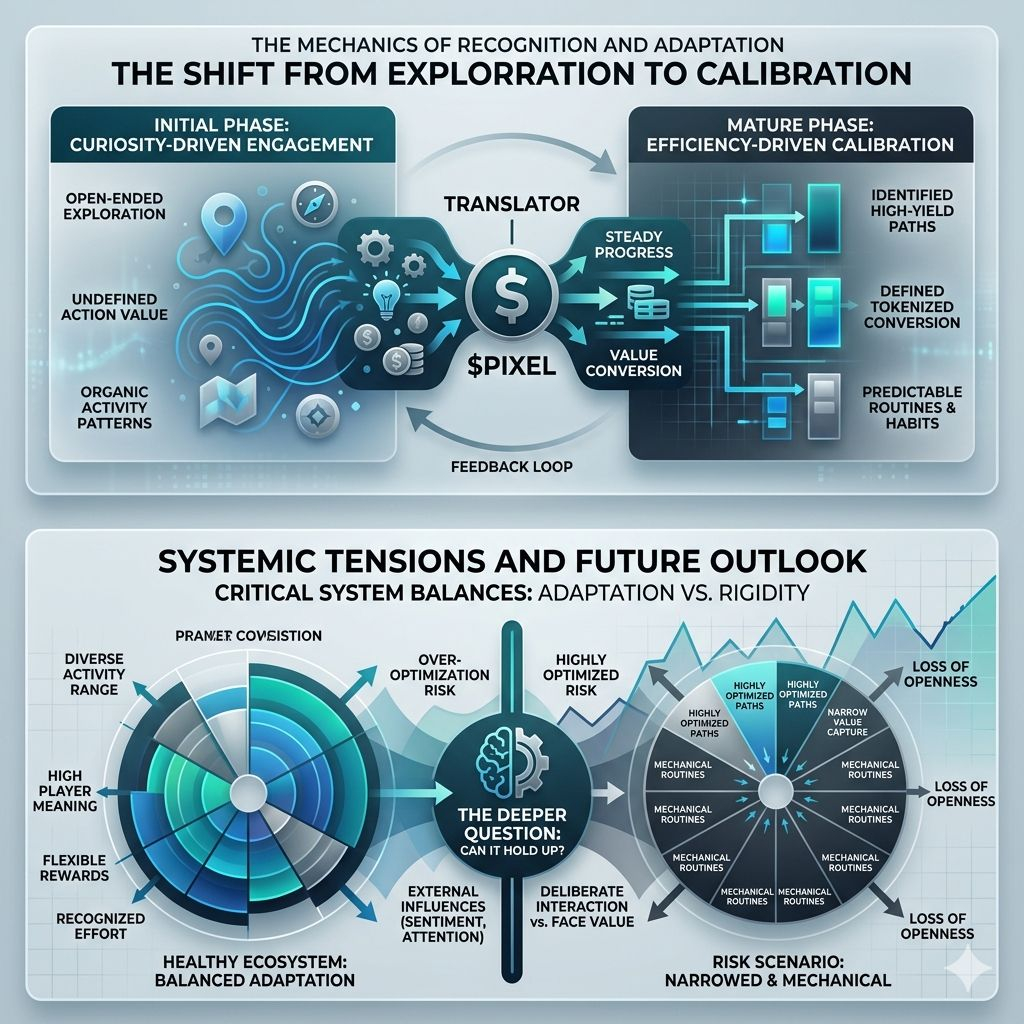
But that feeling comes from somewhere specific. It’s not just good design or pacing. It’s the quiet role of $PIXEL shaping how that time is interpreted. The token isn’t just sitting there as a reward it’s acting more like a translator. It takes different kinds of player activity and converts them into a shared language of value. And once that translation exists, it starts influencing decisions, even if players don’t consciously think about it that way.
You begin to notice it in small ways. Certain actions feel more “worth it” than others. Some loops become habits, not because they’re the most interesting, but because they’re reliable. Over time, the experience shifts slightly. It’s still a game, but it’s also a system where time has weight, where choices carry a kind of invisible pricing.
That’s where things get more complicated than they first appear. Because time in a game isn’t stable. It changes depending on mood, context, outside distractions, and even what other players are doing. People don’t engage the same way every day, and they don’t all value the same outcomes. So when a system tries to organize that time into something measurable, it’s working against something naturally fluid.
At the beginning, this doesn’t feel like a problem. The structure helps. It reduces guesswork and gives players a sense of direction. But as more people settle into the system, patterns start forming. Players figure out what works, what pays off, and what can be repeated with the least friction. The system still looks active, maybe even more active than before, but the reasons behind that activity begin to narrow.
What’s interesting is that nothing is technically broken at this point. The system is doing exactly what it was designed to do. It’s just that the behavior around it has adapted. Players are no longer just participating—they’re calibrating. They’re learning where their time converts most efficiently, and naturally, they lean into those paths.
This creates a subtle shift. The experience moves from being guided by curiosity to being shaped by expectation. Instead of asking “what do I feel like doing,” players start asking “what makes sense to do right now.” And while those two questions can overlap, they don’t always lead to the same place.
There’s also a difference between arriving early and arriving later. Early participants move through a space that feels open, where the value of actions isn’t fully defined yet. Later participants step into something more settled. They see patterns already in motion, strategies already proven, and an economy that has already started to organize itself. Their role isn’t to explore as much as it is to position themselves within what already exists.
All of this adds pressure in ways that aren’t immediately obvious. The system has to keep aligning what it rewards with what players feel is meaningful, even as those players become more aware, more strategic, and more selective with their time. It also has to absorb influences from outside—changes in sentiment, shifts in attention, fluctuations in how the token itself is perceived.
So the real question isn’t whether Pixels works in a straightforward sense. It clearly does, at least on the surface. The deeper question is whether the structure behind it can keep adapting without becoming too rigid or too predictable. Because once a system becomes overly optimized, it risks losing the sense of openness that made it engaging in the first place.
There’s a delicate balance here. If $PIXEL continues to reflect a wide range of meaningful activity, the system can feel alive, even as it remains structured. But if that range narrows—if value becomes too concentrated in specific patterns—then the experience may still function, just in a more mechanical way.
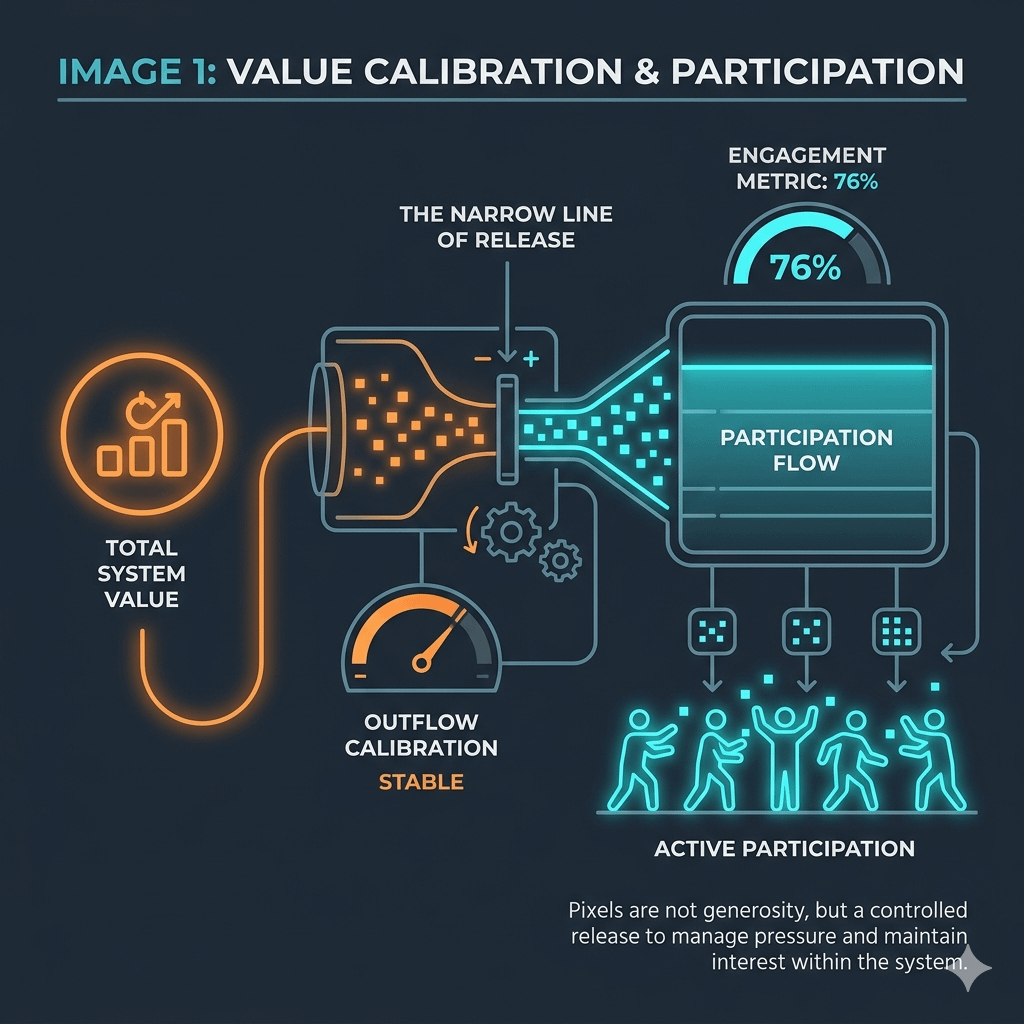
It doesn’t come down to whether the idea is convincing. It comes down to whether it can hold up when people stop taking it at face value and start interacting with it more deliberately. If it continues to feel fair, flexible, and worth the time people give it, then the structure may justify itself over time. If not, it may still look organized and coherent from the outside, while quietly relying on assumptions that are harder to maintain as the system matures.