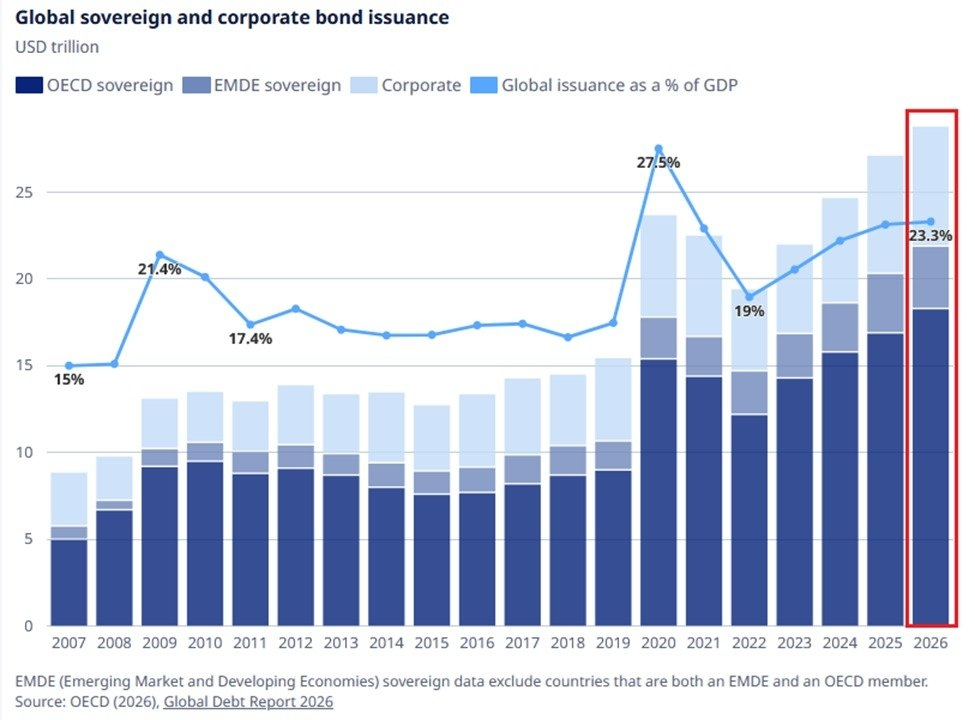

$28.8 trillion
That is the amount of government and corporate debt the world will issue in 2026 alone.
A record number.
The first of its kind in history.
But the more alarming figure is not the absolute size…
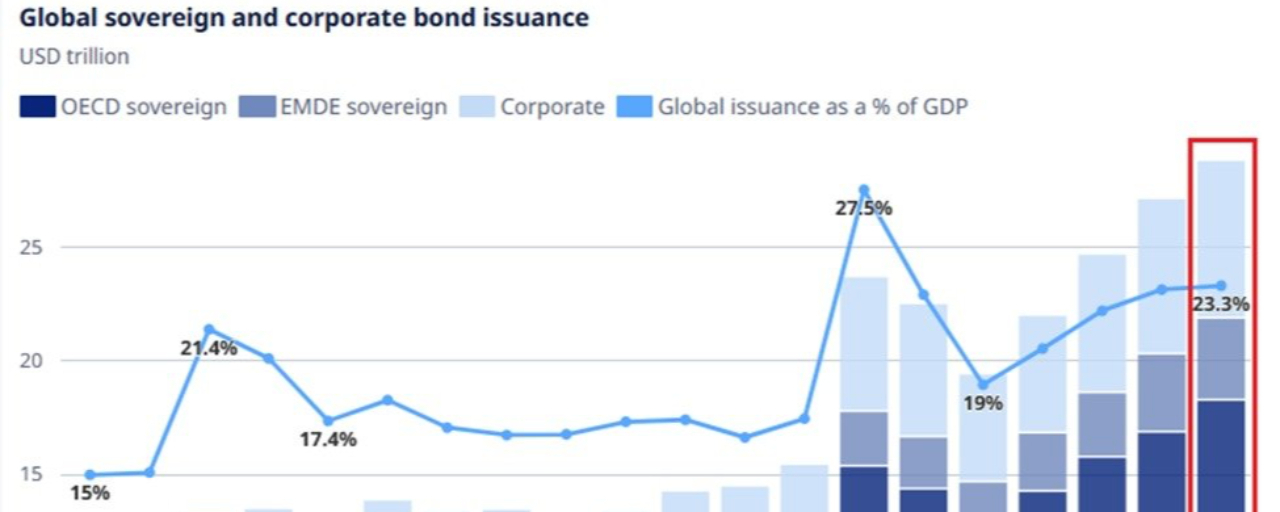
it’s what it reveals about the current state: global borrowing has reached 23.3% of GDP.
That is higher than the peak of the 2008 financial crisis, which stood at 21.4%.
Back then, the world was on fire.
Today, there is no declared crisis.
No pandemic, no visible banking collapse, no world war.
Yet governments and companies are borrowing above crisis levels.
What does this mean for your wealth?
Every dollar, euro, or dirham you hold in cash in your bank account is affected by this process without being consulted.
The mechanism is simple:
Governments need to finance this massive debt.
Part of it comes from higher taxes.
Part from issuing bonds at higher yields which pressures other asset prices.
And the largest part, rarely stated openly, comes from currency dilution through money creation.
The result is inevitable:
What you hold in paper currency today buys less tomorrow.
And as global debt continues to rise at this pace, this erosion accelerates.
History does not lie:
Every major debt cycle in history ended in one of two ways:
A sharp inflation that erodes debt,
or a painful restructuring that erodes wealth.
In both cases, cash holders are the biggest losers.
What does the smart investor do in this environment?
The answer is not a secret…
but its execution requires conviction.
Real assets are the safe haven.
Gold is trading near record levels for a reason central banks themselves are buying it at unprecedented levels.
Stocks in companies with productive assets,
real estate that preserves value,
and essential commodities the world depends on…
all serve as tools to protect purchasing power as currencies erode.
Cash is the risk.
Holding a large portion of wealth in fiat currencies in this over-borrowed environment is not a safe position it is a poor investment decision.
Cash is not stable; it is a systematically depreciating asset.
Geographic diversification has also become essential.
When governments borrow at these levels, fiscal and monetary policies become increasingly volatile and unpredictable.
Relying on a single economy or currency amplifies risk.
$BTC increasingly sits at the center of this discussion as a non-sovereign, fixed-supply monetary asset.
Unlike fiat currencies that expand with debt cycles or traditional assets tied to corporate and fiscal systems, Bitcoin is not dependent on government balance sheets or refinancing conditions.
In environments where global debt accelerates and currency dilution becomes structural, it functions as a parallel store of value driven by scarcity and global liquidity flows rather than policy decisions.
It does not eliminate risk, but it changes the form of it from monetary debasement to price volatility within a fixed supply system.
Conclusion
The world is not borrowing to build something great…
it is borrowing to service old debts with new ones.
This cycle has an end, and historically, fiat currencies are the ones that pay the price.
The only question you should ask yourself is:
Where is your wealth positioned when the bill arrives?
In resilient real assets…
or in paper slowly losing its value?
This article is for information and education only and is not investment advice. Crypto assets are volatile and high risk. Do your own research.
📌 Follow @Bluechip for unfiltered crypto intelligence, feel free to bookmark & share.