

I’ve spent enough time around distributed systems, game platforms, and tokenized infrastructure to know how these stories usually go. A team ships a shiny architecture diagram, adds a token, talks about digital ownership like it changes human behavior by itself, and then acts surprised when the product turns into an incentives treadmill. I’ve seen this fail more than once. That is part of why Pixels caught my attention in the first place
Not because it solved Web3 gaming. It hasn’t. Not because the token model is somehow immune to the usual problems. It isn’t. I paid attention because Pixels looked like one of the few projects in this category that at least understood where the bodies are buried
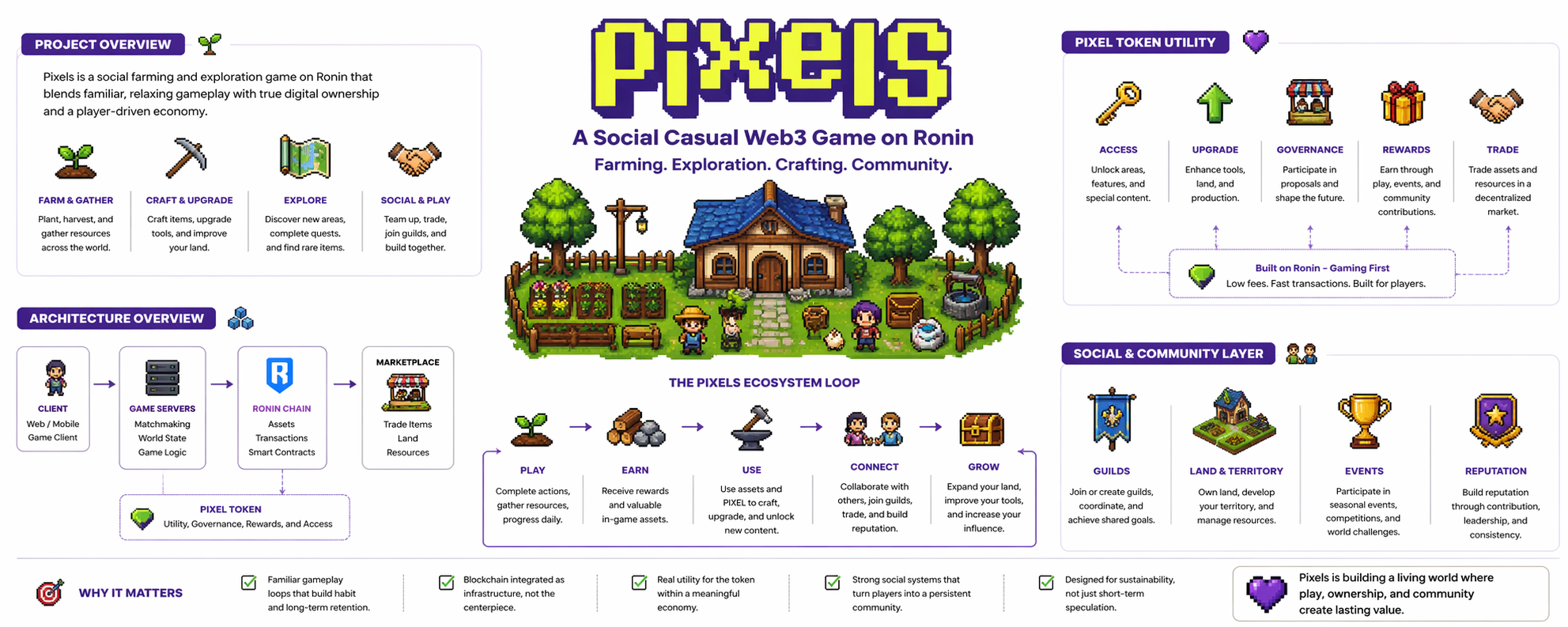
At a glance, Pixels is easy to describe. It is a social casual Web3 game on Ronin, built around farming, exploration, crafting, gathering, and player interaction inside a pixel-art world. That summary is accurate, but it misses the more interesting part. The interesting part is architectural, not cosmetic. Pixels seems to understand that if blockchain is going to work inside a game, it has to behave like infrastructure. Not a sermon. Not a brand identity. Infrastructure
That sounds obvious. It is not obvious in practice
Most Web3 games did the opposite. They led with the economy. They treated the token as the product and the game as a wrapper around issuance, speculation, and retention theater. You could feel it within minutes of using them. The loops were thin. The UX was awkward. The player was basically a labor source attached to a wallet. Once the emissions stopped being exciting, the whole thing sagged. It’s a mess when that happens, and it happens a lot
Pixels seems to have started from a better premise. Give people something recognizable. Something with rhythm. Planting, harvesting, gathering, crafting, upgrading, moving through a world that feels coherent enough to come back to. Those are not revolutionary mechanics. That is the point. Good infrastructure usually disappears into a workflow people already understand. Good product design does the same thing. If users need a manifesto to explain why the expelience matters, you are already in trouble
That is where Pixels made a smarter call than many of its peers. It did not try to force players to care about the chain first. It tried to build a loop that made sense before the blockchain layer even entered the conversation
I like that instinct. I trust it more than big promises
The move to Ronin made that architecture more credible. Ronin is not a general-purpose chain pretending to care about games. It is a gaming-first environment, and that matters. Infrastructure alignment matters more than people admit. Wallet flow matters. Marketplace assumptions matter. Transaction cost expectations matter. Community norms matter. A lot of Web3 projects fail because they deploy into ecosystems that are technically functional but behaviorally mismatched. The stack exists, but the usage pattern is wrong
Pixels on Ronin made more sense than Pixels trying to brute-force its model somewhere else
And yes, the growth numbers helped get attention. Of course they did. Public reporting around the game showed a sharp rise in user activity during its expansion on Ronin, especially around reward-heavy periods and token-related momentum. That is not meaningless, but I am always careful with these numbers. Activity is not the same thing as attachment. Wallet count is not the same thing as retention. Distribution campaigns can light up a dashboard without proving that the underlying system is healthy
I’ve seen this fail too. Metrics go vertical. People celebrate. Then you discover the product has trained users to extract value rather than inhabit the system. That works for a while. Then it doesn’t
Pixels is interesting because it seems aware of that trap. Or at least more aware than most
The game’s structure leans on routines that have worked in online systems for years. Not because they are glamorous, but because they are durable. Repeated actions with light progression. Clear feedback. Small accumulations of effort. A sense that today’s work changes tomorrow’s state. That kind of loop is not exciting in a pitch deck, but it is exactly what creates habit. In systems terms, it reduces cognitive overhead while preserving a feeling of movement. In player terms, it gives people a reason to log back in
That matters more than token theory
The PIXEL token sits in the middle of this design, and that is where the usual complications show up. Any token inside a live product creates tension between utility and distortion. If the token is too disconnected, it becomes ornamental. If it is too central, it warps behavior and starts dictating the shape of the product. Teams talk about “alignment” all the time, but the reality is messier. A token changes incentives. That sounds manageable until you realize it also changes expectations, pacing, social behavior, and even the way outside observers evaluate the system
Pixels has tried to tie PIXEL to actual in-game functions instead of treating utility as a vague future promise. That is the right move. Tokens need to map to actions users already value. Access. Upgrades. Membership. Convenience. Participation in systems that feel native to the product. Otherwise you are not building an economy. You are building a sidecar asset and asking people to pretend it is foundational
Still, there is no clean escape hatch here. Market conditions change. Sentiment cools. Price action starts affecting how users interpret every design decision. Communities that arrive during high-incentive periods can get restless when the product shifts toward slower, more durable forms of engagement. That is not a Pixels-specific problem. That is structural. Any system with financialized user behavior inherits that volatility whether the team likes it or not
So the real test for Pixels was never launch. Launches are easy to overrate. Noise is easy to manufacture. The real test is whether the product can deepen once the easy energy burns off
That is why I pay more attention to the social systems than the token narrative
When a game starts leaning into guilds, land coordination, shared resource flows, and role-based participation, I start to see an architecture that might hold up better over time. Not because guilds are new. They are not. But because social structure is usually where durable systems either stabilize or collapse. A good shared system converts repetitive actions into meaningful contributions. The exact same task feels different when it supports a group, a territory, a collective goal, or a reputation layer. That is not marketing language. That is systems design
Pixels seems to be moving in that direction. That is one of the more credible things about it
Web3 projects love talking about ownership. Fine. Ownership has value. But ownership without social context is thin. People do not stay in persistent systems just because an asset is tradable. They stay because the system starts recognizing them. Their effort matters. Their presence matters. Their absence matters too. Once you get there, the economy stops feeling like an overlay and starts feeling like one component of a broader operating model
That is hard to do. Very hard
And that is also why I do not read Pixels as some grand proof that Web3 gaming has arrived. I read it as a useful correction. It is one of the clearer examples of a team trying to make the chain recede into the background instead of constantly demanding attention. That is the right direction. Infrastructure should enable the product, not dominate it. If users spend all their time noticing the rails, the rails are too loud
I appreciate that Pixels appears to understand this, even if the implementation still has to survive the usual pressure tests
Because those pressure tests are coming, or already here. Can the game retain users when speculative energy drops? Can the community hold together when incentives become less dramatic and more operational? Can the token remain useful without becoming the only thing people measure? Can the social systems produce enough stickiness to offset the volatility that comes with any on-chain economy
Those are system questions. Product questions. Governance questions, eventually. They are not branding questions
And that is why I think Pixels is worth watching
Not because it is flawless. Not because it is the future. I get tired of that framing. Every sector wants a flagship success story, and every project is tempted to volunteer itself for the role. Usually too early. Usually with too much confidence. I am less interested in declarations than in whether the underlying stack makes sense
With Pixels, parts of the stack do make sense. The product loop is familiar enough to reduce friction. The infrastructure choice is aligned with the use case. The token is being pushed toward concrete utility rather than abstract mythology. The social layer seems to be getting more attention, which is exactly where long-term durability tends to come from
That does not guarantee anything. Plenty of systems with sensible architecture still fail. Timing fails them. Execution fails them. User behavior fails them. The market fails them. Sometimes all four at once
But I would rather study a project wrestling with the right problems than another one pretending those problems do not exist
That, for me, is the value of Pixels. It is not a miracle. It is not a clean success story. It is a live system trying to make crypto infrastructure subordinate to product logic, which is rarer than it should be. If the team can keep the economy from overwhelming the game, and keep the social fabric stronger than the speculation cycle, then it has a real shot at becoming something durable
If not, it will still have been useful as a case study
Sometimes that is the more honest outcome anyway
