
I was sitting outside late one night, phone in hand, just planning to do a quick check-in on Pixels before calling it a day. Nothing serious—harvest a few crops, maybe craft something small, log out. That’s how it usually starts.
But that night, I didn’t log out quickly.
I stayed longer than I expected, not because something exciting happened, but because I started noticing a pattern I hadn’t really paid attention to before. The farming part—the planting, watering, harvesting—it felt almost secondary. Like it was there to keep me moving, but not really the main point.
What actually held everything together was the flow underneath.
Every action led somewhere. Nothing really stopped at the surface.
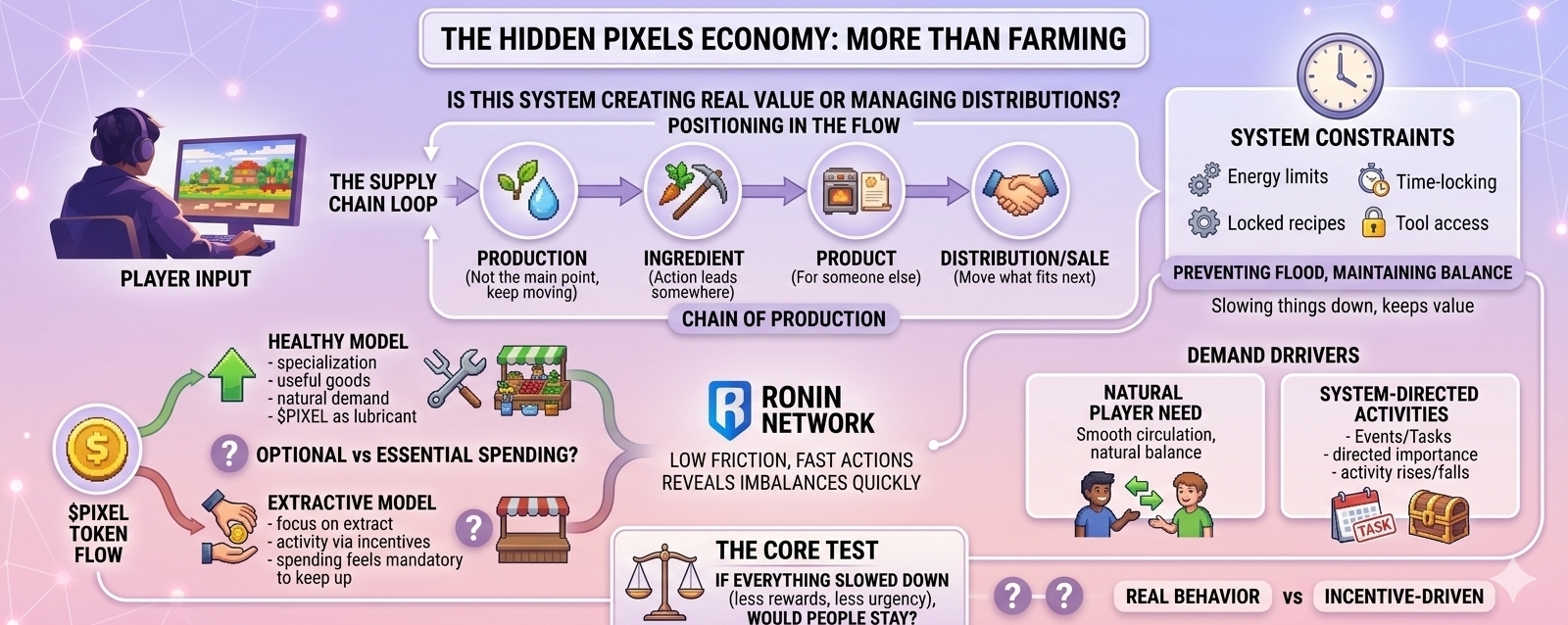
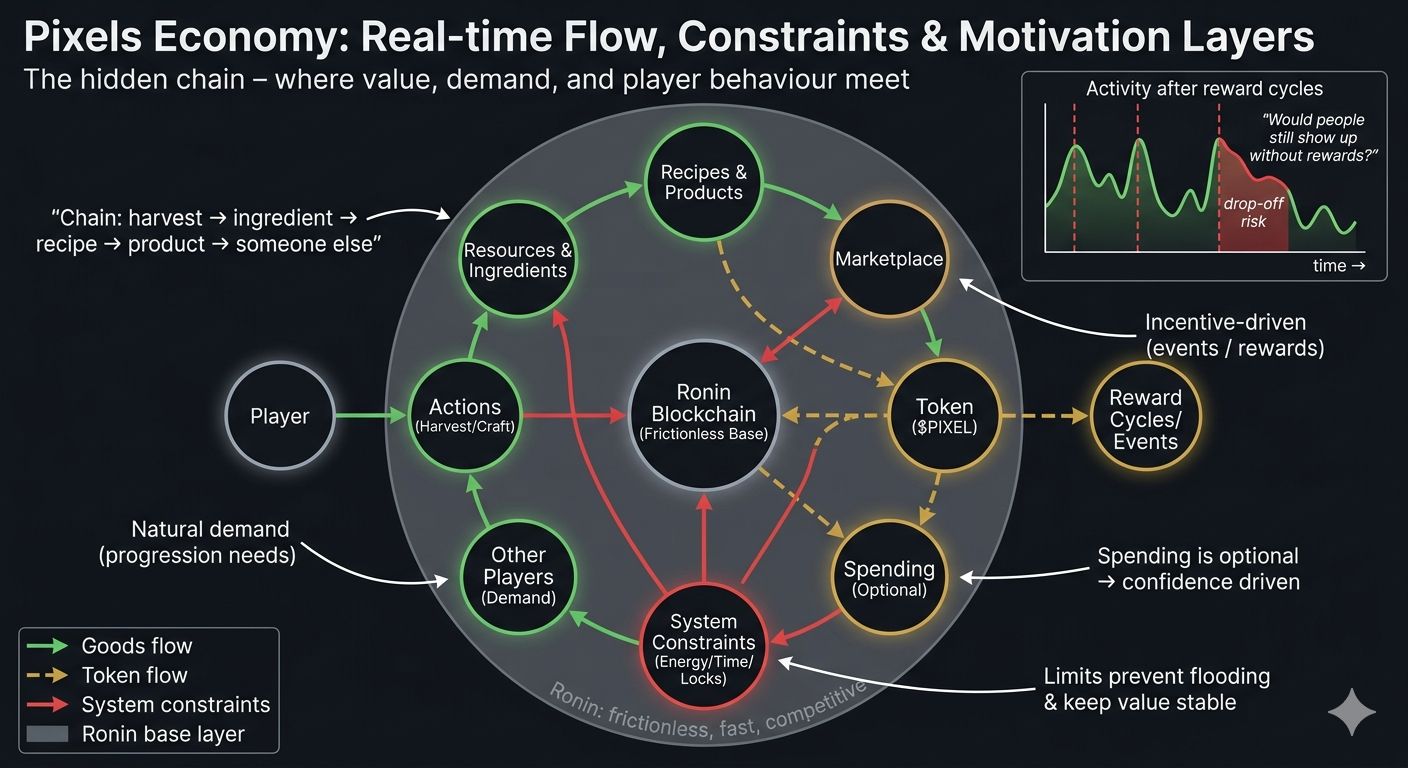
You harvest something, then it turns into an ingredient. That ingredient becomes part of a recipe. That recipe becomes a product. And that product? It doesn’t just sit in your inventory—it’s almost always meant for someone else.
That’s when it clicked for me. This isn’t just a farming loop. It’s a chain.
And once you see it that way, the whole experience changes.
You stop thinking in terms of “what should I grow?” and start thinking “what will move?” What will actually sell, what someone else needs, what fits into the next person’s progression.
It becomes less about playing and more about positioning yourself inside that flow.
The system quietly pushes you in that direction too. You can feel it.
There are limits everywhere—energy runs out, time slows things down, certain recipes stay locked until you’ve done enough, tools aren’t always easy to access. At first, it feels like normal pacing.
But after a while, it feels intentional.
Like the system is constantly making sure things don’t move too fast.
Because if they did, everything would flood at once. Everyone would produce the same items, and suddenly those items wouldn’t be worth anything anymore.
I’ve seen that happen in other places. It doesn’t take long.
Here, it feels like Pixels is trying to stay one step ahead of that. Not stopping players, just slowing them enough to keep the balance.
Then there’s the token side of things.
At the beginning, earning $PIXEL feels straightforward. You put in time, you stay active, and there’s a reward attached. It makes the effort feel real.
But after a few sessions, I started asking myself something simple:
Where does this actually go?
Because tokens don’t just hold value on their own. They need movement. They need reasons for people to use them, not just collect them.
So I started paying attention—not to what I was earning, but to what I was spending.
And honestly, most of the spending didn’t feel necessary. It felt optional. Helpful, yes—but not essential.
That’s where things get a bit uncertain.
When spending is optional, it depends on how people feel. If they’re confident, they spend. If they’re unsure, they hold back.
And the moment people start holding back, the whole flow slows down.
On the flip side, if spending becomes something you have to do to keep up, it solves the token problem—but changes the experience.
It starts feeling like every step has a cost attached. Like you’re constantly paying to stay in motion.
That balance isn’t easy to get right.
Too much freedom, and value drifts.
Too much pressure, and players lose interest.
Somewhere in between is where things work—but that “in between” doesn’t stay fixed.
Another thing I noticed is how much the system relies on other players.
A lot of what you produce only matters because someone else needs it. Tools, consumables, ingredients—they all move because they’re part of someone else’s process.
When that demand is natural, everything feels smooth. People produce, people buy, things circulate.
But when demand comes from events or specific tasks, it feels different. More directed.
Like the system is quietly deciding what’s important at that moment.
That’s not necessarily a problem—it keeps things active. But it also means activity can rise and fall depending on what’s being pushed.
If rewards are strong, everything speeds up.
If they slow down, so does the market.
And that brings everything back to one thing: consistency.
Because underneath all of this, Pixels is trying to maintain a working economy in real time. Not just a game loop, but a system where inputs, outputs, and value all stay connected.
And that’s where Ronin plays a bigger role than it seems.
Everything feels fast. Smooth. No friction.
You don’t think twice before crafting something, listing it, or buying what you need. It just happens.
That ease makes the system feel natural—but it also makes it competitive.
If there’s a better way to do something, people find it quickly. If there’s an imbalance, it doesn’t stay hidden.
The system gets tested constantly, just by people trying to get the most out of it.
And over time, that testing reveals something deeper.
Is this system creating real value between players, or is it mostly distributing rewards and trying to manage the outflow?
The healthy version is easy to imagine—people specialize, goods stay useful, demand feels real, and the token just helps everything move.
The other version is quieter. People focus on extracting as much as they can. The system slows them down just enough to keep things stable. Activity is there—but it’s driven more by incentives than by actual need.
The difference between those two doesn’t show up immediately.
It shows up over time.
In whether items keep selling without being pushed.
In whether people keep playing when rewards aren’t as strong.
In whether the system holds together without constant adjustments.
That’s why I don’t try to reach a conclusion anymore.
I just watch.
What happens after big reward cycles?
Do people stay active, or do they disappear?
Are tokens being used in meaningful ways, or just moving around?
Does the market feel natural, or does it need a push every time?
And one thought that keeps coming back to me:
If everything slowed down for a while—less rewards, less urgency—would people still show up?
Not because they feel like they should.
But because they actually want to be there.
That answer doesn’t come quickly.
You only start to see it when things quiet down a bit—when the system isn’t pushing as hard, and people are left to decide for themselves.
That’s when the real behavior shows.
And honestly, that’s the part I’m paying attention to now.