

I remember hitting that point in a game where rewards stopped feeling like rewards.
At the beginning, everything felt earned. You complete a task, get something back, and it feels proportional. But after a while, the system starts giving more, more often. Daily rewards, bonuses, extra drops. It looks generous on the surface, but something changes underneath.You stop caring.
Not because you don’t like rewards, but because they start to feel disconnected from effort. They arrive too easily, too predictably. And once that happens, the whole loop starts to feel hollow.
At that moment, I realized the problem isn’t about rewards themselves. It’s about how they enter the system. If value is constantly injected without restraint, it stops being meaningful. It turns into noise.
Most systems don’t manage this well. They either flood users with incentives to keep engagement high, or they tighten too much and make participation feel unrewarding. There’s rarely a balance. It’s usually one extreme or the other.That’s where something like @PIXEL started to shift how I was looking at it.
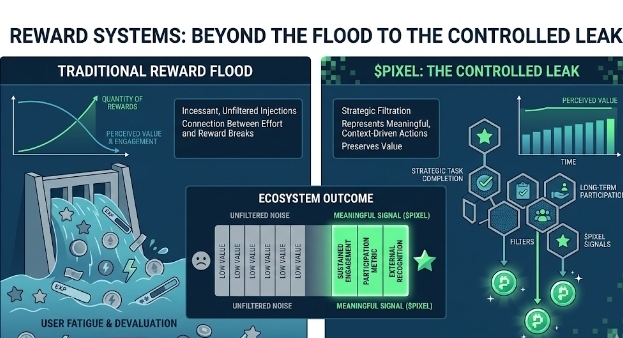
Initially, I thought $PIXEL was just another reward layer. Another token tied to activity, another output from a loop designed to keep players engaged. It didn’t seem fundamentally different from what I’d seen before.But the more I paid attention, the less it felt like a traditional reward.It felt constrained.
Not in a restrictive way, but in a controlled one. As if the system wasn’t just handing out value, but carefully releasing it. Not everything you do results in $PIXEL. Not every action translates directly into output. There’s a filtering effect.That’s when the idea started to shift for me.
Instead of thinking of pixel as a reward, it started to feel more like a controlled leak from the system.Something that escapes the internal loop, but only under certain conditions.That framing changes how the whole structure looks.
Inside the system, actions are constantly happening—resources being produced, tasks being completed, value circulating. But very little of that needs to leave. If everything did, the system would lose its balance quickly.
So $PIXEL becomes selective. It represents moments where internal activity is allowed to convert into something external, something persistent.What I find interesting is that this creates a kind of pressure.
Players are still active, still producing, but not all of that activity results in extraction. Some of it stays contained. And that forces a different kind of behavior. You start paying attention to when and how value actually exits the system.Not everything is equal anymore.Still, I had doubts.
If players don’t receive constant rewards, will they stay engaged? Most systems rely on frequent feedback to keep people coming back. Reducing that flow can easily backfire if it feels like effort isn’t being recognized.Initially, it felt risky. Maybe even unnecessary.But upon reflection, the alternative is worse.
When everything becomes a reward, nothing really is. Systems inflate, values blur, and eventually users disengage anyway. Just more slowly.
A controlled leak, on the other hand, preserves meaning. It makes the moments where value exits the system more noticeable. More intentional.
And if pixel is tied to those moments, then it starts to represent something different. Not just activity, but filtered activity. Actions that align with what the system is actually trying to sustain.That opens up a broader possibility.
If what leaves the system is already selective, then other systems can treat it differently. Not just as raw output, but as something that carries context. A signal of participation that has already been shaped internally.
You could imagine other environments recognizing that. Not because they trust the system completely, but because the output itself is limited and therefore more meaningful.But I don’t think this becomes widely useful right away, at least not yet.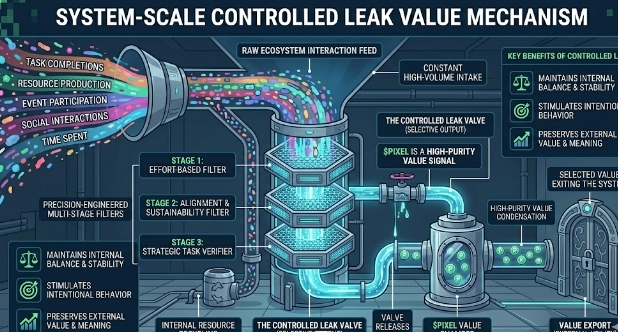
There’s friction in getting people to understand why less frequent rewards might actually be better. There’s also the challenge of maintaining that balance over time. If the leak becomes too tight, users lose interest. Too loose, and it loses meaning again.
And then there’s the ecosystem question. For Pixel to matter beyond its origin, other systems need to recognize it. That kind of coordination doesn’t happen easily.Right now, I’m still watching it closely.
I hold a small amount of $PIXEL, mostly to stay connected to how this mechanism evolves. I’m not fully convinced the “controlled leak” idea will hold under pressure, but it’s one of the few approaches that at least acknowledges the problem.For me, the proof is simple.
If over time, players don’t feel flooded or starved—if they continue engaging without questioning the value of what they receive—and if pixel remains something that’s earned under specific conditions rather than constantly distributed, then the balance is working.
And if other systems begin to treat it as a meaningful output, not just another token, then that controlled leak starts to look like something more deliberate.Not a reward in the usual sense.But a signal that something inside the system was worth letting out.