
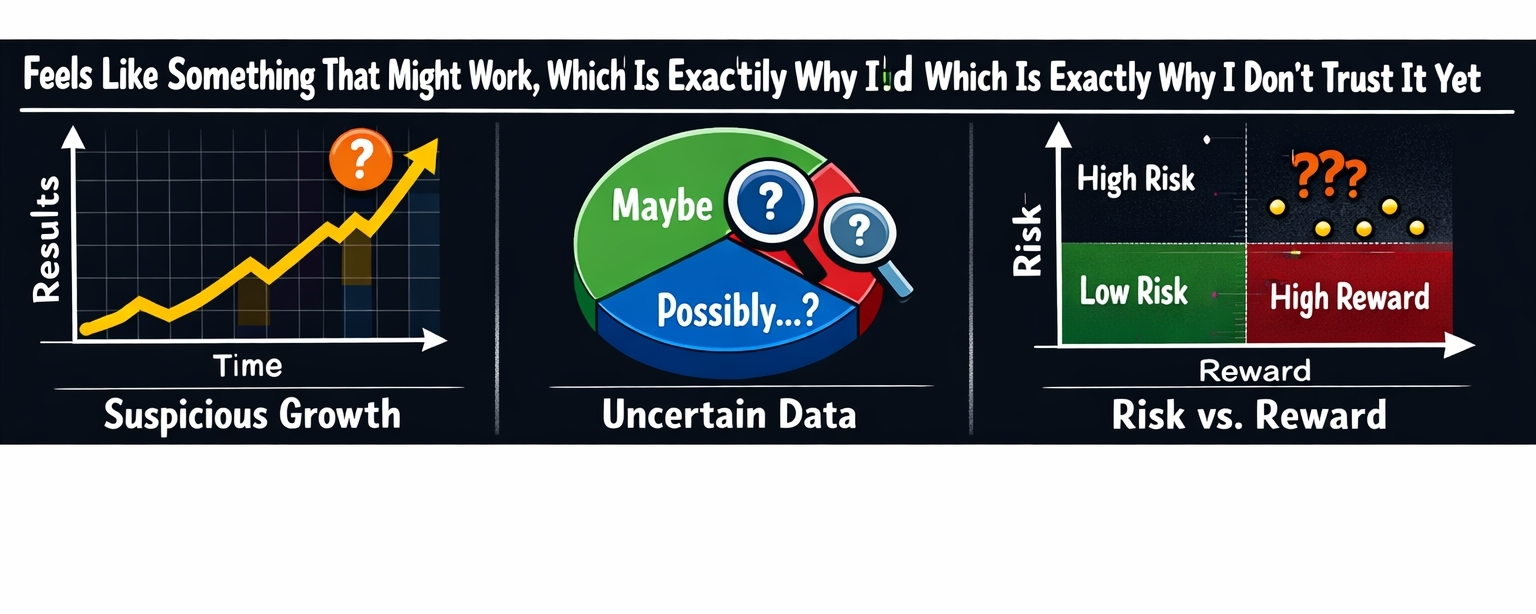

Pixels started as one of those ideas that feels almost too simple for this space. A social, casual Web3 game built around farming, exploring, and creating — running on Ronin, which already carries some history in blockchain gaming. On paper, it doesn’t try to sound revolutionary. No grand rewrite of gaming, no heavy promises about digital ownership changing everything. Just a world where you log in, do small things, and come back later to do them again.
And maybe that’s why I didn’t ignore it.
I’ve been around long enough to feel when something is just noise dressed up as innovation. Most projects hit you with big words first and hope you won’t look too closely at what’s actually there. With Pixels, there’s less to hide behind. It either works at a basic level or it doesn’t. That makes it easier to look at, but harder to believe in.
Because I’ve seen this pattern before. A game loop that looks fine at the start. A bit of farming, a bit of progression, some sense of ownership layered in. People show up, not always because they enjoy it, but because there’s something attached — a token, a reward, some future upside they don’t want to miss. And for a while, that’s enough. Activity looks real. The world feels alive.
Then things slow down.
The question that always shows up is simple and uncomfortable. If you take away the financial angle, even partially, do people still care? Not in theory. Not in tweets. In actual behavior. Do they log in because they want to, or because they feel like they should?
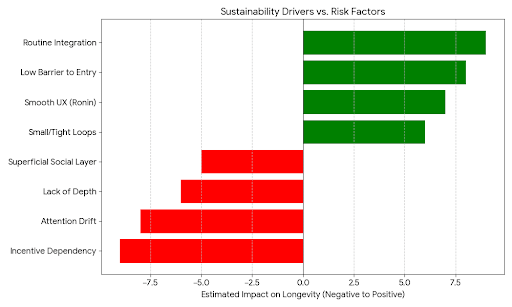
Pixels sits right in that tension. It’s casual by design, which makes it approachable, but that also means it doesn’t have the depth to trap attention the way more complex games do. So it has to rely on something else — rhythm, habit, maybe even a quiet attachment to the space it builds. That’s harder to measure than user numbers or token volume, but it’s the part that decides whether something lasts.
I don’t think the chain it’s built on solves that problem either. Ronin helps with friction, sure. It makes things smoother, more usable. But smooth infrastructure doesn’t create meaning. It just removes excuses. What’s left after that is the actual experience, and that’s where most projects quietly fall apart.
What keeps me watching Pixels, though, is that it doesn’t feel like it’s trying to rush past that reality. It’s not pretending to be bigger than it is. It leans into small actions — farming, moving around, building things — and lets those actions speak for themselves. That can either become its strength or its limit. I’m not sure yet.
Because small loops need to be tight. If they’re even slightly off, people drift. And in crypto, drifting happens fast. Attention here isn’t stable. It moves to whatever feels new, whatever feels like it might pay off, whatever hasn’t disappointed yet. Holding that attention without constantly feeding it incentives is where things get difficult.
There’s also the social layer, which sounds good in theory. Shared spaces, interaction, community — all the usual words. But I’ve seen how quickly that can turn into something artificial. People performing engagement instead of actually feeling it. Worlds that look busy but feel empty once you pay attention for more than a few minutes.
So I keep coming back to behavior. Not what the project says, not what the roadmap implies, just what people actually do inside it. Are they staying longer than they need to? Are they coming back without being pushed? Those are small signals, but they’re real.
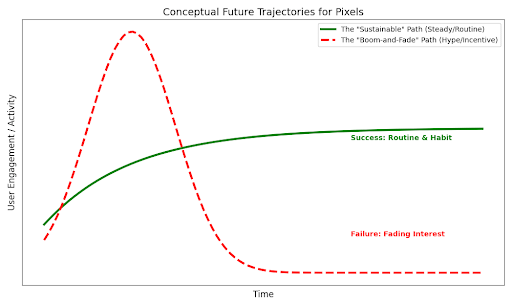
There’s a version of this where Pixels quietly works. Not in a way that dominates headlines or drives hype cycles, but in a slower, steadier way. A place people return to because it fits into their routine without demanding too much. That kind of success doesn’t look impressive from the outside, but it’s probably more sustainable than the usual boom-and-fade pattern.
And then there’s the other path, the one I’ve seen too many times. Interest fades, the economy starts to feel off, the balance shifts just enough that the whole thing loses its weight. People stop showing up, not all at once, just gradually. Until one day it’s mostly quiet, and the only activity left is from the ones who haven’t accepted it yet.
Right now, Pixels is somewhere in between. Not proving anything, not collapsing either. Just existing, which sounds small, but in this space, it isn’t. A lot of projects don’t even manage that without constant noise.
So I don’t look at it with excitement. I look at it with a kind of cautious attention. The kind that comes from seeing how often good ideas don’t make it, and how rarely something simple actually holds together over time.
Maybe it finds its rhythm. Maybe it doesn’t. For now, it’s just something I haven’t looked away from yet. And that, on its own, is already a little unusual.