
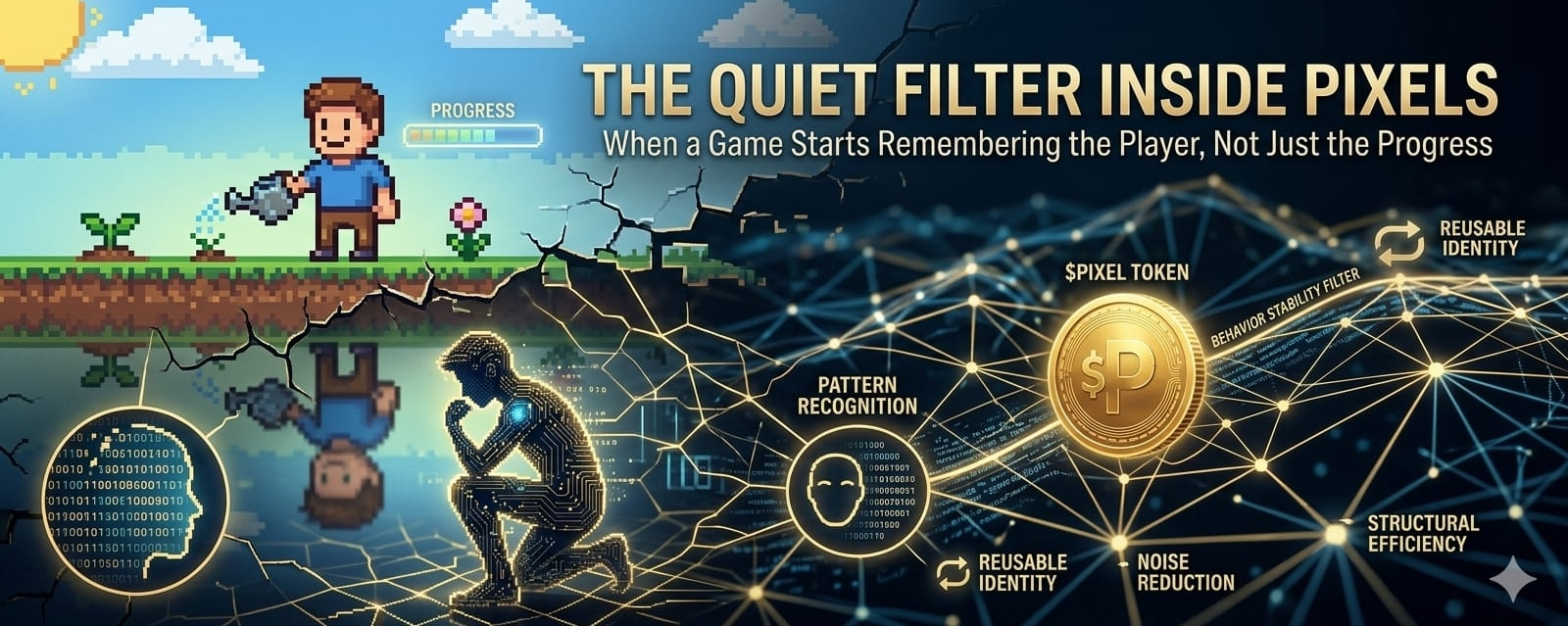
At first, nothing about Pixels feels complicated. That’s probably why it’s easy to stay longer than expected. You log in, follow a few simple loops, make a bit of progress, and log out without thinking too much about it. It doesn’t push you aggressively, doesn’t overwhelm you with mechanics, and doesn’t constantly remind you that it’s built on blockchain rails. If anything, it feels closer to older online games where repetition wasn’t a flaw, it was the experience itself. That calm surface makes it easy to assume the system underneath is just as straightforward. But the longer you sit with it, the more that assumption starts to slip.
There’s a moment, usually not immediate, where things begin to feel slightly uneven. Not broken, not unfair, just… different. You start noticing that some players don’t just progress faster, they seem to move through the game with less resistance. Their momentum feels intact in a way that doesn’t fully reset between sessions. It’s not about grinding harder or spending more. It’s something quieter. Almost like the system has become familiar with how they play and no longer treats them like a new input every time they return. That’s when the thought starts forming, slowly but persistently. Maybe this isn’t just a game measuring what you do. Maybe it’s paying attention to how you do it, and deciding what’s worth keeping.
In most games, your actions are recorded but not truly remembered in a meaningful way. You can earn items, complete tasks, and build progress, but the system doesn’t reuse your behavior. Every session still evaluates you as if you’re starting fresh, just with better tools. Pixels doesn’t always feel like that. Over time, there’s a sense that repetition begins to shift from effort into identity. Certain patterns stop being just actions and start becoming signals. The system doesn’t announce this. There’s no interface telling you that your behavior is being recognized differently. But the feeling is there, subtle and consistent, like the game is quietly learning which versions of you are easier to understand.
That changes how the entire experience feels. Because once behavior becomes recognizable, it can also become reusable. And reuse is where things stop being simple. A single action has no weight beyond its reward. But a repeated pattern can start shaping what the system does next. It might influence how opportunities appear, how smoothly you move through different loops, or how the economy seems to respond to you over time. None of this needs to be visible. The system doesn’t need hard rules or obvious tiers. It only needs to lean, slightly and consistently, toward what it already understands.
This is where $PIXEL starts to feel less like a traditional reward token and more like part of a filtering process. Not a harsh or obvious filter, but a gradual one. Instead of simply pricing time or output, it may be participating in deciding which behaviors become stable enough to matter. That’s a very different role. It suggests that not all activity holds the same structural value, even if it looks similar on the surface. Some actions pass through the system and disappear. Others leave a trace that gets reinforced, quietly shaping future interactions.
If you look at it from the perspective of the system itself, this approach makes a certain kind of sense. A game economy is easier to manage when it’s built around predictable behavior. Players who show up in consistent ways create cleaner feedback loops. Their actions are easier to model, easier to balance, and easier to integrate into a living system. Unpredictable behavior, on the other hand, adds noise. It makes the economy harder to stabilize and harder to design around. So instead of treating all players equally, the system may naturally begin favoring patterns that reduce uncertainty. Not as a preference, but as a form of structural efficiency.
But that introduces a quiet shift in what it means to play. If the system begins reinforcing only certain types of behavior, players may start adapting to that without even realizing it. Exploration becomes less attractive if it doesn’t “stick.” Experimentation starts to feel like wasted effort if it isn’t recognized in the same way as stable loops. Over time, play can slowly turn into alignment. You stop asking what you want to do, and start asking what the system understands best. That might make the game more efficient, but it also risks making it narrower, less spontaneous, less alive.
There’s also the question of growth. In most games, more players is always seen as a positive signal. More activity, more engagement, more value. But if Pixels is operating on a layer where only reusable behavior truly accumulates, then raw numbers might not mean as much. A large influx of players who behave unpredictably could create surface-level activity without strengthening the underlying structure. In that scenario, a smaller group of consistent players might actually contribute more to the system’s stability than a massive, fluctuating population. It’s an unusual tradeoff, and one that most games aren’t built to handle.
Then there’s the issue of transparency. Right now, much of this exists in a space that players can feel but not clearly define. That ambiguity can be intriguing at first, but over time it becomes fragile. If outcomes start depending on patterns that aren’t visible or explained, frustration builds quietly. Players don’t need full technical breakdowns, but they do need a sense that the system is understandable. Without that, even a well-designed structure can start to feel arbitrary.
And finally, there’s the role of the token itself. If $PIXEL is truly part of this deeper layer, then it needs to meaningfully connect to how behavior is recognized and reused. If it doesn’t, if players can move through these reinforced loops without relying on it in a significant way, then its position weakens. The system might still be doing something interesting, but the token wouldn’t be at the center of it. That’s still an open question, and probably one that only becomes clearer over time.
What stays with me is not a conclusion, but a feeling. That slight unevenness that shows up after you’ve spent enough time inside the system. The sense that some things don’t reset the same way. That consistency here isn’t just about doing something again, but about becoming something the system can recognize. If that’s the direction Pixels is moving in, then the real shift isn’t about earning or owning. It’s about being understood. And once a game starts understanding its players at that level, the experience stops being just about what you do, and starts becoming about who the system believes you are.
