
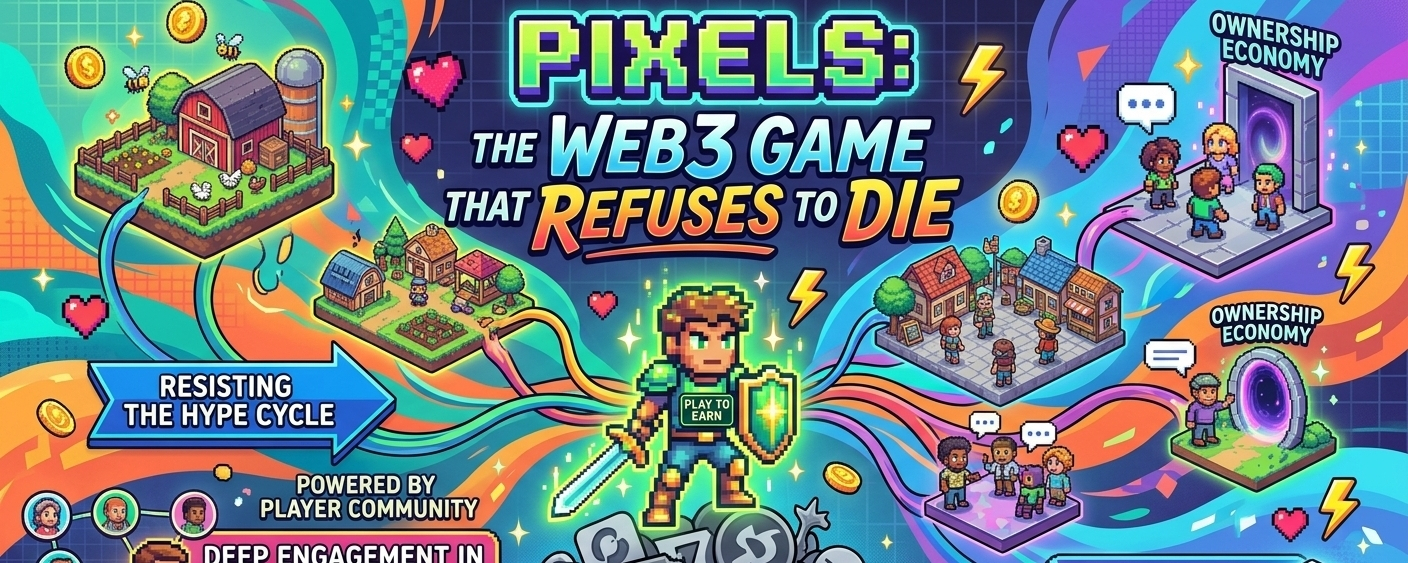
Pixels keeps showing up in conversations for a simple reason: it didn’t follow the usual life cycle of a Web3 game.
Most blockchain games explode on launch, attract a wave of farmers, then slowly fade once incentives dry up. Pixels didn’t fully break that pattern, but it also didn’t collapse into irrelevance. Instead, it settled into something rarer a steady, evolving system that still has players showing up long after the initial hype cooled down.
That alone makes it worth looking at more seriously.
A Simple Game That Quietly Became a System
At first glance, Pixels looks almost too familiar. Farming loops, resource gathering, land upgrades mechanics that have existed in traditional games for decades. Nothing visually loud. Nothing aggressively complex.
But underneath that simplicity is a structure designed around progression and time investment rather than pure reward chasing.
Players don’t just log in for tokens anymore. They optimize land, plan resource cycles, and build longer-term strategies around in-game efficiency. That shift changes the entire meaning of participation. It stops being a “farm-and-exit” loop and becomes something closer to a persistent digital economy.
Why It Survived Where Others Didn’t
The biggest reason most Web3 games fail is imbalance.
Too many rewards → extraction and collapse
Too few rewards → no users stay
Too complex systems → nobody enters
Pixels sits in a middle zone that accidentally works in its favor. It is easy enough to understand, but structured enough to retain engagement over time.
Instead of relying only on token emissions, it uses gameplay progression as the core driver. That matters because it reduces pure financial behavior and replaces it with habitual interaction.
People don’t just chase rewards they build routines.
The Real Signal: Changing Player Behavior
The most interesting shift around Pixels isn’t in price charts or announcements. It’s in how players behave over time.
Early users treated it like a yield tool. Later users started treating it like a system worth improving.
That change is subtle but important. Once players begin discussing optimization strategies instead of quick exits, the ecosystem starts to stabilize naturally. Communities form around efficiency, planning, and long-term advantage rather than just reward extraction.
That’s usually the point where a Web3 game either stabilizes or survives longer than expected.
The Hard Problem It Still Hasn’t Solved
Despite its relative stability, Pixels still sits inside the core challenge of all Web3 games: sustainability.
A game economy must constantly balance three forces:
Incentives that attract new users
Rewards that keep existing users engaged
Emissions that don’t destroy long-term value
If one side dominates, the system breaks. Pixels is still experimenting with that balance.
It hasn’t fully transitioned into a self-sustaining economy yet, but it also hasn’t fallen into pure inflationary farming loops either. That middle ground is rare, and unstable, but interesting.
Why It Gets Misunderstood
Pixels doesn’t behave like most crypto projects. It doesn’t rely on constant hype cycles or aggressive narrative shifts. That makes it easy to overlook in a space where attention usually equals perceived value.
But stability doesn’t always look exciting.
What often gets mistaken for stagnation is actually slow compounding especially in systems where player behavior matters more than marketing momentum.
Where It Might Be Headed
The future of Pixels depends on whether it can evolve beyond a farming loop into a more durable digital economy.
That would require:
deeper utility for in-game assets
stronger long-term progression systems
reduced reliance on short-term incentives
and a player base that grows from engagement, not just rewards
If it manages that transition, it moves from being “just another Web3 game” into something closer to a persistent online economy with real behavioral stickiness.
If it doesn’t, it risks falling back into the same cycle that kills most projects in this category.
Final Perspective
Pixels doesn’t win attention through shock value. It wins attention by still being here after the cycle should have ended.
In Web3, that alone is a form of signal.
And whether it becomes a long-term ecosystem or just a survivor of its own early hype phase, it has already done something most projects fail to do it lasted.