
I remember the moment a game stopped feeling worth my time, even though nothing obvious had changed.
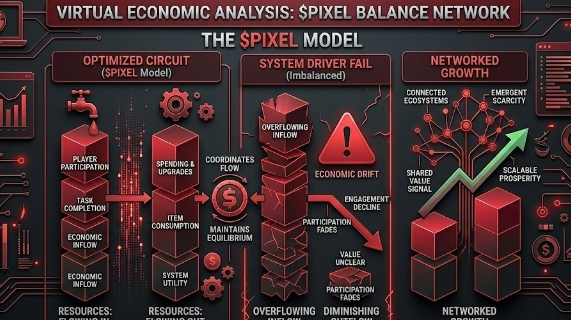
I was still logging in, still completing tasks, still earning rewards. But something felt off. The rewards didn’t mean much anymore. I had more than I needed, and whatever I earned next felt interchangeable with what I already had. Progress didn’t feel like progress—it felt like accumulation without purpose.So I slowed down. Then I stopped.
At that moment, I realized the issue wasn’t content or gameplay. It was the economy underneath it. There was no real balance between what was being created and what was being used. Things kept flowing in, but very little flowed out.And once that imbalance sets in, it’s hard to ignore.
Most systems don’t fail immediately when this happens. They drift. Value becomes unclear, effort becomes less meaningful, and eventually participation starts to fade—not because players are bored, but because the system stops responding to their actions in a meaningful way.
That’s where something like @PIXEL started to catch my attention, even if I didn’t fully trust it at first.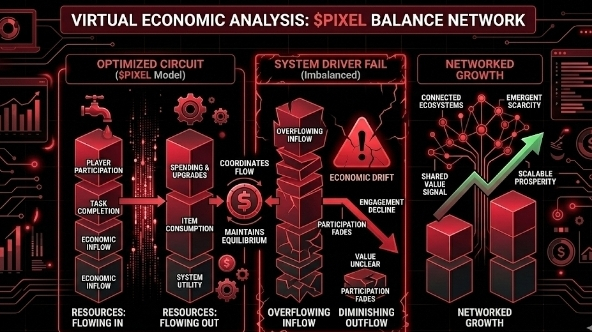
Initially, I thought the idea of carefully managing an in-game economy with tokens like Pixel sounded too controlled. Almost like overengineering something that should just feel natural. Games are supposed to be fun, not finely tuned financial systems.But then I started looking at it less as control, and more as balance.
The idea of sinks and faucets isn’t new. Resources enter the system through rewards, tasks, or participation—that’s the faucet. And they leave through spending, upgrades, or other forms of consumption—that’s the sink.Simple in theory. Hard in practice.
What $PIXEL seems to do is sit between these flows, acting as a kind of reference for value. Not just tracking how much is earned, but helping coordinate how and where it’s used. So instead of resources endlessly accumulating, there are consistent reasons to cycle them back into the system.That loop matters more than it first appears.
If faucets are too strong, everything loses meaning. If sinks are too aggressive, participation drops because effort doesn’t feel rewarded. The balance isn’t static either—it shifts based on how players behave, what they prioritize, and how the system evolves.
What I find interesting is that most players don’t think about this directly.They just feel it.
They feel when rewards stop being exciting. They feel when costs start to feel unfair. They adjust their behavior based on those signals, often without realizing it. And over time, those small adjustments shape the entire system.That’s where my hesitation came in.
If this balance is so delicate, can it really be maintained? Or does it inevitably drift like every other system? It’s easy to design sinks and faucets on paper, but much harder to keep them aligned with real user behavior.
Initially, it felt like something that would require constant intervention.
But upon reflection, the more interesting possibility is when the system starts adjusting through participation itself.
If tasks, rewards, and spending opportunities are tied to actual conditions—what’s scarce, what’s abundant, what players are doing—then the balance doesn’t have to be forced. It can emerge, slowly, from interaction.
And if $PIXEL acts as a consistent layer across that interaction, then it becomes more than just a currency. It becomes a signal of how value is moving through the system.That opens up a different kind of structure.
You could have multiple environments, each with their own mechanics, but still connected through a shared economic layer. Actions in one place influencing availability or cost in another. Not directly, but through a common reference point.
It starts to look less like isolated games and more like a network of systems, loosely connected by how value flows.But I don’t think this works automatically, at least not yet.
There are real constraints. Balancing even a single economy is difficult. Expanding that across multiple systems introduces more uncertainty. There’s also the question of whether users actually want this level of interdependence, or if they prefer simpler, self-contained experiences.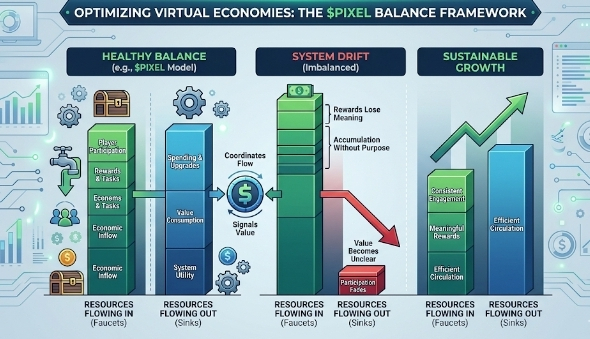
Adoption isn’t guaranteed, and execution risk is high.Right now, I’m still watching it closely.
I hold a small amount of $PIXEL, mostly to stay engaged and see how the balance evolves over time. I’m not fully convinced the system can maintain that delicate equilibrium, but I can see why it matters if it does.For me, the proof is straightforward.
If players keep participating without feeling like rewards are meaningless or costs are frustrating—if resources continue to circulate instead of piling up or disappearing too quickly—then the balance is holding.
And if that behavior stays consistent over time, without needing constant resets or corrections, then something real is working underneath.
Not perfectly, but well enough that people don’t think about it.Which, in a system like this, might be the clearest signal of all.
