

I keep seeing people use the words client and network like they mean the same thing when talking about Fogo, and that small mixup causes a lot of confusion about what the chain is actually trying to improve.
If you are new to this, here is the simplest way to think about it. The client is the software a validator runs. The network is the whole system created when many validators run that software together, coordinate, produce blocks, and agree on state. In Fogo, both matter, but they solve different problems.
Fogo’s own docs describe it as a Layer 1 built for DeFi applications, based on Solana’s architecture, using multi local consensus for low latency, with a Firedancer based client and full SVM compatibility. That already tells you there are two layers of design in play. One is execution software performance and the other is network coordination design.
The client side is about how fast and efficiently a validator machine can do the work. In Fogo’s architecture docs, the project explains a unified client approach, meaning it standardizes around a single canonical client based on Firedancer instead of supporting a wide mix of validator clients with different performance profiles. The stated reason is practical. If one network has several clients and some are slower, the whole network tends to be constrained by compatibility and by the weakest performance in the set. Fogo is explicitly trying to remove that bottleneck.
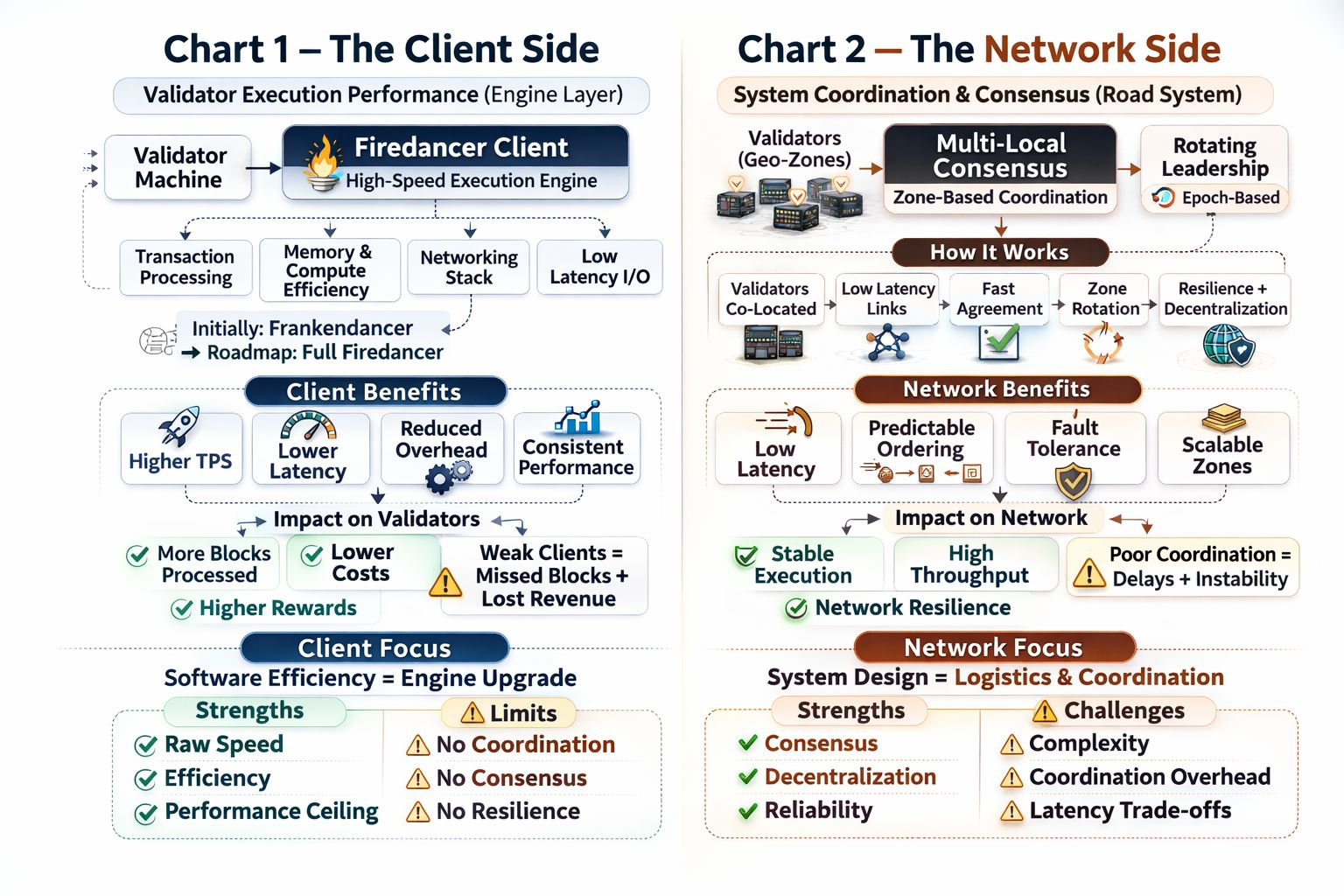
So when someone says Fogo is fast because of Firedancer, they are talking about the client side. That is the engine level improvement. It affects things like processing efficiency, memory use, networking stack behavior, and how much overhead a validator carries while executing transactions. Fogo also notes it initially deploys with Frankendancer before transitioning to full Firedancer, which is another clue that client strategy is a software rollout decision, not the entire network design by itself.
The network side is a different question. Even if every validator runs a very fast client, you still need those validators to communicate, agree on ordering, rotate leadership, and maintain resilience across failures and jurisdictions. That is where Fogo’s multi local consensus comes in. The docs describe zone based validator co location, where validators operate in close physical proximity to reduce communication latency, with zones rotating across epochs to preserve decentralization and resilience. In plain language, this is not just a better engine. It is also a different road system.
This distinction matters most for traders and builders because execution quality is not only about raw compute speed. It is also about timing consistency under pressure. A fast client can reduce software overhead, but a network with poor coordination can still introduce delays, variance, or unstable behavior during heavy demand. Fogo’s design is interesting because it treats both as part of the same performance problem, but it does not pretend they are the same thing.
A real life analogy makes this easier. Imagine a food delivery business in a busy city. The client is the motorcycle each rider uses. A faster, more reliable motorcycle helps. But the network is the entire dispatch system, the road layout, traffic flow, routing rules, and how riders are distributed across the city. If you only upgrade the motorcycles but keep bad routing and chaotic dispatch, deliveries still arrive late. If you only improve routing but riders use weak bikes that break down, you still have problems. Fogo’s thesis is basically that onchain finance needs both the machine upgrade and the logistics upgrade.
There is also a harder issue that does not get discussed enough, and this is where the retention problem comes in. Performance claims can attract attention at launch, but they do not automatically keep users, liquidity, or validators engaged over time. Retention is what happens after the first wave of curiosity fades. Builders stay when deployment is easy and activity is real. Traders stay when execution remains predictable during volatile periods. Validators stay when economics are sustainable and the operational model is worth the effort.
This is exactly why separating client from network is useful. A strong client story may help initial interest because it sounds concrete and measurable. A strong network design is what has to carry long term trust. Fogo’s docs even frame incentives around validator behavior, noting that slower implementations can miss blocks and lose revenue in a high performance environment, and they pair that with a curated validator set and performance standards to protect network quality. That is less glamorous than headline speed, but it is much closer to the retention question.
Another practical point is compatibility. Fogo says it maintains SVM execution layer compatibility so existing Solana programs and tooling can migrate without modification. That is not just a developer convenience line. It is part of the retention strategy too, because ecosystems keep people when switching costs are lower and tooling is familiar. If builders can reuse what they already know, they are more likely to test, iterate, and stay long enough to see whether the performance claims translate into actual product quality.
My neutral take is that the cleanest way to evaluate Fogo is to stop asking one vague question like is it fast and start asking two better ones. First, does the client architecture improve validator execution in a way that holds up in production. Second, does the network architecture preserve enough resilience and decentralization while delivering the latency benefits it promises. Those are different tests, and Fogo is unusual because it is trying to answer both at once.
If you follow Fogo as a trader, builder, or investor, keep your eye on retention, not just launch narratives. Watch who keeps building, who keeps routing flow, and how the network behaves when conditions are no longer easy. That is where the difference between a fast client and a durable network stops being technical vocabulary and becomes the whole story.
