
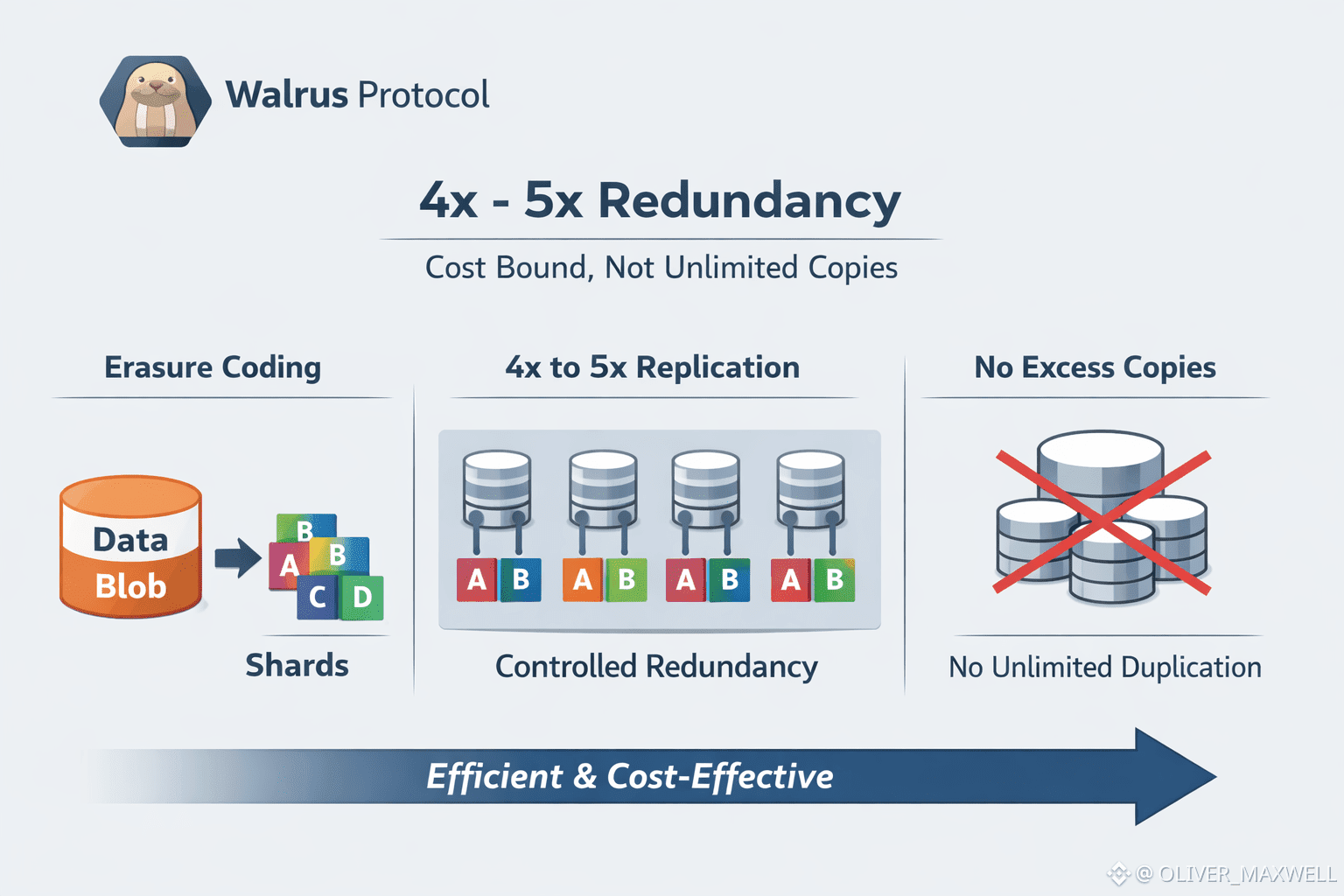
I increasingly view Walrus as a storage protocol that treats redundancy as an explicit cost policy, and the stated 4x to 5x replication target is the policy boundary that shapes everything else. Walrus operates in a market where decentralized blob storage fails less often from “can it store data” questions and more often from “can it keep storing data when real demand arrives” pressure, because every extra copy of every blob becomes a permanent tax on users and node operators. By committing to a minimal replication factor, Walrus is not describing a tuning knob, it is declaring that the protocol’s unit economics must survive scale without drifting into a cost structure that only works in demo conditions.
The strategic part is what that ceiling does to the mental model of a blob on Walrus. A blob is not treated as a single object that must be duplicated wholesale across a growing set of nodes, because that path makes cost grow in lockstep with distribution. Walrus instead builds around erasure coding and blob storage so that what spreads across the network are coded pieces whose redundancy is engineered rather than improvised. When the protocol frames redundancy around 4x to 5x, it is implicitly saying that Walrus wants availability and recoverability to come from coding and placement discipline, not from brute-force copying that becomes unaffordable as usage rises.
That number also draws a hard line between “decentralized storage” as a slogan and Walrus as an operational system on Sui. In a fully replicated approach, every new storage node that must hold complete blobs pressures the network toward ever-increasing aggregate storage, bandwidth for propagation, and ongoing rebalancing. Walrus’s 4x to 5x target makes the opposite statement: Walrus expects growth in nodes and clients, but it refuses to let growth automatically multiply the physical footprint of each blob beyond a bounded factor. WAL’s role inside that design becomes clearer when you treat WAL as the accounting layer for maintaining that bound, because any incentive that pays for storing more than the ceiling would be paying for the protocol to violate its own cost policy.
I find the most revealing consequence shows up in failure handling, because redundancy is only “strategic” if it still works when nodes leave, disks fail, and churn is normal. With erasure coding, Walrus can tolerate losses by reconstructing missing pieces, but reconstruction has a real bandwidth and compute bill that someone must bear. A 4x to 5x design goal implicitly forces Walrus to keep the repair path efficient, since there is not an unlimited pile of extra full copies sitting around waiting to mask operational weakness. The protocol’s redundancy target becomes a constraint that pushes Walrus toward fast detection of missing pieces, predictable re-encoding work, and incentives that reward nodes for staying reliable without requiring Walrus to drown the network in duplicates.
This is where the “minimal” label matters more than the number itself. If Walrus were willing to keep adding redundancy whenever uncertainty appears, it could paper over imperfect placement, uneven node quality, or slow repair coordination by paying for more copies. Walrus’s framing blocks that escape hatch. The 4x to 5x ceiling pressures Walrus to get shard distribution right across the set of storage nodes, to make retrieval and sampling behavior align with how blobs are dispersed, and to design WAL incentives so that the cheapest strategy for a node is to behave honestly and remain available rather than gambling on the protocol compensating with extra replication.
The Sui context is not decoration here, because Walrus’s blob commitments and verification hooks live alongside an execution environment that can coordinate incentives and state transitions without turning storage into a separate universe. That matters for the replication ceiling because enforcement is as important as intention. If Walrus says it targets 4x to 5x, then Walrus must be able to express what is stored, what is missing, and what must be repaired in a way that clients and operators can rely on, or the ceiling becomes marketing instead of policy. Walrus’s use of structured blob storage and erasure-coded pieces is the kind of architecture that can make a ceiling enforceable, since the protocol can reason about pieces, thresholds, and reconstruction rather than arguing about whether “enough full copies” exist.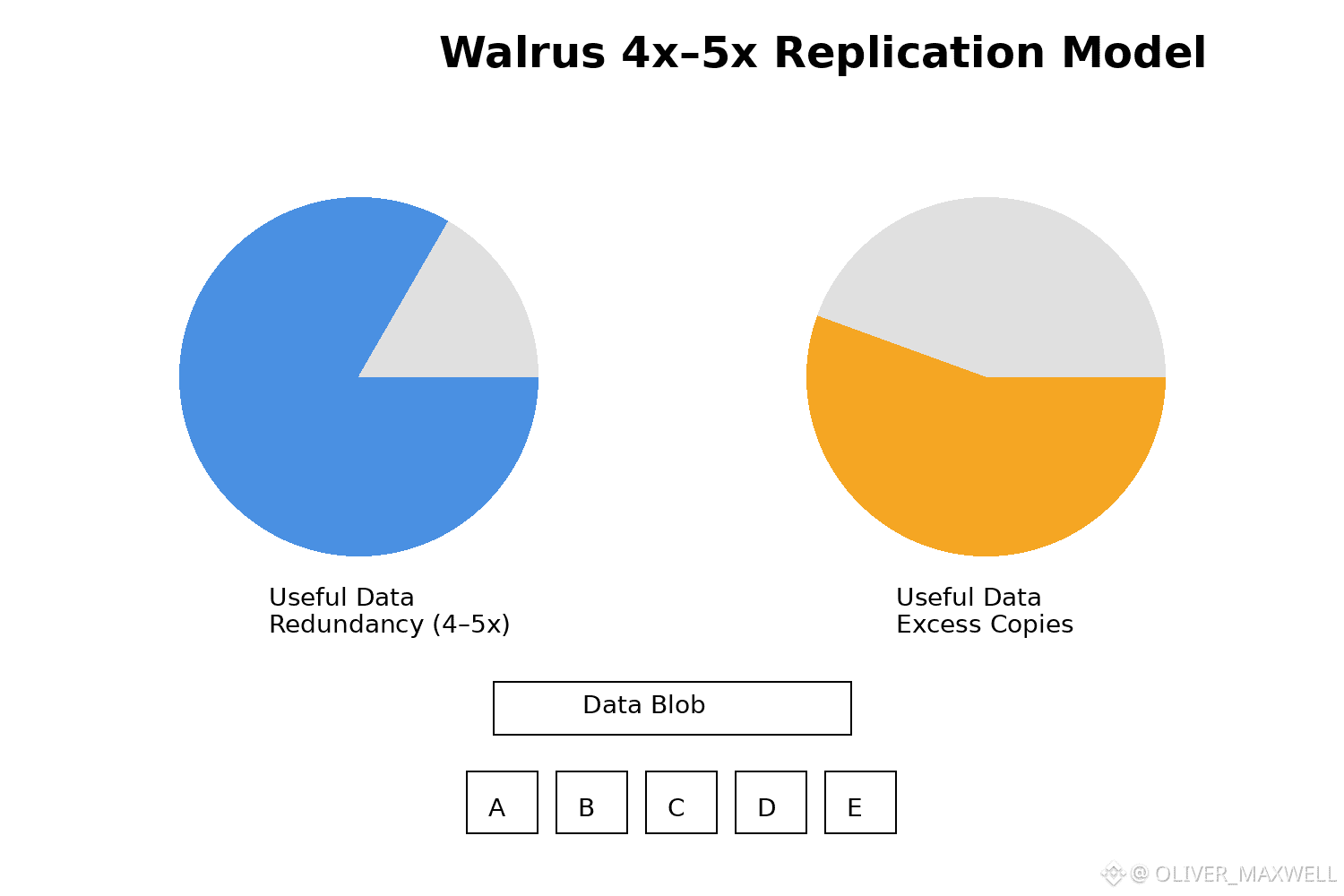
A bounded redundancy factor also changes how developers should think about using Walrus for large application data. When a project stores big blobs, the hidden question is whether the protocol forces everyone else to subsidize that choice through runaway replication. Walrus’s 4x to 5x target is a commitment to keep the subsidy controlled, because the network’s physical burden per logical blob stays within a known band rather than growing with every expansion of the node set. That strategic choice makes Walrus more legible for builders who need to forecast costs and for operators who need to forecast hardware demand, because the protocol’s design is anchored to a ceiling rather than to an open-ended replication spiral.
There is a real trade-off embedded here that should not be smoothed over. When Walrus holds redundancy to 4x to 5x, Walrus is betting on correctness in coding, placement, and recovery coordination, because it is choosing engineered resilience over abundance. If the protocol’s repair logic is slow under churn, or if incentives allow too many weak nodes to cluster around the same blobs, Walrus cannot rely on endless extra copies to hide the flaw. The ceiling makes Walrus more honest, but it also makes Walrus less forgiving of sloppy operations, which is exactly what “strategic” should mean in a storage protocol that expects real usage.
My judgment is that Walrus is deliberately setting the bar for decentralized blob storage economics rather than competing on vague claims of durability. The 4x to 5x framing is an attempt to define a maximum overhead that the network is willing to carry, and to make everything else, from WAL incentives to repair behavior, conform to that budget. If Walrus can keep availability high while staying inside that ceiling, the protocol will have done something that matters more than another storage narrative: it will have proven that decentralized blob storage can be costed, planned, and operated with the discipline of infrastructure, not with the elasticity of hype.

