I’ve been looking at Newton Protocol through a question that comes up surprisingly often in software: what happens when the application still works, but the rules around it need to change? Nothing may be broken in the usual sense. The contracts execute correctly, transactions settle, and automation follows its instructions. Yet the system can still produce an unacceptable outcome because its permissions no longer match reality.
That question stayed with me while exploring Newton. At first, the project can seem like another layer of blockchain infrastructure, surrounded by policies, operators, attestations, and transaction checks. The more I examined it, however, the more its central idea began to feel quite simple. Newton separates the ability to perform an action from the authority to perform it.
Those two things are often treated as though they are identical.
If a wallet has enough funds and provides a valid signature, a smart contract can usually process its transaction. From the contract’s perspective, everything is correct. But the contract may not know that the wallet has reached its daily spending limit. It may not know that a treasury is no longer permitted to use a particular protocol. It may not know that an automated agent was allowed to exchange assets but never authorized to transfer them elsewhere.
A blockchain checks the conditions written into its logic. It cannot recognize an intention that was never expressed in a form it can enforce.
Developers often handle this by placing additional controls around the contract. A user interface may prevent certain actions. A private server may screen addresses or monitor account limits. An administrator may maintain a database of approved destinations. These methods can be useful, but they often sit outside the part of the system that actually controls settlement.
That creates an uncomfortable gap. A restriction in an interface does not necessarily prevent someone from interacting with the contract another way. A private service may approve a transaction without giving the contract any way to verify how the decision was reached. If that service becomes unavailable or compromised, the application may stop working or continue without the protections users thought were present.
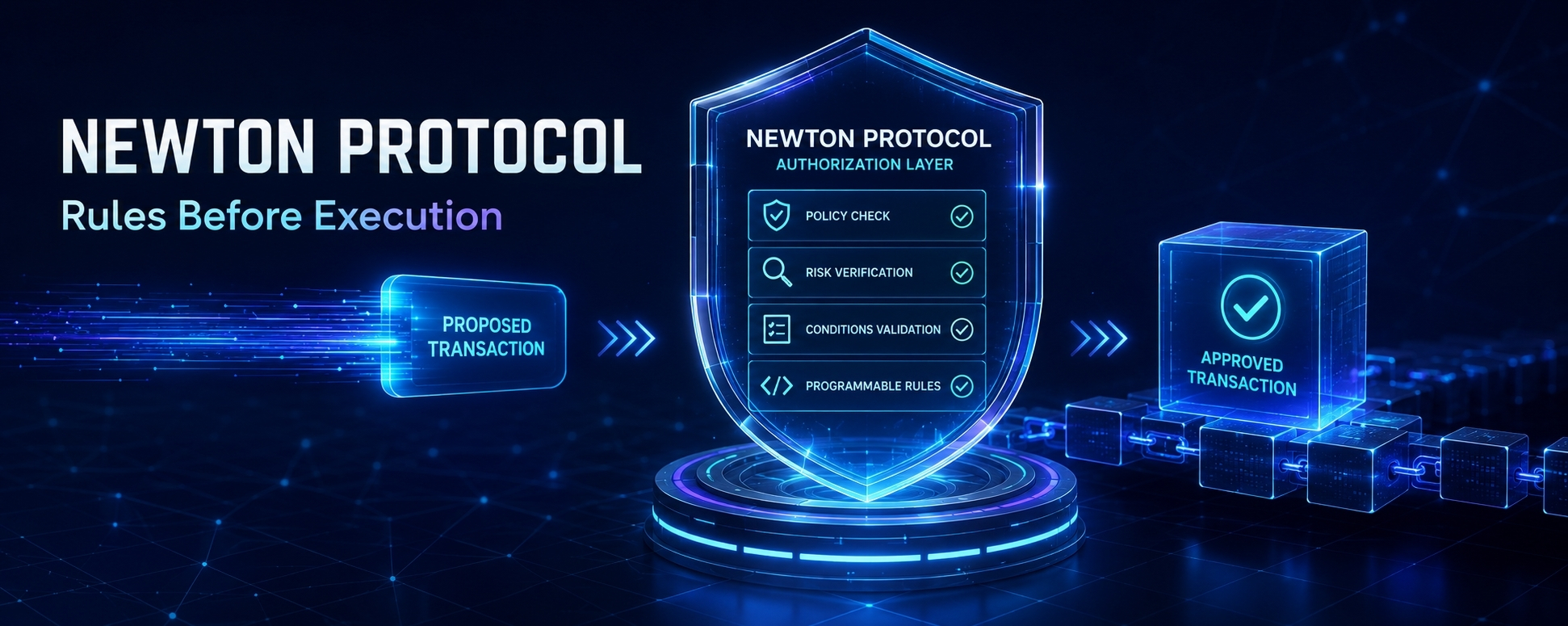
Newton Protocol focuses on this gap. It adds a policy evaluation step before a transaction is executed. Instead of allowing the destination contract to consider only signatures, balances, and local blockchain state, Newton can evaluate a wider set of rules and produce verifiable authorization.
The policy does not replace the application. It does not move the assets or perform the trade. It answers a narrower question: does this proposed action satisfy the rules that currently apply to it?
I find that separation practical because applications and policies rarely change at the same speed. The basic logic of transferring an asset might remain stable for years. The conditions governing that transfer could change several times during the same period. Limits may be adjusted, credentials may expire, addresses may be restricted, and new security requirements may appear.
Placing every changing rule inside the main contract can make an application harder to maintain. Each adjustment introduces another opportunity for an error. In some cases, a policy change might require an upgrade or migration even though the application’s fundamental purpose has not changed.
It is a little like changing access permissions in an office building. The elevators do not need to be rebuilt because someone is no longer allowed onto a particular floor. The machinery still works. Only the permissions need to be updated.
Newton brings a similar separation to onchain applications. Developers can describe what should be permitted without mixing every policy decision into the core execution logic. A rule might limit how much an address can spend in a day, allow interaction only with selected contracts, require a valid credential, or request additional approval when a transaction crosses a certain threshold.
These rules are expressed as programmable policies. Instead of describing every step the system should take, a policy defines the conditions that must be true before an action can proceed.
That approach makes sense to me because security boundaries are easier to understand when permission is explicit. A policy can begin by denying actions and then allow only those that meet its requirements. The developer does not need to predict every possible harmful transaction. The developer defines the smaller space in which acceptable activity can occur.
Imagine a community treasury that wants to earn a return on idle assets without giving an automated system complete control over its funds. Its policy could allow deposits into a few reviewed protocols, place a limit on exposure to each one, and require human approval for larger movements. The automation would still have room to operate, but that room would have visible walls.
This becomes especially relevant for autonomous agents.
An agent may analyse market conditions, monitor positions, and decide when to act. Giving it a wallet is not particularly difficult. Deciding how much authority that wallet should carry is much harder.
A private key does not understand why it was given to an agent. It cannot tell whether the agent is following its original assignment, responding to manipulated information, or producing an unexpected result. If the signature is valid, the blockchain generally sees an authorized transaction.
Newton can place another boundary between the agent’s decision and final execution. The agent may propose a swap, but the policy can check whether the asset is approved, the amount remains below the limit, the destination contract is permitted, and the action falls within the agent’s assigned role.
I see this as a more realistic form of automation. Useful automation does not require unlimited freedom. In everyday systems, we delegate specific responsibilities rather than transferring every available permission. Someone may be authorized to pay routine invoices without being allowed to empty the entire account. A purchasing manager may order equipment within a budget but need additional approval beyond it.
Newton tries to bring that kind of limited authority onchain. An agent can remain flexible inside its assignment, while the policy stays deliberately strict about the boundaries.
Writing a rule is only one part of the problem, though. The receiving contract also needs a reason to trust the result. If Newton were simply one private system returning “approved” or “rejected,” it would replace one central dependency with another.
This is why Newton relies on a network of independent operators to evaluate policies. Operators examine proposed transactions, apply the relevant rules, and participate in producing cryptographic evidence of the decision.
The destination contract does not need to repeat the entire evaluation itself. It can verify the resulting authorization before continuing with the transaction. This allows more complicated checks to happen away from the destination chain while keeping the final result connected to evidence the contract can validate.
That balance is important. Running every identity check, risk calculation, or external-data lookup directly inside a smart contract would be expensive and sometimes impractical. Moving the work elsewhere offers more flexibility, but it also introduces trust questions. Newton’s operator network is intended to avoid placing the complete decision in the hands of a single private service.
The resulting authorization record is easy to overlook, but I think it is one of the more meaningful parts of the design.
In many conventional systems, compliance is checked after an event. Auditors collect server logs, database entries, administrative records, and other evidence to understand why a transaction was permitted. The information may be scattered across several systems, and some of it may be controlled by the same organization being examined.
Newton moves the policy check earlier. A transaction is evaluated before settlement, and the authorization can leave behind verifiable evidence that the evaluation occurred. This does not prove that the policy was sensible. It establishes something narrower: the transaction passed the policy the application had chosen to enforce.
There is an important difference between proving that a rule was followed and proving that it was a good rule. Newton can help with the first. The second remains a matter of governance, judgment, and accountability.
A poorly designed policy can be enforced perfectly and still cause problems. A spending limit may be set too low. An approved list may contain the wrong address. A credential may be outdated. Operators can evaluate the policy correctly while the information feeding that policy is incomplete.
Newton’s security therefore cannot depend on cryptography alone. It also depends on where policy data comes from, how rules are updated, who controls those updates, and what happens when required information is unavailable.
Suppose a policy needs a current risk measurement before approving a transaction. If the data source stops responding, Newton has to decide what failure means. The safer response may be to deny the transaction, but that could freeze legitimate activity. Allowing it preserves availability but weakens the protection the policy was designed to provide.
There is no single answer that fits every application. A personal automation tool may tolerate a temporary interruption. A payment system may need a carefully designed fallback. A treasury holding substantial funds may prefer to stop completely rather than act on uncertain information.
Newton’s usefulness will partly depend on how clearly developers can define these failure conditions. The normal path is only one part of infrastructure. The more revealing question is what the system does when an operator becomes unavailable, a data source is delayed, or different pieces of information disagree.
Policy updates introduce another challenge. Imagine that a transaction receives authorization, but the rule changes before the transaction settles. Perhaps a contract has just been exploited, an address has lost its eligibility, or an organization has reduced its exposure limit.
Should the earlier authorization remain valid?
For a routine adjustment, a short period of overlap may be acceptable. During an active security incident, even a few minutes could matter. Newton therefore has to manage policy versions, authorization expiry, revocation, and emergency updates. These details may sound administrative, but they determine whether the system can respond safely when conditions change quickly.
The problem becomes even more interesting across multiple blockchains. A treasury might operate on several networks while following one overall exposure limit. Two transactions could each appear acceptable when evaluated separately, yet exceed the limit when both settle.
In that situation, policy evaluation becomes a coordination problem. Newton needs a way to account for pending actions and state changes across networks that do not share one clock or one transaction order. Producing cryptographic approval is only part of the job. The system must also ensure that separate approvals do not contradict the wider rule they are supposed to enforce.
This is why I do not see Newton as merely a transaction filter. It sits between intention, policy, external information, and execution. Each of those elements changes under different conditions.
A user may describe an intention imperfectly. An automated agent may interpret that intention too broadly. A data source may become stale. A policy may change while an action is pending. Operators may fail to respond at the same time. The destination chain may take longer than expected to settle the transaction.
Newton has to turn that messy collection of moving parts into a clear result that a smart contract can verify. That is a difficult systems problem, but it is also what makes the project worth examining.
Decentralization must be considered across the entire authorization path as well. A large operator network is useful, but it does not remove every concentrated dependency. A policy could rely on one data source. A single administrator might control rule updates. Most applications could depend on the same access point for submitting requests.
The meaningful question is not only how many operators exist. It is whether one party can quietly change the outcome, whether users can inspect the active policy, whether alternative sources of information are available, and whether the final authorization can be verified independently.
Newton Protocol does not need to govern every onchain transaction for its architecture to be useful. Many blockchain applications should remain open and permissionless. Not every transfer requires an additional policy check.
The clearer use case appears where constraints already exist. Asset issuers may have operating requirements. Tokenized assets may carry eligibility conditions. Treasuries need risk limits. Automated strategies need spending boundaries. Autonomous agents need permissions that are more precise than simple control of a private key.
Those systems already follow rules. The real choice is whether the rules remain hidden inside private infrastructure or become part of a transaction path that can be inspected and verified.
What keeps me interested in Newton is that it treats authorization as an infrastructure problem rather than a small feature attached to an application. The difficult part is not writing a rule that says “allow” or “deny.” It is making that decision dependable when policies change, information arrives late, networks progress at different speeds, and automated systems behave in unexpected ways.
I keep returning to the idea that infrastructure should not be judged only when every component behaves as expected. Its design becomes visible when one assumption stops being true. Newton Protocol is working at that exact boundary: the point where technically valid execution still needs to answer to changing human rules. For me, the way a system handles authority, uncertainty, and failure ultimately matters more than any headline figure about speed or throughput.
#Newt @NewtonProtocol
#BinanceTurns9 #JuneCPIFedHike20% #SamsungExploresPotentialUSADRListing #MicronFallsNearly14%InAMonth
$NEWT