
when i trade onchain, i’m usually very easy to impress.
if the platform feels fast, the order goes through clean, slippage is low, and i don’t feel like i’m fighting the chain every time i enter or exit a position, i already think “ok this is good enough.” that’s basically why Hyperliquid stands out to me. it made onchain trading feel much closer to the speed and smoothness people usually expect from a CEX.
and honestly, for a while i thought that was the main goal.
make onchain trading fast enough, liquid enough, clean enough, and the rest will take care of itself.
but after reading into @NewtonProtocol , i started seeing the gap from a different angle.
because fast execution is only one side of the story.
the other side is much less exciting, but maybe more important once real capital gets involved:
should this trade be allowed to happen at all?
that question barely matters when it’s just a solo trader degening with his own wallet.
but it matters a lot for vaults, treasury managers, institutions, and eventually AI agents.
a trader might want freedom.
a vault needs rules.
an institution needs proof.
an agent needs boundaries.
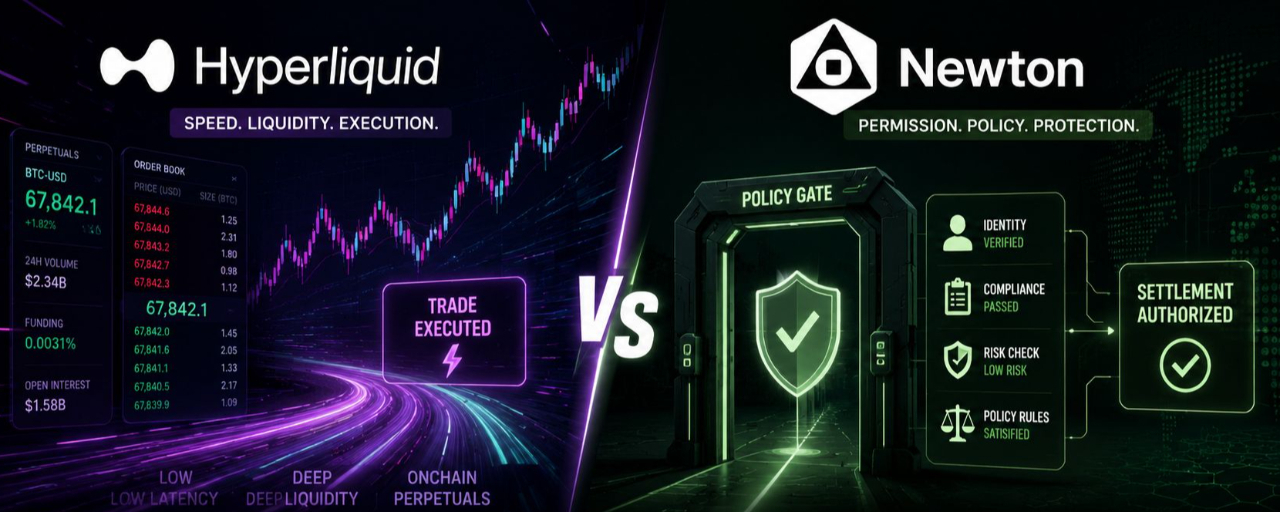
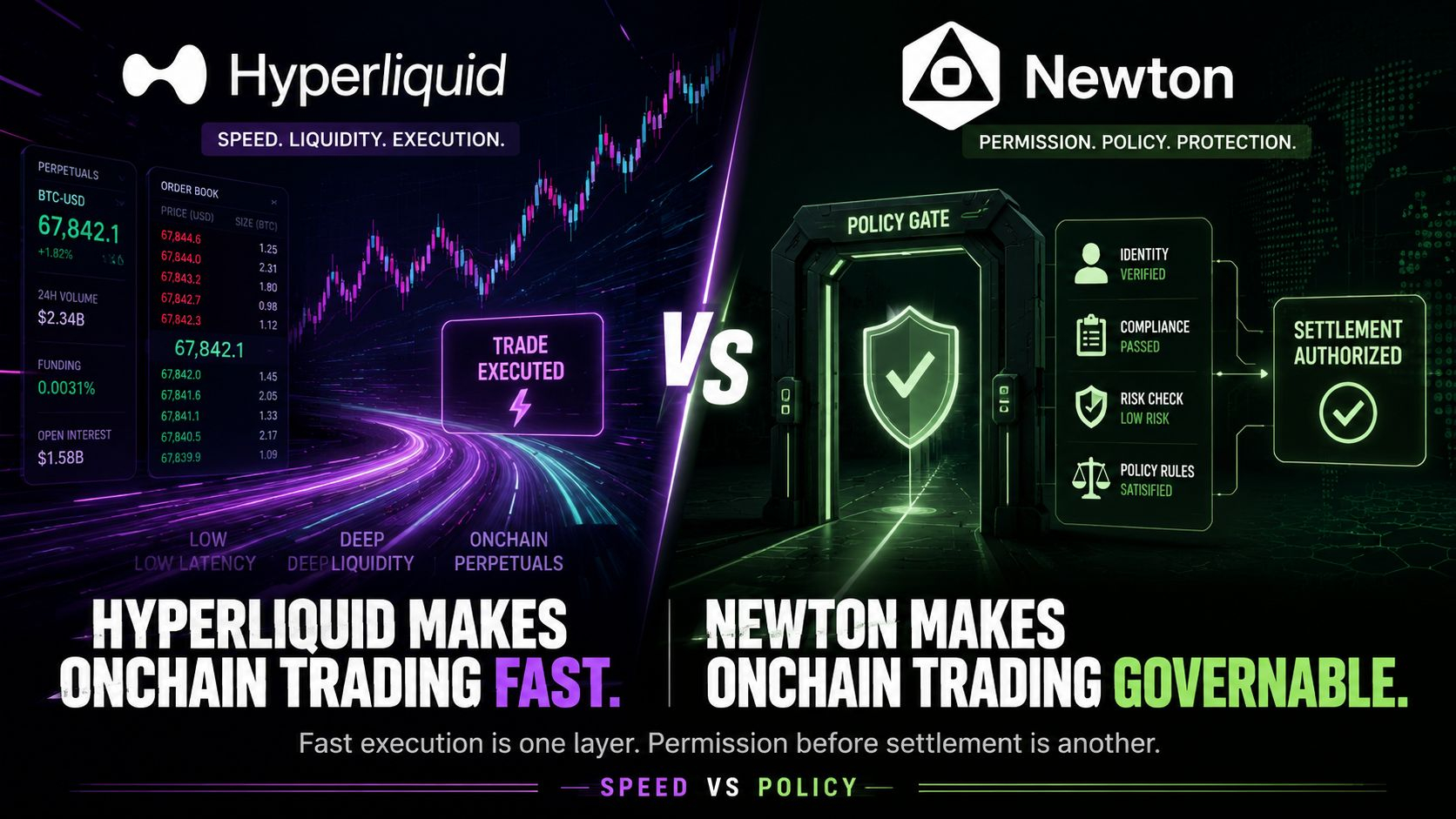
that’s where Hyperliquid and Newton feel like two very different layers to me.
Hyperliquid is about making the market itself work well. good execution, fast trading, deep liquidity, smoother onchain perp experience.
Newton is not trying to be the trading venue. it sits before execution and asks whether the action passes policy first.
that’s the talking point that clicked for me:
other systems can show what happened after the transaction.
Newton is trying to record what it enforced before the transaction settled.
and that difference is huge.
imagine a vault wants to open a leveraged position through an onchain trading venue. the platform may execute perfectly. no problem there.
but should the vault have been allowed to open that position?
did it exceed the leverage cap? did it touch a market outside the approved list? is the counterparty risk acceptable? is the oracle healthy? does the action pass compliance, identity, security, and risk checks?
Hyperliquid doesn’t exist to answer those questions.
Newton does.
with Newton’s model, a transaction intent can be checked before settlement, then the network returns a signed pass/fail attestation. if it passes, execution can continue. if it fails, there is no valid authorization, so no settlement.
to me, that’s the real comparison.
Hyperliquid makes onchain trading feel fast.
Newton makes onchain trading governable.
one solves market experience.
the other solves whether capital should be allowed to use that market under active policy.
and i think that second question becomes way more important as DeFi grows up.
because once trading is no longer just individuals clicking buttons, but vaults, RWAs, stablecoins, and AI agents moving serious money, “fast” is not enough.
the system also needs a brake.
not to kill trading.
just to make sure the wrong trade never gets executed in the first place.