

kept looking for the part of the spec where agent identity and an ordinary nft get treated differently. never found it, because there isnt one.
the Identity Registry is just an ERC-721.
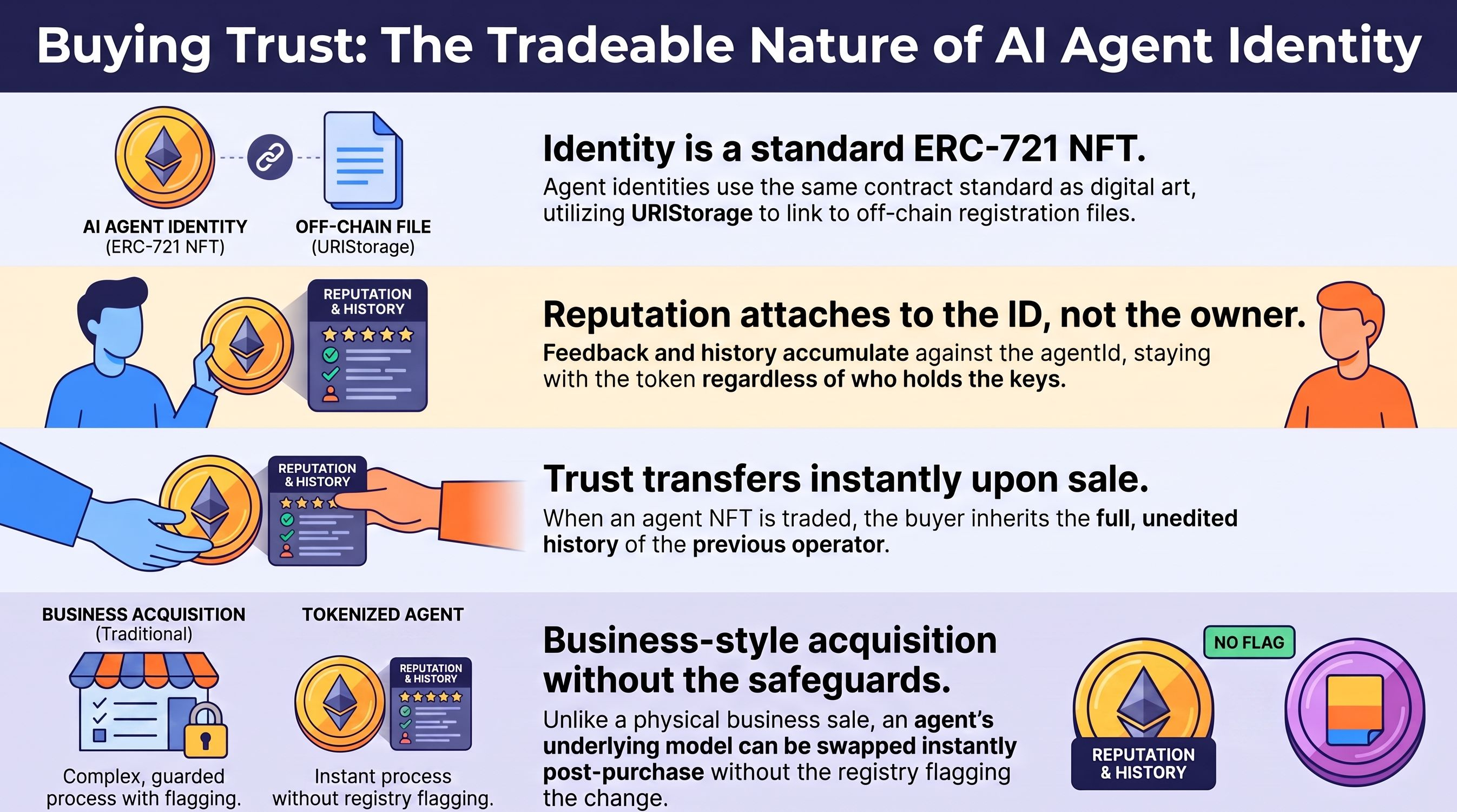
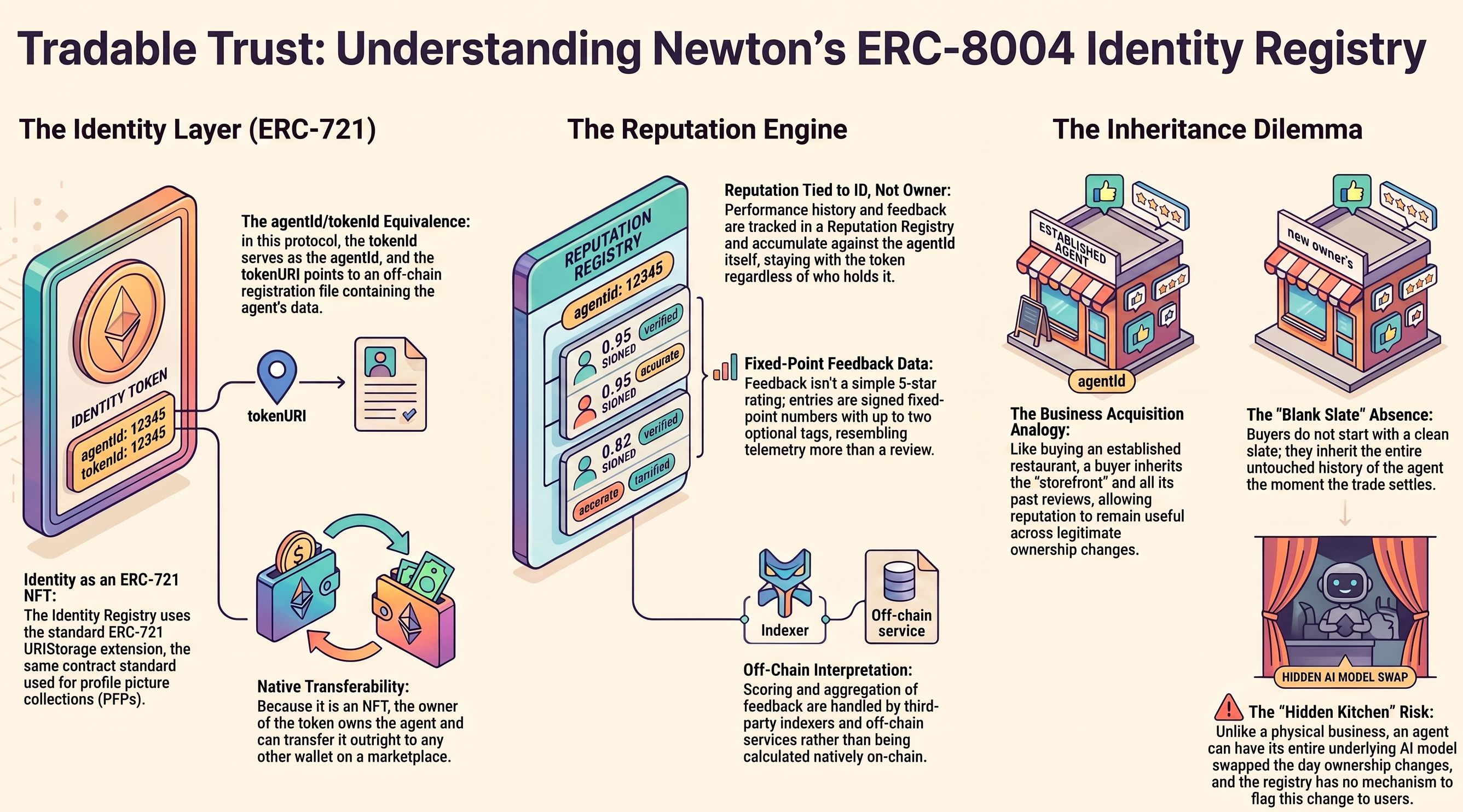
an actual ERC-721 with the URIStorage extension, where tokenId doubles as the agent's agentId and tokenURI resolves to an off-chain registration file, the same contract standard used to mint profile pictures.
makes sense as a starting point.
what actually got me wasnt the identity token itself, it was what "transferable" quietly does to everything built on top of it.
if identity is a token, identity is transferable, and the spec is explicit that the owner of that token owns the agent and can transfer it outright. reputation, tracked in the Reputation Registry, accumulates against the agentId itself, not against whoever currently holds it.
that part i expected.
what i didnt expect is that each feedback entry isnt a five star rating. its a signed fixed-point number with up to two optional tags, closer to telemetry than a review, and the spec leaves scoring and aggregation to indexers and off-chain services built on top of it.
so the reputation an agent displays isnt native to the chain, its an interpretation, keyed to the same agentId no matter who owns it.
but something kept nagging at me.
feedback keyed to an agentId means an agent with a long, clean history of finished jobs can change hands in a single NFT transfer, the same way any jpeg does on a marketplace, just with a track record attached instead of art.
the buyer doesnt inherit a blank slate.
they inherit the whole history, untouched, the second the trade settles. same agentId, same accumulated feedback, just a different wallet holding the keys.
the registry cant tell the difference between the operator who actually earned this history and the wallet that just bought it.
it was never designed to.
Newton doesnt run a separate version of this, it forked the actual reference implementation. the Newt Foundation's github maintains that fork for its own agent trust work, and as far as i can tell it kept the exact transferability intact at the identity layer.
worth flagging, this lives in their github, not the main Newton docs i usually cite, so i cant say yet how tightly its wired into the rest of the protocol.
but theres a genuine counter here. reputation tied to a persistent identity instead of an individual isnt some crypto-native weirdness. buy an established business and you inherit its reviews along with the storefront. the new owner didnt earn those five stars either.
but a bought restaurant usually keeps the same kitchen and the same staff, at least for a while. an agent can have its entire underlying model swapped the same day ownership changes, and the registry has no way to notice, let alone flag it.
so the analogy only goes so far.
maybe ERC-721 is still being honest about something true of reputation generally, that its never really about the individual doing the work, its about the identity everyone agreed to trust, which matters even more for a protocol like Newton thats explicitly trying to make agent behavior trustworthy in the first place.
still sits a little wrong though.
the part i havent settled is whether an agent identity deserves the same scrutiny a business acquisition gets before the sale closes, especially once the kitchen can change without anyone noticing. Newton's fork, from what i can see right now, doesnt appear to add any.
does transferable agent identity keep earned reputation useful across legitimate changes of ownership, the same way a sold business keeps its name and its reviews, or does it just let accumulated trust get sold off separately from whoever built it, with the agent free to become someone else entirely the moment the sale clears?
@NewtonProtocol #Newt $NEWT $EVAA $LAB