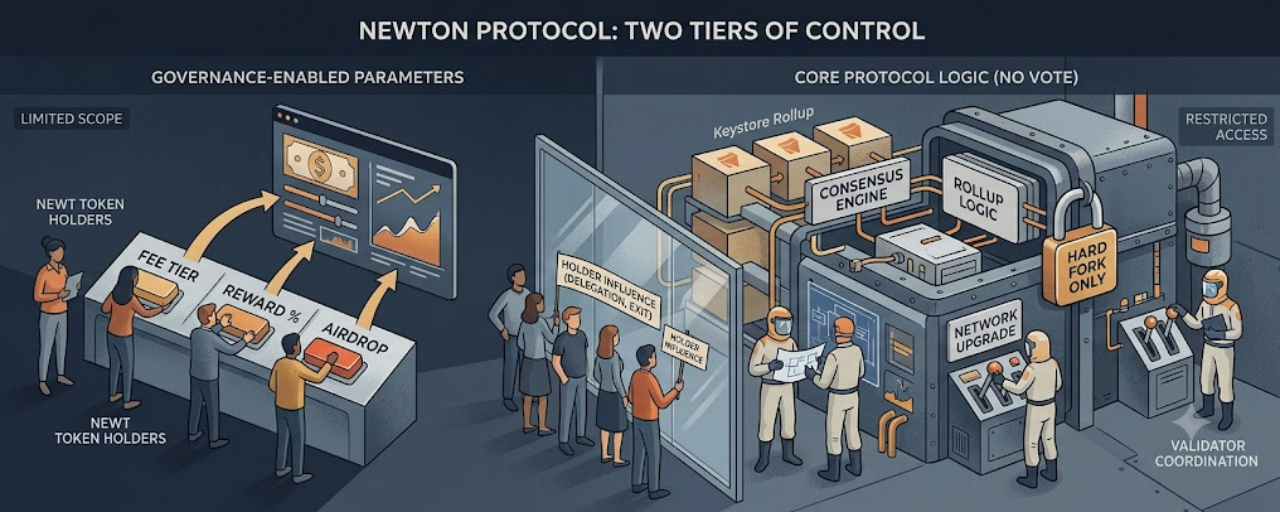
There is a specific kind of confusion that shows up whenever a protocol says its token holders "govern" it. The word does a lot of quiet work, implying a level of control that, in practice, almost no crypto governance system actually grants. Newton Protocol's own documentation is unusually explicit about where that line sits, and the analogy that keeps coming to mind is a familiar one from ordinary corporate life.
The Shareholder Who Cannot Rewire The Factory
Imagine a manufacturing company where shareholders get a real, binding vote on the dividend policy, how much profit gets returned versus reinvested, and even a vote on certain operational budgets. What they do not get a vote on is how the factory floor itself is wired, which safety systems protect the machinery, or how the production line's core physical layout works. Those decisions sit with engineers and plant operators, not with a shareholder ballot, because getting them wrong risks the whole facility, and popularity is a bad substitute for structural soundness when the stakes are that direct.
Newton's governance framework draws almost exactly that line. Fee parameters, reward structures, and other economic settings are things NEWT holders can vote to change through standard governance. Core protocol upgrades, changes to the rollup logic, the Keystore architecture, or the consensus mechanism itself, are explicitly not upgradeable through governance vote alone. Those require coordination among the network's validator operators and implementation through protocol level hard forks, a process much closer to how Ethereum separates routine parameter tuning from consensus breaking change.
Why Newton Draws The Line There
The stated reasoning in Newton's transparency report is that this separation is designed to maintain system integrity and prevent governance overreach into low level infrastructure, while still letting the community shape the protocol's evolution at the economic and coordination layers. That is a deliberate tradeoff, not an oversight. A popular vote is a reasonable way to decide whether transaction fees should go up or down, or how staking rewards get distributed. It is a much riskier way to decide whether the Keystore rollup's underlying architecture should change, because a slim majority getting that wrong could compromise the entire system's security in a way a bad dividend vote never could for a factory.
What Gets Lost In Translation
The trouble is that "NEWT holders can vote on protocol governance" gets repeated constantly as though it describes one uniform level of authority, when Newton's own structure describes two very different tiers. One tier, economic parameters, is genuinely community governed in the sense most people picture, a proposal, a vote, an outcome that takes effect. The other tier, core protocol logic, runs through an entirely separate process that token holders do not directly control at all, no matter how the vote would have gone.
This is not unique to Newton, plenty of mature protocols draw a similar line, but Newton names it with unusual specificity for a project still this early in its lifecycle. That specificity is worth taking seriously precisely because it tells you what kind of governance participation you are actually signing up for when you stake or vote with NEWT. You are shaping the economics. You are not, at least not directly, shaping the engineering.
The Real Test Still Ahead
The honest unresolved question is what happens the first time a genuinely controversial fork decision arrives, one where validator operators disagree sharply and the economic stakes on either side are real. Newton's structure assumes that keeping this decision with validators rather than a token vote produces a more stable outcome than popular sentiment would. That assumption has not been tested under real pressure yet, because no fork decision with that kind of stakes has happened. Until it does, the shareholder-and-factory analogy remains a description of intent rather than a description of something that has survived contact with an actual disagreement.
There is one more layer worth noting. The shareholder analogy breaks down slightly in Newton's favor at one point, because unlike most shareholders, NEWT holders who disagree with a validator coordinated decision are not entirely without recourse, they can, in theory, stop delegating stake to validators they distrust, or advocate publicly for a different technical direction ahead of any hard fork. That is closer to influence through exit and reputation than influence through direct vote, a softer form of accountability than a binding ballot but not nothing either. Whether that softer mechanism is enough to keep validator coordinated upgrades aligned with what the broader NEWT holder base actually wants is, again, untested, and probably will not be tested until the stakes are high enough for someone to actually try withdrawing support over it.
@NewtonProtocol $NEWT #Newt $EVAA