
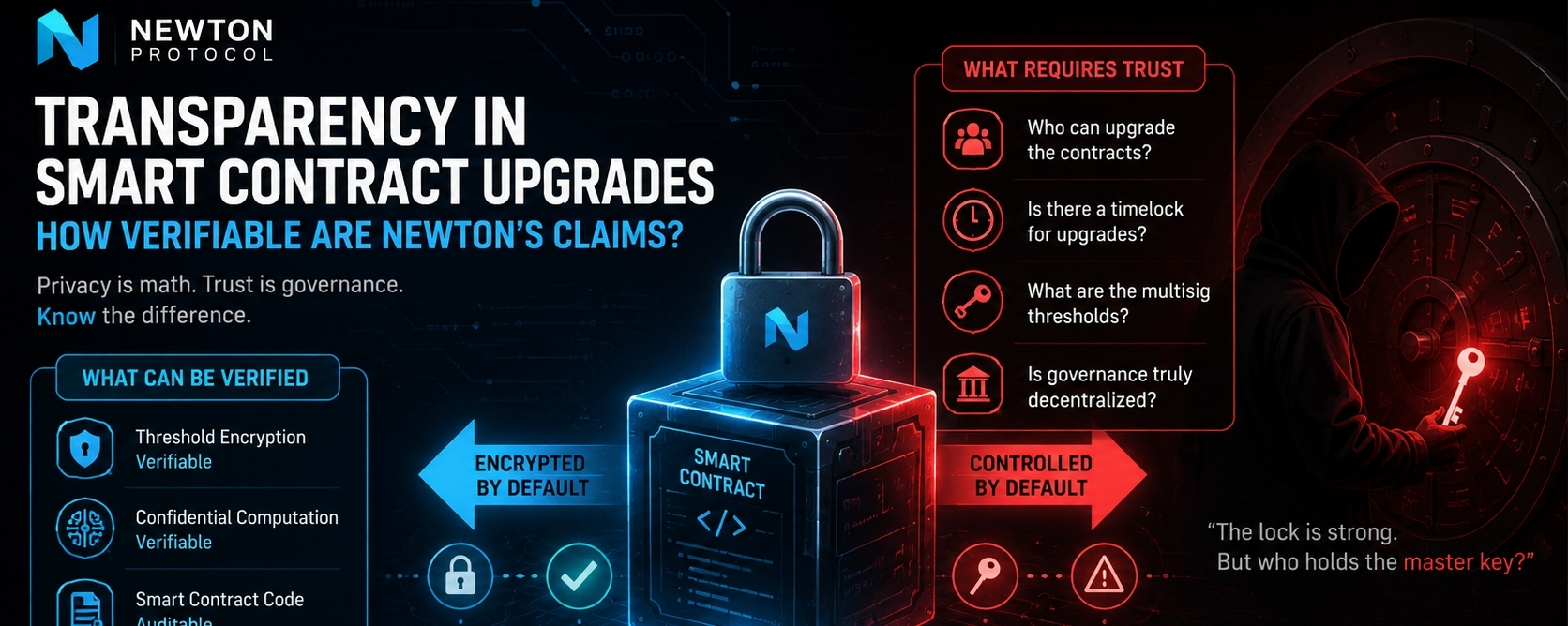
@NewtonProtocol To be honest, I've stopped trusting the word “decentrallater” at face value. Every protocol tells you it's decentralized until the day someone finds the admin key.
I've been sitting with this one for a while now, longer than usual actually 🤔, because the more I dig into Newton the more I realize the question isn't really about privacy tech at all. It's about who can quietly change the rules after the fact.
Here's the thing that keeps nagging at me. A smart contract can be audited, verified, praised by three different security firms... and still be upgradeable by a multisig that nobody outside the core team fully understands. So when (NEWT) talks about threshold encryption and confidential computation, my first instinct isn't “wow, private data.” It's “okay, but who can upgrade the contracts that manage this private data, and under what conditions?”
That's the real test of transparency, not the whitepaper language. If the contracts governing policy evaluation can be modified by a small set of keys without a public timelock, then the “trustless” framing starts feeling more like marketing than architecture. I'm not saying Newton is hiding anything intentionally, but the difference between “we can technically decentralize this later” and "this is decentralized right now" is the entire ballgame in crypto 👀... and I've watched too many projects blur that line to just take it at face value tbh.
One thing I keep coming back to, almost like a nervous habit at this point, is asking myself: if the operators involved in policy evaluation can see plaintext at any point in the pipeline, what exactly is the upgrade mechanism protecting? Is it protecting the users, or is it protecting the protocol's ability to patch things quietly when something breaks? Those are two very different design philosophies wearing the same PR language.
Think of it like a landlord who tells you the locks on your apartment are unbreakable... but keeps a master key "just in case." Technically true, technically secure, but the actual guarantee you're relying on isn't the lock, it's the landlord's judgment. That's not a criticism exactly, it's just an honest description of the tradeoff, and I think projects owe users that honesty more than they owe them confidence.
What makes me genuinely curious about Newton Protocol here is whether the roadmap treats contract upgradeability as a temporary bridge toward full decentralization, or as a permanent operational convenience. Those read identically in a pitch deck. They do not read identically five years from now.
I also think about governance participation the same way. A DAO vote to approve an upgrade means very little if voting power is concentrated among early allocators. So my honest answer, when I ask myself how much of this is actually verifiable right now, is... partially. The cryptography can be verified. The upgrade governance, at least right now, requires more trust than the messaging suggests.
None of this means I'm bearish on the project's ambition. Confidential computation is genuinely hard, and I'd rather see a team acknowledge the gap between "encrypted by default" and "controlled by default" than pretend the gap doesn't exist. What I want to see next, honestly, is a published timelock policy and a clear public commitment on multisig thresholds for anything touching the confidentiality layer, and until (NEWT) shows that publicly, I'll keep treating the claim as unproven rather than false.
Until then I'm watching this one the way I watch most infrastructure claims lately... with genuine interest, some skepticism, and a lot of unanswered questions I'm not ready to let go of yet 🤔
DYOR, obviously.


