
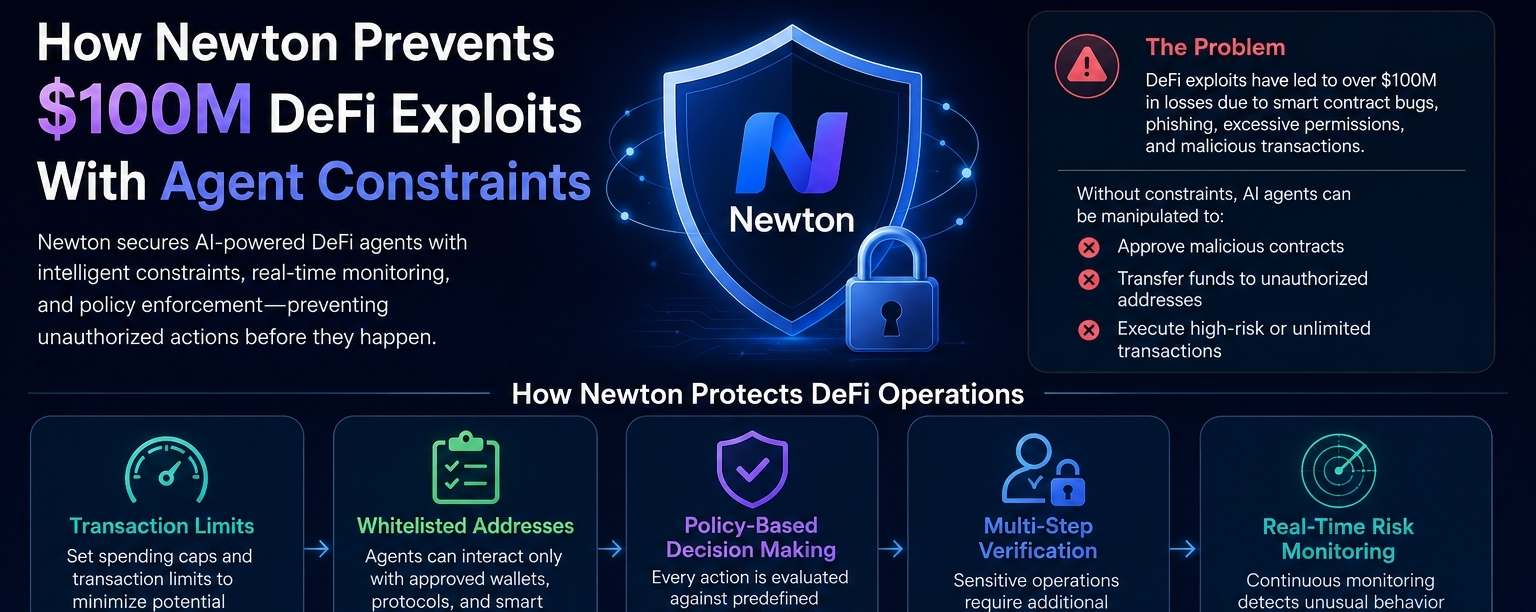

Decentralized Finance (DeFi) has transformed the financial landscape by enabling users to trade, lend, borrow, and earn yields without relying on traditional intermediaries. However, the rapid growth of DeFi has also attracted sophisticated attackers, resulting in exploits that have cost protocols and users hundreds of millions of dollars. As AI-powered agents become increasingly responsible for executing on-chain transactions, ensuring their security is more important than ever. Newton addresses this challenge through a robust system of agent constraints that reduce risk, prevent unauthorized actions, and protect digital assets.
The Growing Threat of DeFi Exploits
DeFi protocols manage billions of dollars in total value locked (TVL), making them prime targets for hackers. Exploits often occur due to smart contract vulnerabilities, compromised wallets, phishing attacks, excessive permissions, or malicious transaction approvals. AI agents that automate financial operations can amplify these risks if they are allowed to act without sufficient safeguards.
Without proper controls, an autonomous agent could accidentally approve malicious contracts, transfer assets to unauthorized addresses, or execute high-risk trades, leading to devastating financial losses.
What Are Agent Constraints?
Agent constraints are predefined security rules that govern what an AI agent can and cannot do. Instead of giving agents unrestricted authority, Newton enforces clear operational boundaries that ensure every action aligns with user-defined policies.
These constraints create a secure execution environment where AI agents operate within carefully controlled parameters, minimizing the chances of costly mistakes or malicious exploitation.
How Newton Protects DeFi Operations
Transaction Limits
Newton allows users to define spending caps and transaction limits. Even if an attacker gains temporary access to an AI agent, the amount that can be transferred remains restricted, significantly reducing potential losses.
Whitelisted Addresses
Agents are permitted to interact only with approved wallets, protocols, and smart contracts. Any attempt to send funds to unknown or unauthorized addresses is automatically blocked.
Policy-Based Decision Making
Newton evaluates every requested action against predefined security policies before execution. Transactions that violate user rules are rejected before reaching the blockchain.
Multi-Step Verification
For sensitive operations such as large transfers or permission changes, Newton can require additional verification or human approval before execution. This layered approach prevents single-point failures.
Real-Time Risk Monitoring
Newton continuously analyzes transaction behavior and detects unusual patterns. Suspicious activities, such as abnormal trading frequency or unexpected contract interactions, trigger alerts or automatic intervention before damage occurs.
Reducing the Impact of Large-Scale Exploits
Many historic DeFi attacks escalated because compromised systems had unrestricted permissions. Newton's constraint-based architecture follows the principle of least privilege, ensuring agents receive only the permissions necessary to complete their assigned tasks.
This significantly limits the blast radius of any compromise. Even if an attacker manipulates an AI agent, the predefined constraints prevent unrestricted access to user funds and protocol assets.
Benefits for Developers and Users
Newton's agent constraints provide multiple advantages:
Enhanced protection against unauthorized transactions.
Reduced financial risk from compromised AI agents.
Greater transparency through policy-driven automation.
Improved compliance with organizational security standards.
Increased confidence in autonomous DeFi operations.
Developers can build intelligent financial applications without sacrificing security, while users maintain greater control over how their assets are managed.
The Future of Secure AI in DeFi
As AI becomes deeply integrated into decentralized finance, security must evolve alongside automation. Agent constraints represent a proactive approach to protecting users by embedding safety directly into the decision-making process. Rather than relying solely on post-attack recovery, Newton focuses on preventing dangerous actions before they occur.
By combining policy enforcement, transaction controls, continuous monitoring, and human oversight where necessary, Newton creates a secure foundation for autonomous financial agents.
Conclusion
The future of DeFi depends not only on innovation but also on trust and security. Newton's agent constraints provide a powerful defense against the types of vulnerabilities that have led to some of the industry's largest exploits. By limiting agent permissions, enforcing strict operational policies, and continuously monitoring activity, Newton helps protect users and protocols from catastrophic financial losses. As autonomous AI agents become a standard part of decentralized finance, solutions like Newton will play a critical role in making DeFi safer, more reliable, and resilient against increasingly sophisticated cyber threats.