
For a long time, I believed the future of AI would be decided by one thing: smarter models.
Every headline celebrated bigger breakthroughs, faster reasoning, and more capable systems. It felt like the entire industry was racing toward intelligence, and whoever built the smartest AI would eventually win.
But the more I watched the space evolve, the more I realized something important was missing.
What happens when an AI makes a decision that affects money, businesses, or even people's lives? How do we know it followed the right process? More importantly, how do we verify its actions instead of simply taking its word for them?
That question may be more important than building another powerful model.
History shows that every major leap in technology succeeded because people learned to trust it. Science changed the world because experiments could be repeated. Banking expanded because transactions could be verified. The internet became essential because millions of computers could communicate using shared rules.
AI is now reaching a similar moment.
As intelligent agents begin handling automated trading, research, financial strategies, and real-world decisions, trust becomes more than a feature—it becomes the foundation.
This is why Newton Protocol caught my attention.
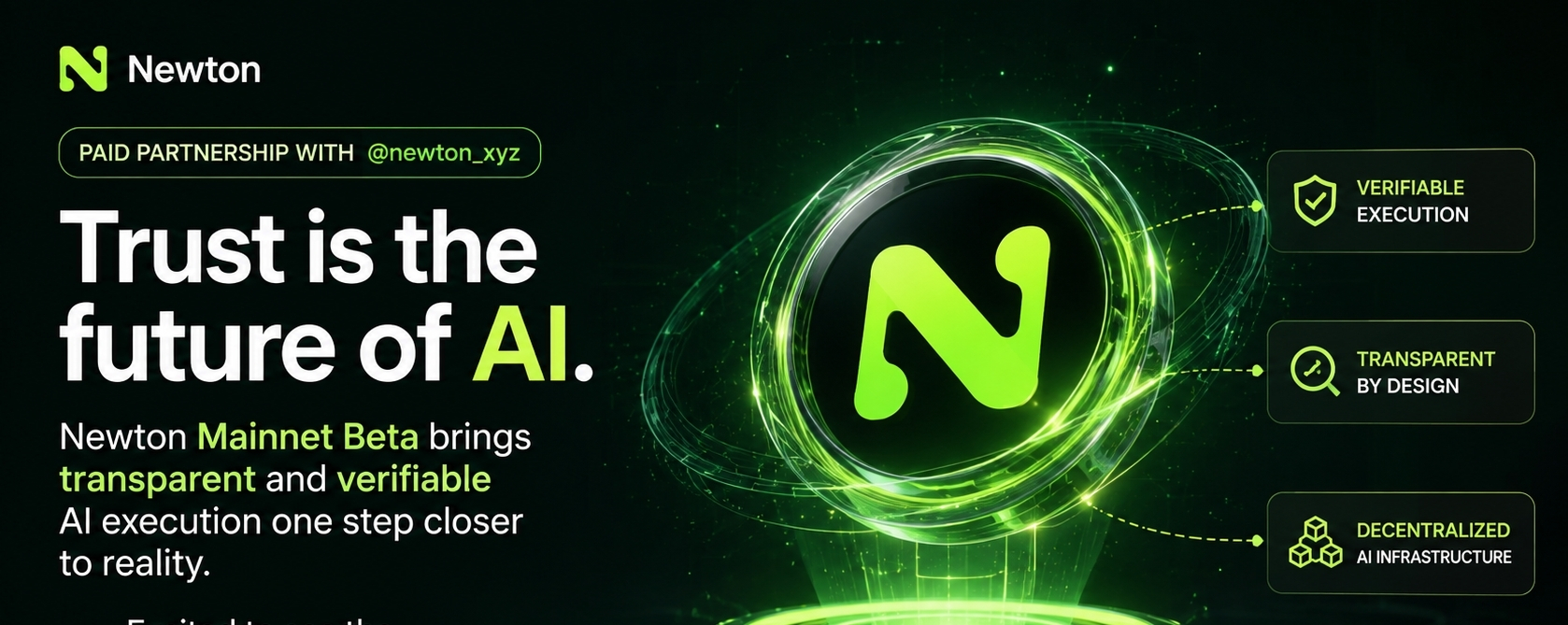
Instead of focusing only on making AI smarter, it explores something deeper: how autonomous systems can become transparent and accountable. By building a secure rollup for AI-driven strategies, automated trading, and an open marketplace for developers, the protocol aims to make AI execution verifiable rather than hidden behind a black box.
That changes the conversation.
The future may not belong to the AI that generates the most impressive answers. It may belong to the AI that can prove how it reached those answers.
From an economic perspective, trust lowers risk. Lower risk encourages adoption, investment, and innovation. From a scientific perspective, verifiable results are what transform ideas into reliable knowledge. And from a human perspective, people naturally place more confidence in systems they can understand and verify.
These ideas are beginning to shape the next stage of AI.
Developers may soon compete not only on speed and intelligence but also on transparency, security, and accountability. Users will likely expect intelligent systems to explain themselves, not just impress them.
That's a healthier direction for the industry.
We've spent years asking how smart AI can become.
Maybe it's time to ask a different question:
Can AI earn our trust?
Because intelligence may capture attention, but trust is what creates lasting impact. The technologies that shape the future are rarely the ones that amaze us for a moment—they're the ones we feel confident relying on every single day.