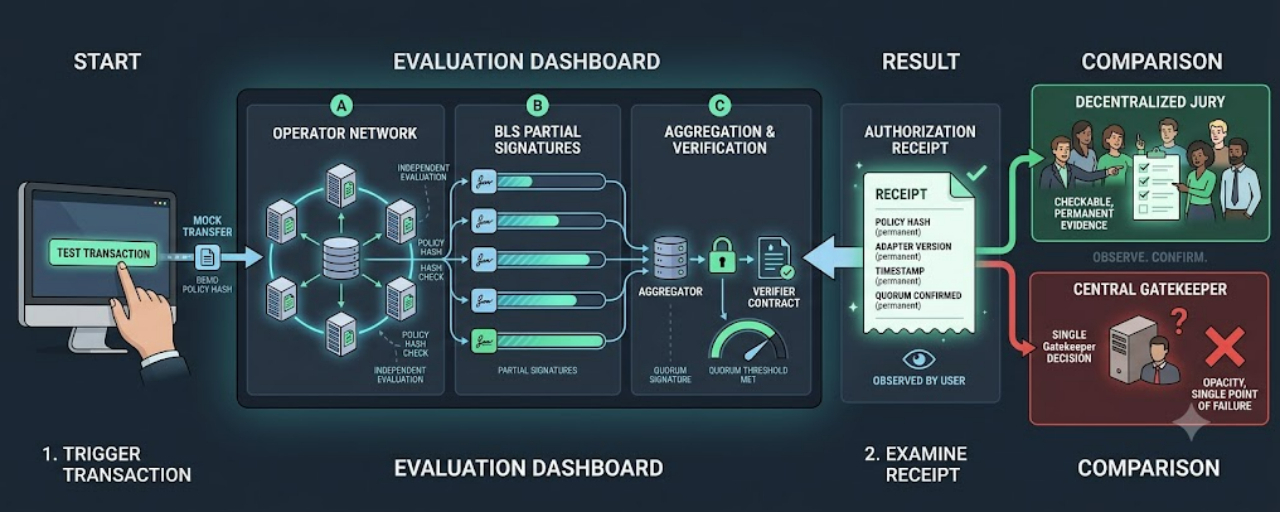
I was working through Newton's public dashboards on a weekday evening, mostly curious what "operator health" actually looked like as a live metric rather than a line item in documentation, when I decided to trigger a test transaction just to watch what happened underneath.
The transaction itself was nothing dramatic, a small mock transfer against a demo policy on testnet. What caught my attention was not the outcome, it was the sequence. I watched the request go out, get picked up by the operator network, and then sit for a few seconds while the dashboard showed individual operators independently evaluating the same intent against the same policy hash. Not one server making one decision. Multiple, separate, independent evaluations happening in parallel, each one checking the same rule against the same data.
Then came the part that actually stuck with me. The dashboard showed BLS partial signatures accumulating one at a time as operators finished their independent checks, then an aggregator collecting those partials into a single quorum signature, and finally a verifier contract confirming that quorum threshold before the Authorization Receipt got issued. The whole thing took maybe four or five seconds end to end, but watching each stage light up individually made something click that reading the architecture diagram never had.
Every prior mental model I had of "policy enforcement" was some version of a single gatekeeper checking a rule and returning yes or no. What I actually watched was closer to a jury deliberating, each member independently forming a verdict, then those verdicts getting tallied and only counted once enough of them agreed. The receipt that finally showed up on my end was not one operator's opinion. It was cryptographic proof that a quorum of independent evaluators reached the same conclusion, verified and aggregated before anything got returned to me as an answer.
The part that made this feel real rather than academic was seeing the policy hash and adapter version stamped directly onto the receipt, timestamped, permanent, checkable later by anyone with the receipt in hand. I pulled the receipt up again the next day just to confirm it still resolved to the same information, no drift, no ambiguity about which version of the rule had actually been applied. That is a small thing to test, but it is exactly the kind of small thing that either holds up under scrutiny or quietly does not, and this held up.
I think this personal moment matters more than it might sound like on paper, because most people evaluating a compliance protocol never actually watch a decision get made. They read a whitepaper's description of quorum-based consensus, nod along, and move on, trusting the description without seeing the mechanism actually operate. Watching the dashboard populate stage by stage turned an abstract claim about decentralized evaluation into something I had personally observed happening, transaction by transaction, operator by operator, signature by signature.
It also reframed something for me about what "decentralized compliance" is actually supposed to mean in practice. It is not a marketing phrase describing some vague distributed architecture. It is a literal, observable process where no single party's evaluation counts on its own, where the final answer only exists once independent parties converge on the same result, and where that convergence is captured permanently in a receipt anyone can check afterward. That is a genuinely different guarantee than a centralized compliance API returning a yes or no from a server nobody outside the company can inspect.
I do not think one test transaction proves Newton's security model is flawless. It proves the mechanism described in the documentation is not just theoretical, it is something that actually runs, visibly, and produces an artifact that holds up to a second look the next day.
Newton's security domain does not just claim decentralized evaluation, it makes that evaluation observable through public dashboards, ties every decision to a permanent, checkable Authorization Receipt, and turns what could have been an abstract architectural promise into something I personally watched happen in real time, which is a different and more convincing kind of evidence than reading the same claim in a whitepaper.
If I had one suggestion after going through this exercise, it would be that Newton should make this kind of live walkthrough more front and center in how it explains itself to newcomers. Most protocols explain their security model through diagrams and prose, both of which ask the reader to trust a description. Watching the actual sequence unfold, operator by operator, signature by signature, receipt by receipt, does something a diagram cannot. It turns a claim into an observation. Anyone skeptical of decentralized compliance as a concept should try triggering a test transaction and watching the dashboard themselves before deciding whether the architecture is real or just well-described marketing language dressed up as engineering.
@NewtonProtocol $NEWT #Newt $TAIKO