
I have learned over time that most traders spend far more effort studying what happened than asking what should have been prevented. Watching smart contract exploits unfold despite public audits changed one of my assumptions. I used to believe execution itself was the critical security boundary, yet repeated incidents suggested the bigger weakness often appeared before settlement. Risk management became less about reacting quickly and more about deciding which transactions deserved to exist in the first place. That shift gradually changed how I evaluate infrastructure instead of simply following narratives.
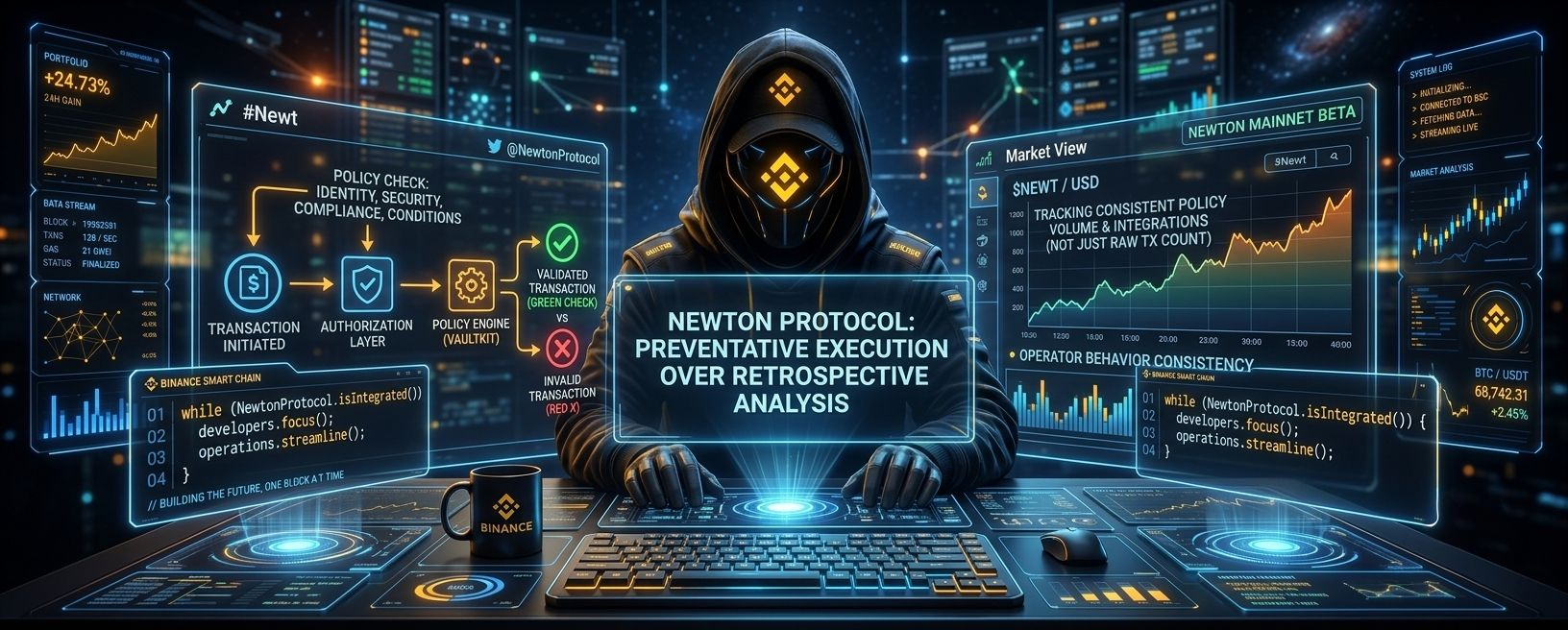
That perspective is why @NewtonProtocol caught my attention after the Newton Mainnet Beta launch. Instead of adding another monitoring dashboard, the protocol focuses on evaluating transactions before they settle through an authorization layer. I found that execution paradigm more interesting than conventional alert systems because policy decisions become part of the workflow rather than an afterthought. The idea of verifying identity, compliance, security, and external conditions before execution feels closer to preventative risk management than retrospective analysis.
Many participants still assume policy engines mainly exist to satisfy institutional compliance requirements. I think that interpretation misses the more interesting consequence. When authorization logic becomes programmable and composable through mechanisms like the Policy Engine and VaultKit integrations, developers no longer rebuild identical guardrails across every application. The second-order effect is consistency. If recurring rules become reusable instead of fragmented, operational mistakes may gradually decline even when application complexity continues increasing.
That does not automatically translate into value for $NEWT . Infrastructure projects often face slower adoption than expected because integrations require engineering time and operational testing. Every additional authorization step introduces possible latency trade-offs, while policies depending on external oracle data inherit another layer of assumptions. I also pay attention to whether ecosystem incentives create durable operator participation or simply encourage temporary activity that fades once emissions become less attractive.
Personally, I would spend less time tracking raw transaction counts and more time studying recurring operator behavior. Consistent policy evaluation volume tells me more than temporary spikes. I also want to see how many independent dApps continue integrating authorization layers after initial deployment instead of treating them as experimental features. Sustainable network effects usually emerge when infrastructure quietly becomes part of normal operations rather than a headline.
For now, I see #Newt as an interesting case study instead of a finished conclusion. Markets eventually reveal whether programmable execution rules reduce meaningful risk without creating enough friction to discourage adoption. I am not certain where that balance ultimately settles, but I suspect the lasting advantage will belong to protocols that make stronger safeguards feel almost invisible rather than noticeably slower.