

The stablecoin narrative keeps evolving, and Plasma is positioning itself at the center of where this space is heading. After a turbulent 2025 launch that saw $XPL drop significantly from its highs, the project enters 2026 with tangible catalysts that deserve attention.
Let's cut through the noise and look at what's actually happening.
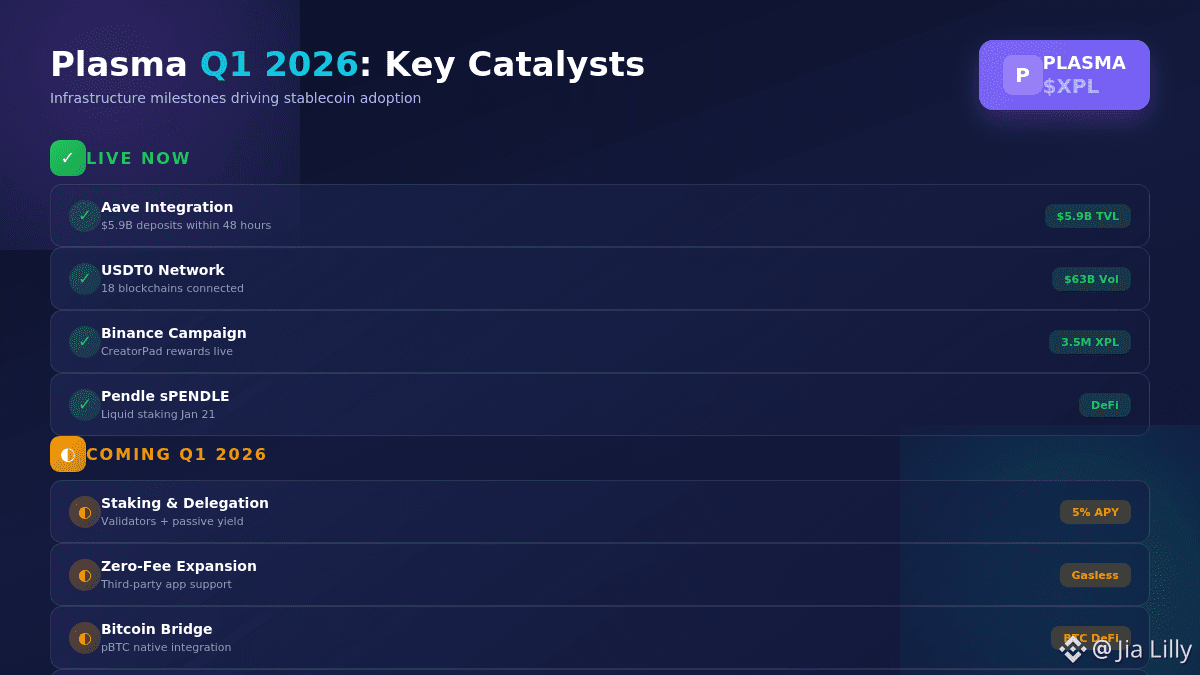
The biggest development is staking and delegation launching Q1 2026. This isn't just another yield farming mechanism – it fundamentally changes the token economics. Validators stake XPL to secure the network and earn 5% annual rewards, decreasing by 0.5% yearly until reaching 3% baseline. For regular holders, delegation means earning passive yield without running infrastructure. When staking goes live, it creates natural buying pressure as tokens get locked.
Plasma uses reward slashing instead of stake slashing. Misbehaving validators lose rewards, not their staked capital. This reduces catastrophic risk while maintaining accountability a design choice that could attract more conservative participants to validation.
The Binance CreatorPad campaign just launched with 3.5 million XPL in rewards running through February 2026. This puts Plasma in front of one of crypto's largest user bases. Whether this converts to long-term holders remains uncertain, but the visibility boost is real.
The USDT0 milestone matters more than people realize. This unified liquidity network connecting 18 blockchains just crossed $63 billion in cross-chain volume over its first year. Plasma facilitated $5.9 billion in Aave deposits within 48 hours of mainnet launch – that's serious institutional-grade throughput.
Pendle Finance, a top-15 DeFi protocol, is deepening integration with Plasma. They're retiring vePENDLE and launching sPENDLE – a liquid staking governance token – with staking going live January 21st specifically on Plasma. When established DeFi protocols choose your chain for new product launches, it signals something about infrastructure quality.
The roadmap extends zero-fee USDT transfers beyond Plasma's own products to third-party applications. Currently, gasless stablecoin sends work within Plasma's dashboard. Expanding this to external apps removes friction for end users who never need to acquire XPL just to move their stablecoins around.
The native Bitcoin bridge activation brings pBTC to Plasma's ecosystem. Bitcoin holders can access DeFi applications without selling – a use case that keeps expanding as BTC accumulates in institutional hands.
Framework Ventures co-founder Vance Spencer stated publicly that "Plasma is going to make it in 2026," pointing to new products shipping. Framework led Plasma's $20M raise at $500M valuation – higher than current market cap. That's conviction with skin in the game.
The January 25th unlock releases 88.89M XPL worth roughly $12-14M. Monthly unlocks continue, creating ongoing supply pressure. However, if staking adoption reduces circulating supply while transaction volume increases from expanded zero-fee transfers, the dynamics could balance.
The EIP-1559 inspired model burns transaction fees, creating deflationary pressure against validator inflation. Whether burns outpace emissions depends entirely on network usage.
Is $XPL guaranteed? No. Execution risk remains. But the infrastructure is live, partnerships are real, and Q1 2026 brings actual utility activation rather than just promises.


