
Introduction: The Data Dilemma in Web3
As decentralized applications grow more complex, the limitations of current blockchain data storage have become a critical bottleneck. The fundamental dilemma is how to store vast amounts of data—from AI datasets and dynamic NFTs to rich media—in a way that is verifiable, permanent, and programmable without incurring exorbitant costs or sacrificing performance.
Enter the Walrus Protocol. More than just decentralized storage, Walrus positions itself as the foundational data infrastructure for the next generation of Web3. Built on the Sui blockchain and secured by a $140 million war chest from elite backers like Standard Crypto and Franklin Templeton, Walrus is engineered to transform data into an interactive, programmable asset.

The Core Innovation: Red Stuff Encoding
Walrus’s competitive edge lies in its proprietary Red Stuff encoding algorithm, a two-dimensional erasure coding protocol. Traditional methods force a difficult choice:
· Full Replication (as used by Arweave): Provides security but at a massive storage overhead.
· 1D Erasure Coding (used by others like Storj): Saves space but requires downloading an entire file's worth of data to recover a single fragment, creating a bandwidth and cost nightmare.
Red Stuff solves this by encoding data into a matrix, creating "primary" and "secondary" slivers distributed across nodes. This architecture enables two key breakthroughs:
1. Efficient "Self-Healing": Data recovery requires only a tiny fraction of the total data, making the network resilient to node churn.
2. Optimized Performance: It maintains the space efficiency of erasure coding with a replication factor of just 4x–5x, while matching the recovery speed and security of full replication.
Beyond Storage: A Programmable Data Economy
CoWalrus isn't just about "putting files on a blockchain." Its integration with Sui's Move programming language allows data to become a programmable asset. This means:
· Tokenized Storage Capacity: Storage rights and data "blobs" are objects on Sui that can be integrated into smart contracts, enabling complex financial and logical operations around data.
· Verifiable Data Markets: The protocol enables open data marketplaces where the provenance, access, and usage of data can be transparently verified and monetized.
· Granular Access Control: With innovations like the Seal system, Walrus offers decentralized secrets management, allowing developers to set fine-grained permissions (public/private) for stored data—a critical feature for enterprise and sensitive AI data.
Real-World Traction and Use Cases
The protocol has moved rapidly from theory to adoption, with its mainnet launching in March 2025. Its ecosystem now supports over 120 projects across high-growth verticals, demonstrating its practical utility:
AI and Autonomous Agents: Serves as the verifiable memory layer for platforms like FLock.io (for decentralized AI training) and elizaOS, where agents require mutable, persistent state data.
Gaming and Dynamic NFTs: Trusted by major IPs like Pudgy Penguins and Claynosaurz, and integrated with leading NFT marketplace TradePort for scalable metadata storage.
Decentralized Media & Social: Partners include media company Unchained, social network builder Collective Memory, and generative AI video platform Everlyn.
Market Position and Competitive Edge
Walrus strategically carves a distinct niche against established players by solving specific pain points.
Vs. Filecoin: Offers a simpler, more cost-efficient model without complex storage deals and with faster, more reliable data retrieval.
Vs. Arweave: Provides the crucial flexibility of deletable, mutable storage, essential for dynamic applications like games and social media, as opposed to Arweave's permanent-only model.
Its deep Sui integration provides a natural developer funnel and enables seamless smart contract interaction with data, making it the preferred storage layer for the burgeoning Sui ecosystem.
The WAL Token: Fueling the Network
The native WAL token is the economic engine, with several key functions:
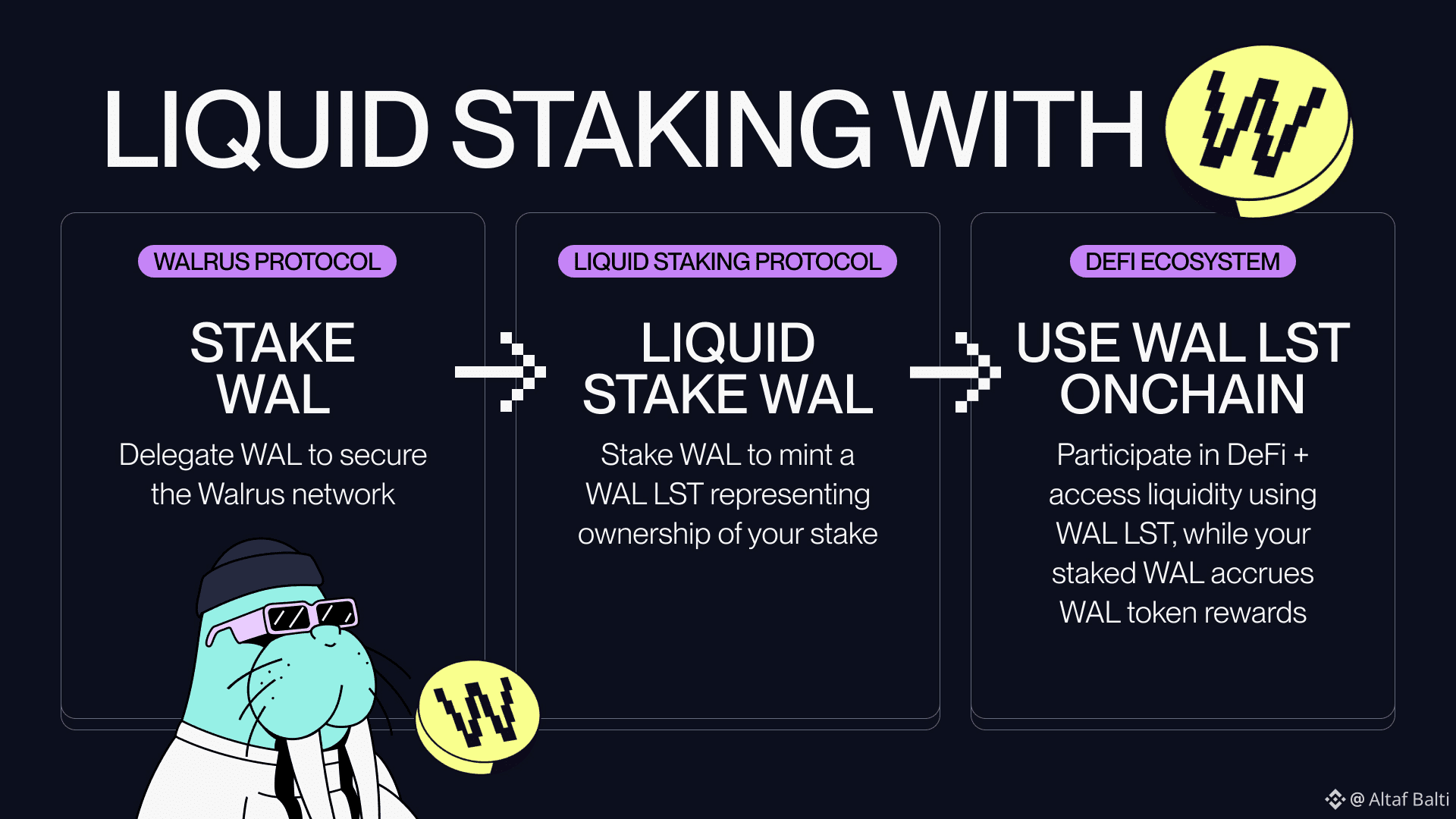
· Network Security & Staking: Operates on a Delegated Proof-of-Stake (dPoS) model. Storage nodes must stake WAL to participate, and token holders can delegate stakes to earn rewards.
· Payment for Services: All storage and retrieval fees are paid in WAL.
· Governance: Holders vote on key protocol upgrades and parameters.
Recent Token Momentum
WAL has seen significant market activity recently:
· Exchange Growth: Deposits and withdrawals resumed on Upbit, South Korea's largest regulated exchange, boosting liquidity and institutional credibility.
· Trading Catalysts: A Binance CreatorPad campaign in early January 2026 drove a 15% price surge and a 472% volume spike, highlighting growing retail interest.
· New Utility: Prediction market protocol Myriad integrated WAL for immutable record-keeping, expanding its use beyond core storage payments.
Looking Ahead: Challenges and the Roadmap
Despite its promise, Walrus navigates a competitive and complex landscape. Key considerations include:
· Proving Sustained Demand: The protocol must convert recent speculative trading activity and partnership announcements into long-term, revenue-generating storage demand.
· Technical Execution: Maintaining "boringly reliable" performance under load is a make-or-break factor for infrastructure projects seeking enterprise adoption.
· Ecosystem Risks: The protocol recently facilitated the migration of users from Tusky, a closing storage partner, underscoring the dependency risks within the decentralized ecosystem.
The near-term roadmap focuses on deepening utility:
1. AI Integration: A collaboration with FLock.io aims to fine-tune an AI "Copilot for Sui Blockchain" in Q1 2026, using Walrus for encrypted data storage.
2. Performance Enhancement: Ongoing integration with Pipe Network's 280,000+ nodes aims to reduce latency for dynamic content like video.
3. Ecosystem Support: Successfully managing the ongoing migration of users and projects to its native network.
Conclusion: The Verifiable Data Layer
The Walrus Protocol represents a fundamental evolution in decentralized infrastructure. By solving the core trade-offs between cost, performance, and security through Red Stuff, and by making data programmable through deep Sui integration, it provides a critical missing piece for Web3 and AI.
It is positioning itself not as a mere alternative to cloud storage, but as the verifiable data layer for an internet where users own and control their information. Its success will hinge on its ability to scale reliably, foster a vibrant ecosystem, and demonstrate that its technical advantages translate into undeniable utility for builders and users alike.


