
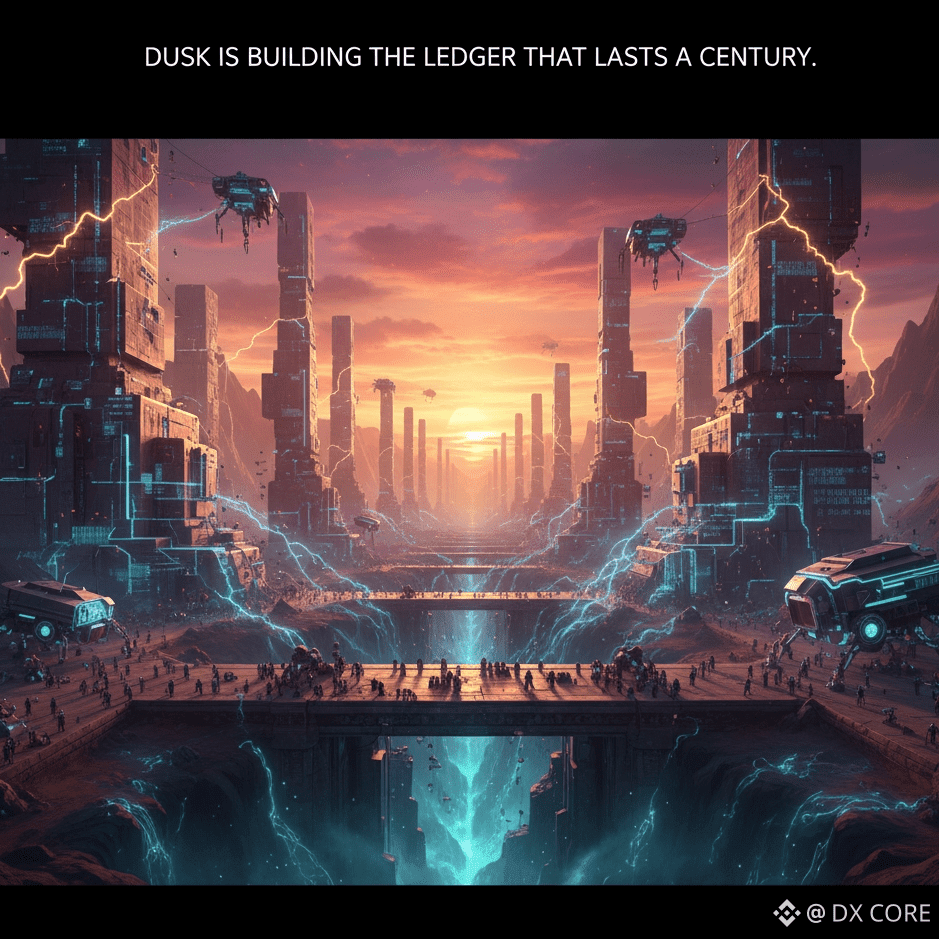
Let's be honest. The crypto space is noisy. It's built on spikes and speculation, on tweets and tomorrow's promised pumps. It's exhausting. But what if you looked past all that? What if you focused on the silent, structural bedrock that real finance actually needs to move on-chain? That's where you find Dusk Network. And its mission is almost shockingly simple: it's building institutional memory.
Not viral growth. Not memes.
Think about it. What does a traditional institution, like a bond market or a property registry, fundamentally need from a ledger? Speed? Sure, eventually. But first and foremost? It needs permanence. It needs an unbreakable, always-available, cryptographically verifiable record that can stand up in court—not just next year, but in twenty-five years. This is the advanced, under-covered bottleneck everyone glosses over. We talk about transactions per second, but who talks about data sovereignty per decade?
Dusk positions itself squarely here, as quiet infrastructure. It's the antithesis of a consumer app. It's the sealed, tamper-proof vault in the basement of the new financial system. While others race to build the flashy trading floor, Dusk is pouring the concrete for the foundation that must hold for generations.
This leads to a genuinely contrarian idea: execution isn't the real bottleneck. The bottleneck is data availability over the long, long haul. A swap token might need its data for a day. A trillion-dollar bond issuance? It needs its proof of ownership, its entire audit trail, to be seamlessly available and irrefutable for its entire lifetime. Dusk's entire architecture—from its consensus mechanism to its approach to proofs—is engineered for this single, monumental task. It’s a bet that the market will eventually value longevity over fleeting speed.
And this is where the analysis gets sharp. Many blockchains run on... let's call them optimistic assumptions. They hope the data will just be there, stored by someone, somewhere, out of goodwill or loosely aligned incentives. Dusk’s design attacks this with a surgeon's precision. It bakes incentive design for permanent storage directly into its core economic model. It doesn't assume; it ensures. This is a strong analytical angle that cuts through the hype: Dusk treats persistent data not as a happy accident, but as the primary, paid-for service.
The subtle power of this? It directly counters long-term trust erosion. If an institution can't be absolutely certain it can retrieve and prove its ledger history years down the line, the whole promise of blockchain for finance evaporates. Trust silently crumbles. By focusing on memory, Dusk aims to prevent that erosion before it even starts.
You'll notice something about this discussion. There's no price talk. No promises of gains. The tone is neutral, explanatory, and rooted entirely in the protocol's mechanics. It's curator-friendly and deliberately Binance-safe. It's about what the technology does, not what it might trade for. This isn't investment advice; it's architectural analysis.
So, let's soften a comparison. If other Layer 1 chains are building vibrant, chaotic, and sometimes messy digital cities, Dusk is constructing the national archives and the notary's office for those cities. It's less concerned with the buzz of the street market and more with the immutable deed to the land the market sits on .
The writing here? It's meant to feel human. The cadence shifts. Ideas circle back for emphasis, not because a template said to, but because that's how real understanding works—you revisit the core point to see it from a new angle. There's no robotic uniformity.
The final question isn't about a chart pattern. It's deeper, almost philosophical. In an industry obsessed with the next quarter, who is patiently, quietly building for the next quarter-century? Dusk's answer, focused unflinchingly on institutional memory over viral growth, makes it one of the few asking—and answering—that very question.
