

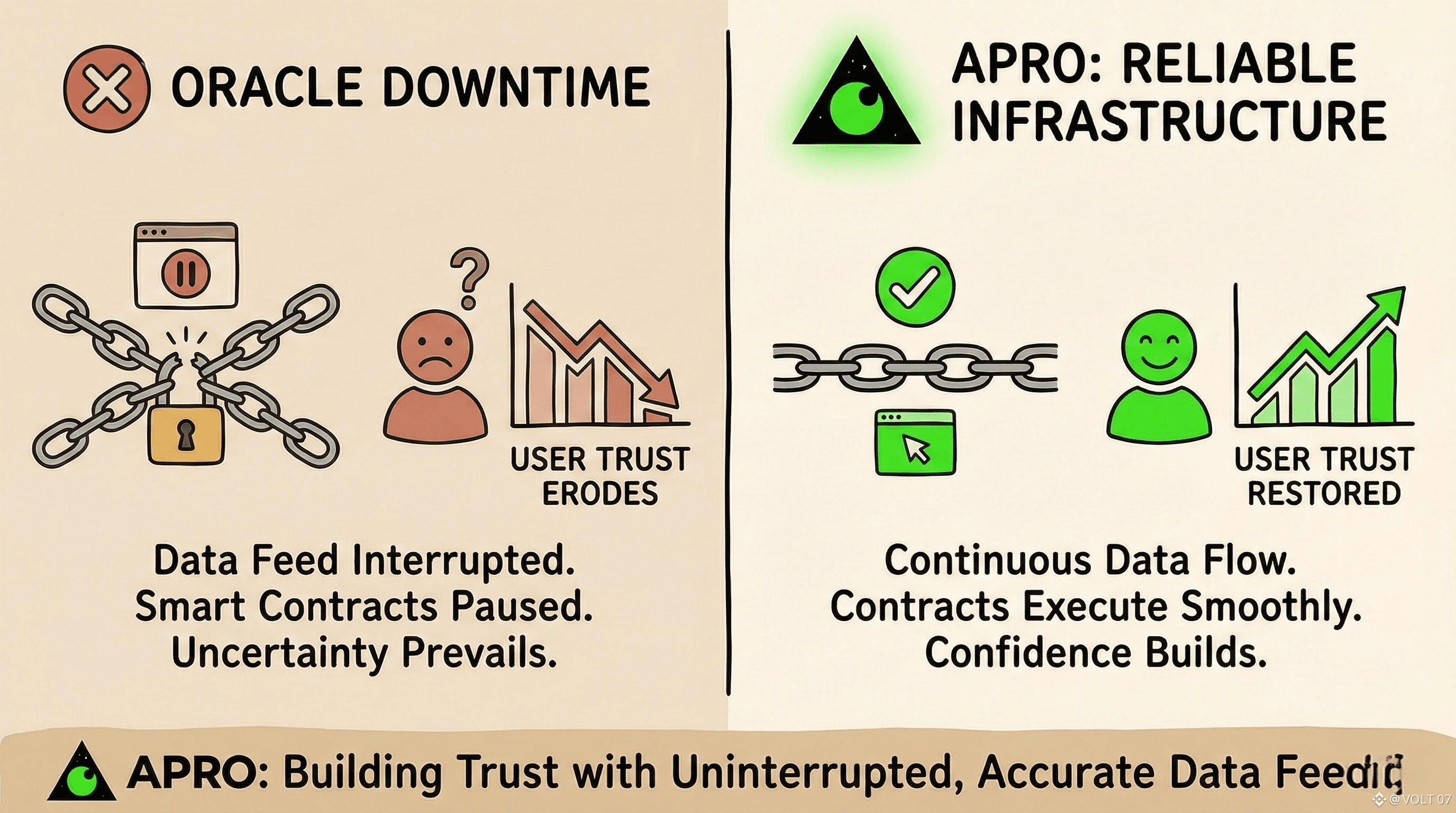
 Smart contracts rarely fail loudly they fail by stopping.
In most on-chain incidents, contracts do not explode, drain, or visibly break. They pause. Markets halt, redemptions freeze, settlements stall, and users are left waiting without clarity. In these moments, the issue is often not code execution or liquidity availability, but oracle downtime or uncertainty.
As Web3 matures, oracle reliability is emerging as one of the strongest determinants of user trust not because oracles are glamorous, but because they define whether systems can continue operating when reality becomes messy.
Downtime is not a technical issue it is a trust event
From a user’s perspective, a paused contract raises immediate questions:
What exactly failed?
Who is responsible?
How long will this last?
Can this happen again?
Is my capital safe or just inaccessible?
When oracle feeds stall, disagree, or become unverifiable, contracts are often designed to halt by default. This is rational from a safety standpoint, but devastating from a trust standpoint if the pause lacks explanation or accountability.
In Web3, unexplained downtime erodes trust faster than losses.
Why oracle downtime increasingly defines user experience
As on-chain applications evolve, they rely on oracles not just for prices, but for:
event verification
conditional execution
settlement triggers
governance decisions
real-world state confirmation
When oracles fail to deliver reliable outcomes, contracts cannot progress safely. This transforms oracle uptime from a backend metric into a front-end trust signal.
Users do not care whether the oracle is “technically decentralized.”
They care whether the system can explain itself when it stops.
The difference between temporary failure and permanent distrust
Short outages are inevitable in any system. What determines whether users return is not the absence of failure, but the quality of resolution.
Systems that lose trust during oracle downtime usually share three traits:
no clear dispute or review process
opaque decision-making during incidents
lack of verifiable post-mortems
In contrast, systems that retain trust:
surface why execution paused
provide auditable resolution paths
demonstrate accountability rather than silence
This is where oracle design becomes critical.
Why “fastest oracle” is no longer the right benchmark
Speed optimizes for ideal conditions.
Trust optimizes for adverse conditions.
As capital size increases and use cases become more complex, the most damaging oracle failures occur during:
volatility spikes
disputed outcomes
delayed real-world events
ambiguous data conditions
In these moments, a fast but unverifiable feed is worse than a slower, defensible one. Reliability becomes the ability to resolve uncertainty without cascading system freezes.
An approach by APRO: Designing for the pause, rather than pretending there won't be one
APRO's design embodies a premise often shunned by other systems: Downtime and conflicts are normal.
Rather than focusing the optimization process just for unidirectional feeds, the APRO framework highlights
dispute-aware resolution mechanisms
review processes that are verifiable
accountability chains Anomalies and accountability chains
There are economic incentives for correctness,
This changes the role of the oracle from the always-on data pipe to the trust mediator in case the execution has to be paused.
Why explainability matters more than continuity
In practice, users tolerate pauses when they understand them.
They abandon systems when pauses feel arbitrary.
APRO’s focus on explainability means that when smart contracts halt:
the reason can be reconstructed
the resolution path is visible
responsibility is traceable
future prevention becomes credible
This transforms downtime from a black-box failure into a managed incident.
Oracle downtime as a stress test for infrastructure maturity
Early-stage protocols optimize for uptime because user expectations are low. Mature systems optimize for incident handling because user stakes are high.
As DeFi expands into:
RWAs
payments and settlement
AI-driven automation
institutional workflows
…downtime will be judged not by duration, but by process quality.
APRO is positioned for this evaluation regime.
Why this matters for long-term adoption
Infrastructure trust does not scale through promises. It scales through:
repeated exposure to stress
consistent handling of exceptions
visible accountability when systems pause
Oracles that cannot demonstrate these traits become bottlenecks. Oracles that can become dependencies.
APRO’s design choices suggest it is betting on the latter path.
The broader shift: from uptime obsession to resolution competence
Web3 is moving away from the question:
“Does it always work?”
Toward:
“Can it handle reality when it doesn’t?”
Oracle downtime is no longer an edge case it is a defining moment for user trust. Systems that treat these moments seriously will increasingly differentiate themselves from those that do not.
Conclusion: when contracts pause, trust is either reinforced or lost
Smart contracts pausing is not a failure of decentralization it is a test of it.
The true measure of oracle infrastructure is not how often it avoids downtime, but how well it explains and resolves it.
APRO’s focus on conflict resolution, accountability, and explanation puts it in a different reliability paradigm, one where trust is built not through seamless execution but through sound resolution under pressure.
As on-chain systems grow more consequential, the oracles that matter most will be the ones users trust when nothing is moving.
Systems earn trust by running smoothly but they keep trust by explaining themselves when they stop.

