
@APRO Oracle :For years, “oracle” has meant one thing in crypto: price feeds pushed on-chain by a set of trusted nodes. This model powered DeFi’s first wave, but it was never designed for what blockchains are trying to do now — interact with messy, probabilistic, real-world data at scale.
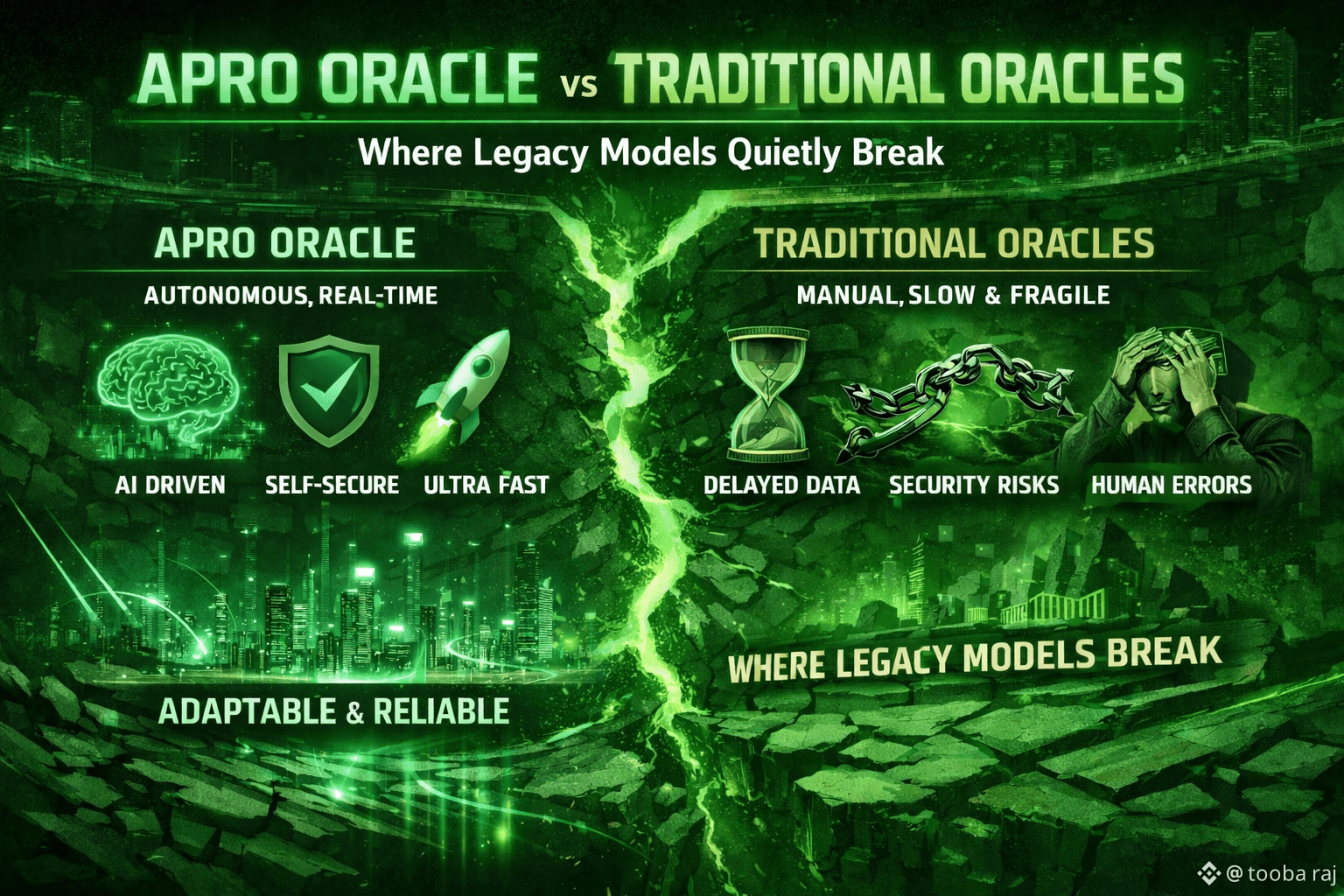
As AI agents, autonomous finance, and real-world integrations expand, the limits of traditional oracle design are starting to show. Not loudly. Quietly. Structurally.
APRO doesn’t compete by being faster or cheaper in isolation. It challenges assumptions baked into legacy oracle architecture — assumptions that worked when data was simple, static, and financial-only.
Let’s unpack where traditional oracles break, and why APRO’s design signals a different direction.
1. Traditional Oracles Assume Data Is Deterministic
Reality: most real-world data isn’t
Legacy oracles were built around a clean premise:
“There exists one correct value, and we just need to report it securely.”
This works for:
Token prices
FX rates
Simple numerical feeds
But breaks down when data becomes:
probabilistic
noisy
contextual
AI-generated
event-based
subjective or multi-source
Examples:
Was a shipment actually delivered?
Did an AI model behave according to policy?
Is off-chain computation valid?
Did a real-world condition meaningfully occur?
Traditional oracles struggle because they are value broadcasters, not truth evaluators.
APRO reframes this: instead of assuming a single “truth,” it treats data as something that must be verified through process, not just fetched.
2. Legacy Oracles Centralize Trust Behind “Decentralization”
Most traditional oracle networks claim decentralization, but in practice rely on:
fixed node sets
reputation-based whitelists
static aggregation logic
uniform data pipelines
This creates a quiet centralization layer:
same providers
same APIs
same incentives
same failure modes
If those upstream sources fail or bias their output, decentralization at the node layer doesn’t fully help.
APRO introduces a more modular trust surface:
heterogeneous nodes
hybrid verification roles
separation between data sourcing, validation, and attestation
Instead of asking “who publishes the data?”, APRO asks:
“How do we prove that the data was produced and verified correctly?”
That shift matters as oracles move beyond prices.
3. Static Aggregation Fails in Dynamic Environments
Traditional oracles aggregate via fixed rules:
median
weighted average
threshold consensus
These rules assume stable conditions. But real-world data environments change constantly:
source reliability fluctuates
latency varies
adversarial behavior evolves
AI outputs differ per context
Static aggregation can’t adapt.
APRO introduces adaptive verification logic, where:
validation methods can change per task
multiple verification paths coexist
confidence emerges from process, not just numbers
This allows oracle behavior to scale across use cases instead of forcing everything into a price-feed-shaped box.
4. Off-Chain Computation Is a Blind Spot for Legacy Oracles
As protocols increasingly rely on:
AI inference
off-chain computation
complex simulations
external workflows
traditional oracles hit a wall. They can report results, but cannot prove how those results were produced.
This creates a trust gap:
Was computation manipulated?
Was the model altered?
Was inference reproducible?
APRO directly addresses this with verifiable off-chain workflows, where computation steps themselves become auditable artifacts.
Instead of trusting outcomes, systems can verify execution integrity.
This is a foundational shift — from data delivery to computation verification.
5. Legacy Oracles Are Price Infrastructure — Not Intelligence Infrastructure
Most oracle networks were designed during DeFi’s first wave, when the dominant need was pricing collateral.
But today’s stack is different:
autonomous agents
AI-driven protocols
real-world coordination
conditional execution
dynamic policy enforcement
These systems don’t just need numbers. They need:
reasoning checkpoints
randomness validation
behavioral proofs
multi-source consensus
auditability
APRO positions itself as infrastructure for machine-to-machine trust, not just DeFi price updates.
That’s why it emphasizes:
randomness verification
AI verification boundaries
hybrid nodes
off-chain/on-chain coherence
It’s closer to a truth engine than a feed publisher.
6. The Quiet Break: Legacy Oracles Still Work — Until They Don’t
This is what makes the shift subtle.
Traditional oracles won’t suddenly fail. They’ll keep serving prices just fine.
But cracks appear when protocols try to:
scale into AI-native systems
automate real-world actions
rely on off-chain reasoning
verify complex events
reduce blind trust
At that point, developers start layering patches:
extra validators
custom verification logic
ad hoc committees
APRO’s thesis is simple:
those patches should be first-class infrastructure, not hacks.
Final Thought: From Feeds to Frameworks
Legacy oracles solved an early problem beautifully: getting prices on-chain.
APRO is responding to a newer one:
How do blockchains reason about the real world without blindly trusting it?
That’s the real divide.
Not speed.
Not cost.
Not node count.
But philosophy.
Traditional oracles deliver data.
APRO builds verifiable truth pipelines.
And as crypto shifts from financial primitives to autonomous systems, that difference quietly becomes foundational.

