
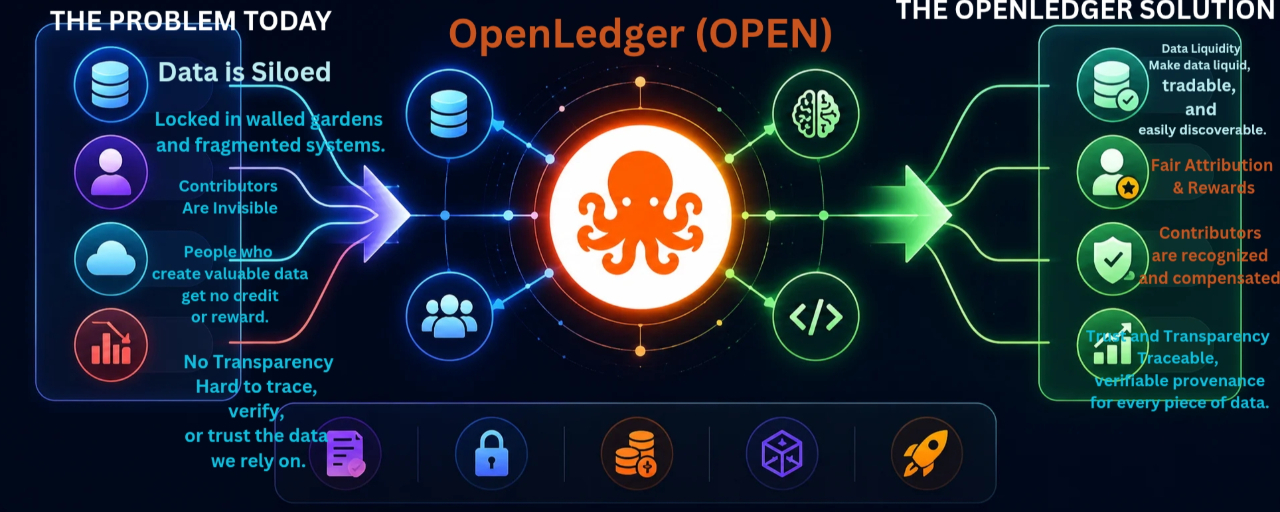

People are obsessed with model size these days—more compute, smarter AI, all that. Feels like almost every headline is another version of “my model’s bigger than yours.” But isn’t that just the surface? The messy part—the one that weirdly gets less attention—is just making data actually usable. Data that you can find, trace, actually trust, even while everything gets more fragmented and chaotic by the month.
Lowkey, every single discussion comes back to hardware and scores. GPUs, benchmarks, FLOPs, whatever. Sometimes it seems like people forget the obvious: none of that matters if the data underneath is junk. Doesn’t matter how fancy your model is—if it’s trained on garbage, it spits garbage out. And then there’s this odd blind spot: people feed these systems with useful data all the time, but contributors barely get a footnote, let alone any credit or cut. Feels like their input just—vanishes. Into the ether. Or the black box, if you want to get dramatic.
Maybe that’s why OpenLedger jumped out at me. They don’t treat data like some background prop. Instead, they’re almost fixated (in a good way) on making data flow—liquid, tradable, traceable. Choose your word. Their $OPEN thing aims to connect datasets, models, and actual human contributors into an open system anyone can join. Not locked up or buried behind another Big Tech wall.
A lot of decentralized AI projects are talking about data ownership and attribution now, but OpenLedger’s all-in on liquidity.
Decentralized AI discussions often revolve around compute networks, yet OpenLedger is approaching the problem from the data side—who contributes knowledge, how it's tracked, and how value flows back to participants.
It’s less "let’s make a cool new app," more "let’s build the pipes everyone else uses later." If I’m not off base, this is truer market infrastructure than yet another AI demo.
As these systems gobble up ever-bigger datasets, questions about who owns what—who gets paid or even noticed—are only getting louder. Not sure why more people don’t see this coming, but it’s there, right under the surface. The more I poke around OpenLedger, the more I get the sense they’re working on something everyone else is kind of ignoring: the foundational stuff. Not just another trending toy, but the backbone for whatever comes next. Or maybe I’m overstating it. Still, it lines up with this hunch that tomorrow’s AI race isn’t just about smarter models—it’s about who can actually turn data and knowledge itself into an open marketplace everyone can plug into.
Oddly, that seems a way bigger shift than folks want to admit.
All that said, OpenLedger’s big vision leans hard on solving data verification and incentives for the long haul—two problems that, frankly, have tripped up plenty before. Maybe I’m skeptical, but that’s where these things tend to break.
If the real AI bottleneck is actually data, not models, does data liquidity turn into the next big crypto narrative? Or are people still just missing the plot? I don’t know, but I’m watching. #OpenLedger $OPEN @OpenLedger
