
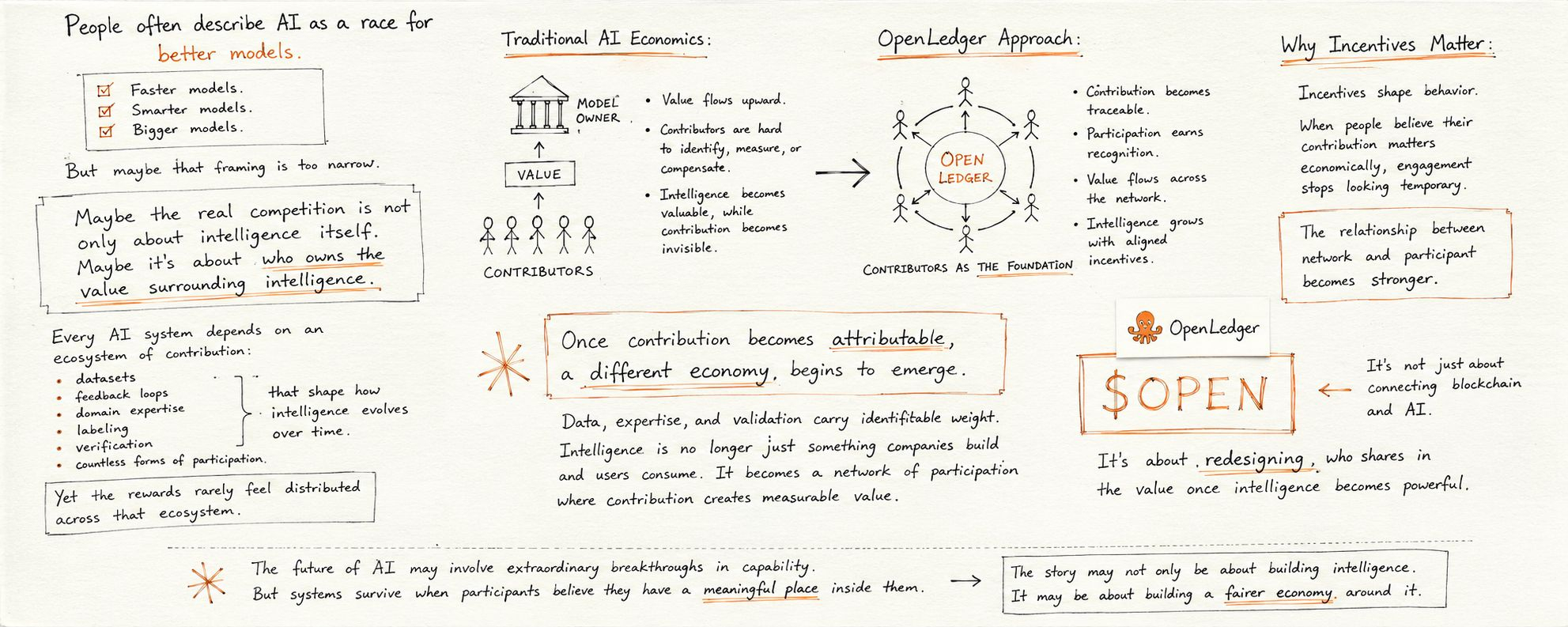

Faster models.
Smarter models.
Bigger models.
But lately I have been wondering if that framing is too narrow.
Maybe the real competition is not only about intelligence itself. Maybe it is about who owns the value surrounding intelligence.
That question keeps bringing me back to @OpenLedger
Most conversations around AI still focus on the visible layer. People admire the model, test the output, and compare performance. What remains strangely hidden is the economic machinery underneath. Every AI system depends on an ecosystem of contribution datasets, feedback loops, domain expertise, labeling, verification, and countless forms of participation that shape how intelligence evolves over time.
Yet the rewards rarely feel distributed across that ecosystem.
This is where the AI discussion starts becoming more interesting to me.
Traditional AI economics often look vertically concentrated. Value flows upward toward the model owner, while contributors remain difficult to identify, measure, or compensate in proportion to the role they played. That structure helped AI scale quickly, but it also created a persistent imbalance. Intelligence becomes valuable, while contribution becomes invisible.
I do not think that tension disappears as AI grows.
If anything, it becomes more important.
The next phase of AI may depend less on whether models become smarter and more on whether the surrounding systems become economically sustainable. Because eventually, contribution quality depends on incentives. People participate differently when their role carries measurable value.
That is partly why #OpenLedger stands out to me.
What I find compelling about OPEN is not simply the attempt to connect blockchain and AI. That story alone is no longer unique. The more interesting layer sits deeper. OpenLedger appears to be asking a structural question: what happens when AI contribution becomes traceable and economically recognized instead of disappearing inside centralized systems?
That shift changes how I think about the space.
For years, data has mostly behaved like extraction fuel. People generate information, platforms capture it, models learn from it, and value accumulates somewhere distant from the original contribution. Most users accept this arrangement because it feels normal.
But normal does not always mean permanent.
Once contribution becomes attributable, a different economy begins to emerge.
Suddenly, intelligence is no longer just something companies build and users consume. It becomes a network of participation where data, expertise, and validation carry identifiable weight. That distinction matters because AI systems do not improve through abstraction alone. They improve through repeated interaction with contributors whose input shapes outcomes.
The economics surrounding those contributors may become one of the defining questions of the entire sector.
This is where I think #OpenLedger enters the conversation from a different direction.
Instead of treating contributors as background infrastructure, the ecosystem appears designed around the idea that participation itself deserves clearer recognition. That does not merely change reward distribution. It changes incentives.
And incentives shape behavior.
When people believe their contribution matters economically, engagement stops looking temporary. The relationship between network and participant becomes stronger because value creation no longer feels one-sided.
I find that possibility fascinating.
Crypto and AI are often discussed separately, yet both industries wrestle with versions of the same problem: how do you coordinate large systems without concentrating all value into a narrow center?
Sometimes blockchain tries to solve that through ownership structures. Sometimes AI tries to solve it through better models. But OpenLedger seems to be exploring whether coordination and contribution economics can evolve together.
That perspective feels increasingly relevant.
The AI market is surging quickly, but growth alone does not resolve architectural questions. More users, more models, and more computation do not automatically produce fairer systems. Without incentive alignment, scale can simply magnify imbalance.
That is why I keep paying attention to ecosystems attempting something deeper than narrative positioning.
The future of AI may involve extraordinary breakthroughs in capability. I do not doubt that. But capability alone rarely determines long-term architecture. Systems survive when participants believe they have a meaningful place inside them.
And perhaps that is the more overlooked story around #OpenLedger
The conversation may not only be about building intelligence.
It may also be about redesigning who shares in the value once intelligence becomes powerful.
That possibility is what keeps OPEN on my radar.