
For nearly two decades, everyday internet users have been the silent, unpaid backbone of the digital economy. Every time you solve a CAPTCHA, type a search query, or interact online, your data is harvested to train profitable algorithms. In the Generative AI era, this has escalated into a structural crisis: massive foundation models generate billions in revenue by training on our collective knowledge without a single cent flowing back to the creators.
This “black box” extraction is a fundamental flaw in the data economy. Enter @OpenLedger, a decentralized infrastructure designed to fix this plumbing by acting as the “AI Liquidity Layer.” It converts data from an exploited resource into a liquid, tradable asset with clear, verifiable ownership.
1. The Era of Specialized Language Models (SLMs)
The AI industry is moving away from massive, general-purpose models. We are entering the era of Specialized Language Models (SLMs)—highly optimized engines designed for deep domain expertise in fields like medicine, law, or finance.
The primary bottleneck for AI development is no longer raw compute power; it is high-quality, expert-verified “Golden Datasets.” Because general foundation models rely on noisy web-scraped data, they lack the precision needed for high-stakes applications. #OpenLedger focuses entirely on this premium niche, establishing a system where high-quality data attribution isn’t just fair—it’s a technical requirement for accuracy.
2. Proof of Attribution (PoA) & OpenLoRA
The core technical breakthrough of the network is its Proof of Attribution (PoA) engine. Think of it as an on-chain citation engine that creates a mathematical link between an AI’s output and the specific data that influenced it. Using advanced frameworks like Infini-gram, it can trace token-level origins within a trillion-token corpus to determine exactly where an AI’s answer originated.
Furthermore, to host thousands of specialized models without collapsing under massive hardware requirements, the project utilizes the OpenLoRA framework. By maintaining one base model in memory and dynamically swapping tiny, specialized “adapters” in real-time, it achieves a staggering 98% reduction in memory usage. This turns a decentralized expert marketplace into a viable economic reality.
3. $OPEN Tokenomics and Real-World Utility
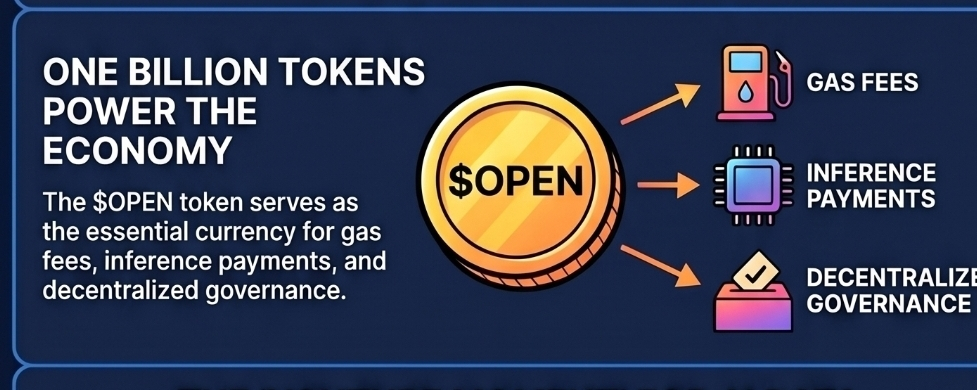
The native $OPEN token is built on true economic utility—dataset purchases and enterprise transactions—rather than speculative circular yield.
Supply Control: The total supply is strictly capped at 1 billion tokens, with institutional and team allocations locked behind a 12-month cliff and a 36-month linear vest.
Community-First: 51.7% of the token supply is allocated to the community, including a 5% allocation reserved for early participant airdrops.
Value Capture: With existing institutional pilots from global corporations like Sony and Walmart, the protocol implements a buyback-and-burn mechanism funded directly by corporate revenues, linking token scarcity straight to real-world AI adoption.
The Bottom Line
@OpenLedger ger is delivering an ambitious infrastructure play that maps out a fair, transparent future for data creators and AI developers alike. For blockchain enthusiasts and AI researchers, keeping a close eye on #OpenLedger er and the ecosystem is no longer optional—it is a glimpse into the next evolution of decentralized AI.