
A strange thing happens when you spend enough time around crypto and AI. The narratives start repeating before the previous ones even finish playing out. One week everyone is talking about model performance. The next week it's agents. Then infrastructure. Then data. Different words, same rhythm. I've caught myself reading entire threads lately and realizing halfway through that I already know how they're going to end.
Maybe that's why I keep getting stuck on attribution.
Not because it's exciting. Honestly, it isn't. Most people would probably scroll past it without a second thought. But the longer I watch AI develop, the more attribution feels like one of those boring pieces that quietly determines whether a system actually works when real people start using it.
I remember when crypto first started talking seriously about ownership. Ownership of assets. Ownership of networks. Ownership of identity. We spent years building mechanisms around proving who owns what. Then AI arrived and somehow the conversation shifted. Suddenly the focus became outputs. Better outputs. Faster outputs. Cheaper outputs.
The inputs became almost invisible.
That's the part that feels odd to me.
Every AI system depends on contributions from somewhere. Sometimes it's data. Sometimes it's expertise. Sometimes it's human feedback that gets layered into a model over months without most people ever noticing. The system improves, but the people who helped improve it gradually disappear from view.
Maybe that works for a while.
Maybe it even scales surprisingly well.
But eventually I start wondering what happens when contributors realize they are participating in systems that can measure almost everything except their own involvement.
The issue isn't fairness. At least I don't think that's the most interesting part.
The issue is coordination.
People tend to contribute differently when they can see a connection between effort and outcome. Remove that connection and behavior changes. Not immediately. Slowly. Almost invisibly. The quality drops a little. Engagement becomes more transactional. Participants stop thinking long term because the system itself doesn't give them many reasons to.
I've seen similar patterns in crypto communities more times than I can count.
Rewards shape behavior.
Visibility shapes behavior.
Even the absence of recognition shapes behavior.
Which is why attribution keeps pulling my attention back.
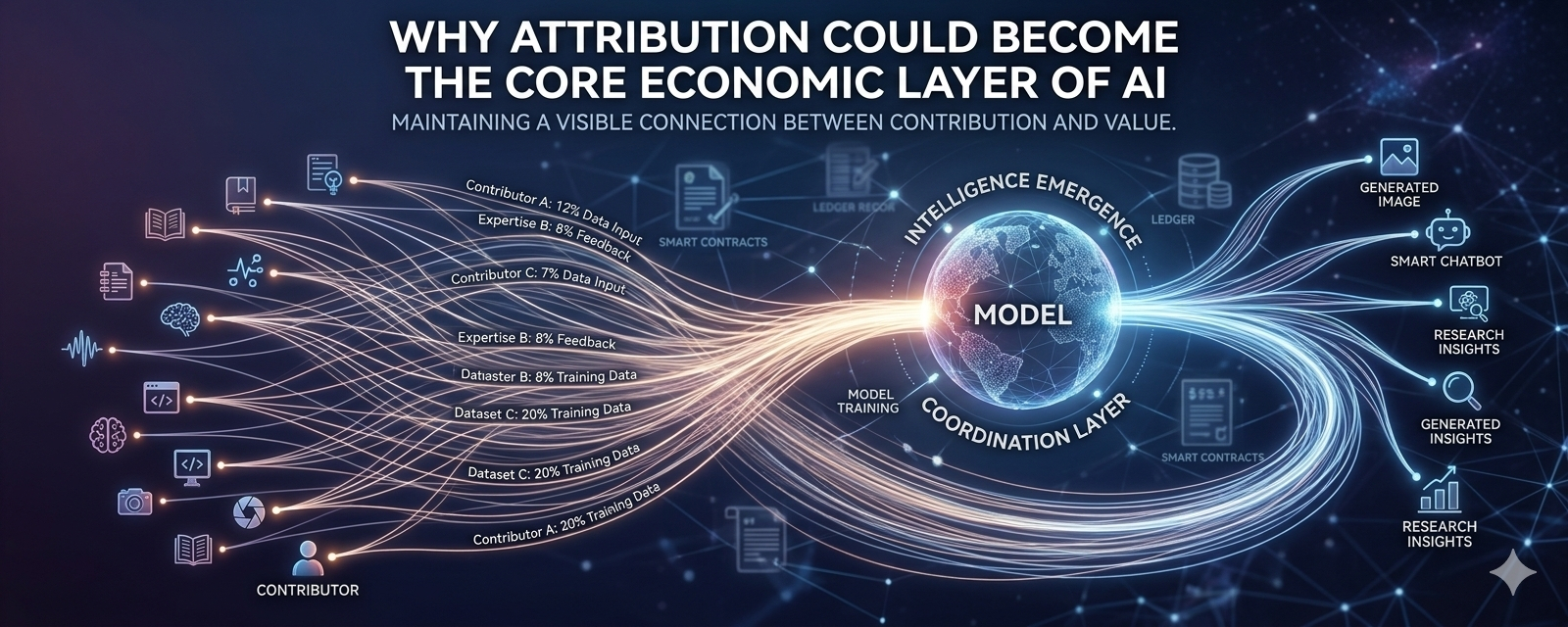
What I find interesting about OpenLedger isn't the usual AI narrative people attach to it. It's the attempt to keep relationships intact between contributors, datasets, models, and outputs instead of treating those things as separate events.
I don't know if that sounds important on paper.
It barely did to me at first.
Then I started looking at it differently.
Most AI conversations treat outputs as the final destination. A model generates something useful and the story ends there. But what if outputs are actually the beginning of another process? What if every inference creates a trail that points backward through the system rather than stopping at the result itself?
I keep visualizing it almost like a river.
Most systems focus on where the water ends up.
Attribution focuses on where the water came from.
Not exactly the same thing.
And maybe that's why it feels more significant than people realize.
The more AI becomes embedded into everyday workflows, the harder it becomes to ignore questions about origin. Where did this capability come from? Which dataset influenced it? Who contributed to the training process? Who made the system valuable before anyone else started using it?
Those questions aren't always practical today.
But systems have a funny habit of making old questions important again once enough value starts flowing through them.
Still, I don't think attribution is some perfect solution.
Actually, I suspect it introduces new problems.
Once rewards become attached to contribution records, people will inevitably start optimizing for whatever gets measured. That's just how humans work. Some participants will focus on creating value. Others will focus on appearing valuable. The difference between those two things can become surprisingly difficult to detect.
I've watched that happen in social media.
I've watched it happen in crypto.
There's no reason AI would be immune.
That's why I'm cautious whenever people describe attribution as if it automatically fixes incentives.
It doesn't.
It changes incentives.
Those are very different things.
The real question is whether the new incentives create better long-term behavior than the old ones. I don't think anyone knows yet.
What I do know is that AI increasingly looks less like a software product and more like an economy.
Data providers.
Model builders.
Application developers.
Users.
Researchers.
Everyone contributes something different, yet most existing systems still struggle to connect value creation with value distribution in a transparent way.
That's a coordination challenge more than a technical one.
And coordination problems tend to stay hidden until scale exposes them.
Maybe that's what makes attribution interesting right now. Not because it's guaranteed to succeed. Not because it's a revolutionary idea. Mostly because it feels like an attempt to address a problem that becomes more obvious the larger these systems grow.
The market spends a lot of time talking about intelligence.
I'm starting to wonder if the harder problem is remembering where intelligence came from in the first place.
Maybe attribution becomes a foundational layer.
Maybe it remains a niche experiment.
Maybe contributors care far less than people expect.
I honestly don't know.
But every time I look at AI infrastructure, I find myself drifting back toward the same question. Not who owns the model. Not which model performs best. Not even which application gains the most users.
Just whether future AI systems can maintain a visible connection between contribution and value without collapsing under their own complexity.
That's the part I keep coming back to.
Not because I have an answer.
Because I don't.