
Lately, I have been thinking about how loud the AI conversation has become.
Everywhere I look, someone is promising a new future. New intelligence. New economies. New systems that will supposedly change everything.
Maybe that is why I find myself becoming quieter.
Not because I have lost interest.
Because I have learned that the loudest stories are not always the most important ones.
Crypto has a habit of falling in love with ideas before those ideas have a chance to prove themselves. I have watched entire narratives explode across timelines, attract billions in attention, and then slowly fade once the excitement ran out. The charts moved. The engagement looked incredible. Yet underneath all the activity, very little had actually changed.
That history stays with me.
It makes me look at every new trend with a mixture of curiosity and caution.
Especially when AI is involved.
These days almost every project seems connected to artificial intelligence in one way or another. The language changes, but the promise feels familiar. Better models. Smarter agents. Decentralized intelligence. Data ownership.
After a while, the words start losing their weight.
What matters is not what a project says.
What matters is what happens when nobody is watching.
When rewards stop flowing.
When attention moves somewhere else.
When the market finds a new obsession.
That is usually where reality reveals itself.
This is why OpenLedger caught my attention.
Not because it claims to be part of the AI movement.
Almost everyone does.
What made me pause was the question sitting underneath the story.
For years, people have been feeding the digital world with pieces of themselves without really thinking about it. Every search. Every conversation. Every image. Every opinion. Every line of code. Every late-night thought typed into a screen.
Little by little, we have been creating something valuable.
And most of us never owned any part of it.
The more I think about that, the stranger it feels.
Human knowledge has become one of the most valuable resources on earth, yet the people generating it rarely participate in the value being created.
Artificial intelligence has only made that reality more obvious.
AI learns from human effort.
It learns from our curiosity.
Our mistakes.
Our creativity.
Our experiences.
The intelligence being built today is not appearing from nowhere. It is being shaped by countless people whose contributions often disappear into the background.
That feels like the real issue.
Not technology.
Not tokens.
Ownership.
Recognition.
Value.
Who creates it.
Who keeps it.
Who benefits from it.
These are old questions wearing modern clothes.
And they are becoming harder to ignore.
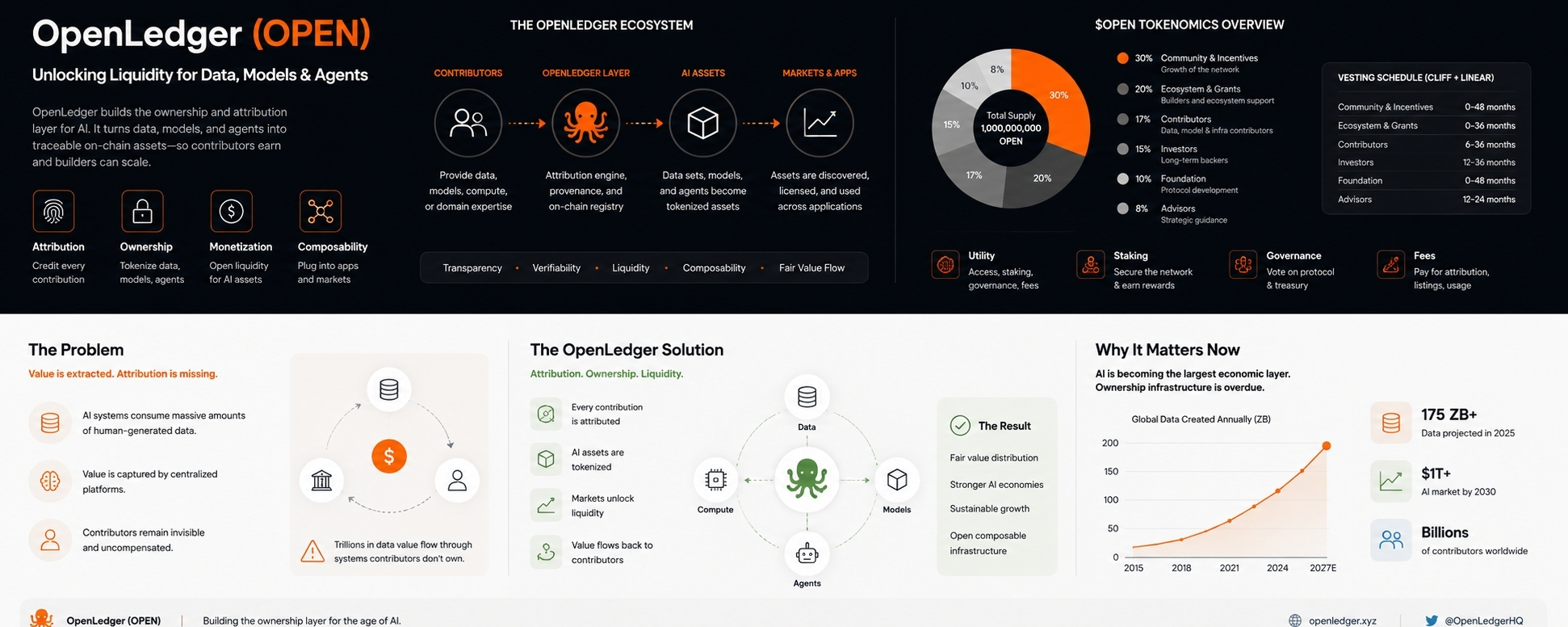
OpenLedger seems to be positioning itself around this gap.
The idea is simple enough to understand but incredibly difficult to execute.
If people contribute data, models, knowledge, or intelligence, can their contribution actually be measured?
Can it be tracked?
Can it be rewarded?
Can value flow back to the people who helped create it?
Those questions sound straightforward until you start pulling them apart.
Because reality is messy.
Data blends together.
Models evolve constantly.
Outputs come from thousands of invisible inputs.
The deeper you go, the harder it becomes to identify where value truly originated.
That is where my skepticism lives.
Crypto has never struggled to tell beautiful stories.
The industry is filled with beautiful stories.
What it struggles with is building systems that continue working after the excitement disappears.
A real coordination layer has to survive beyond incentives.
A real infrastructure layer has to matter even when nobody is speculating on it.
That is the standard I keep coming back to.
Could OpenLedger eventually become something people genuinely need?
Or is it another idea that sounds powerful during a narrative cycle but struggles once reality arrives?
I do not know.
And honestly, I think anyone claiming certainty is probably guessing.
What I do know is that the problem feels real.
The internet created massive value extraction systems.
AI is accelerating them.
Every day, more intelligence is being trained, refined, and monetized.
The question of who deserves ownership inside that process is not going away.
Whether users care enough to demand attribution is another matter entirely.
Most people choose convenience.
Most people want results.
They rarely spend time thinking about the invisible systems operating underneath their tools.
That creates another challenge.
Even if attribution matters philosophically, does it matter enough economically?
Can people be convinced to care?
Can developers build around it?
Can businesses depend on it?
Those answers will determine far more than any marketing campaign ever could.
Then there is the issue of incentives.
I always pay attention to what happens when rewards become the main attraction.
Crypto has a long history of creating activity that looks impressive from a distance.
Wallets appear.
Transactions increase.
Communities grow.
Everything seems alive.
Then incentives disappear and the activity disappears with them.
What looked like adoption was often temporary behavior rented by rewards.
Real networks behave differently.
People continue showing up because the system solves a problem.
Not because someone is paying them to stay.
Whether OpenLedger can reach that point remains one of the biggest unanswered questions.
And maybe that uncertainty is exactly why I keep watching.
Because beneath all the noise, there is something interesting happening here.
Not necessarily a finished solution.
Not necessarily a future winner.
Just an attempt to address a problem that feels increasingly important.
As AI becomes more capable, intelligence itself begins to look less like software and more like an economy.
Agents will perform work.
Models will create value.
Data will become fuel.
Ownership will matter.
Attribution will matter.
Accounting will matter.
Someone will eventually build the systems that connect those pieces together.
The only question is who.
Maybe OpenLedger becomes part of that future.
Maybe it does not.
Maybe it succeeds.
Maybe it becomes another forgotten experiment buried beneath the next cycle of excitement.
Right now, I cannot confidently say which outcome is more likely.
What I can say is that the conversation feels bigger than one token, one chart, or one narrative.
Something important is changing beneath the surface.
The relationship between intelligence and ownership is starting to shift.
The old systems feel increasingly incomplete.
The new systems have not fully arrived.
And somewhere in that uncertain space, projects like OpenLedger are trying to find their place.
That does not make them inevitable.
It does not make them valuable.
It does not make them successful.
It simply makes them worth paying attention to.
And sometimes, especially during the quiet hours when the market noise fades away, that is enough reason to keep looking.
