
The crypto market spent years obsessing over speed.
Faster chains.
Cheaper transactions.
Lower latency.
More throughput.
AI inherited that same obsession almost immediately. Bigger models became the center of attention. More compute meant stronger narratives. Most investors still evaluate AI projects using the same framework traditional tech markets used during cloud expansion cycles.
But I think something much more important is starting to emerge beneath the surface.
Control.
Not control in the centralized corporate sense.
Control in the economic coordination sense.
Who owns intelligence?
Who controls access?
Who receives attribution?
Who gets rewarded when AI systems generate value?
And more importantly, who gets left out?
That shift is one reason why I have been paying closer attention to @OpenLedger lately.
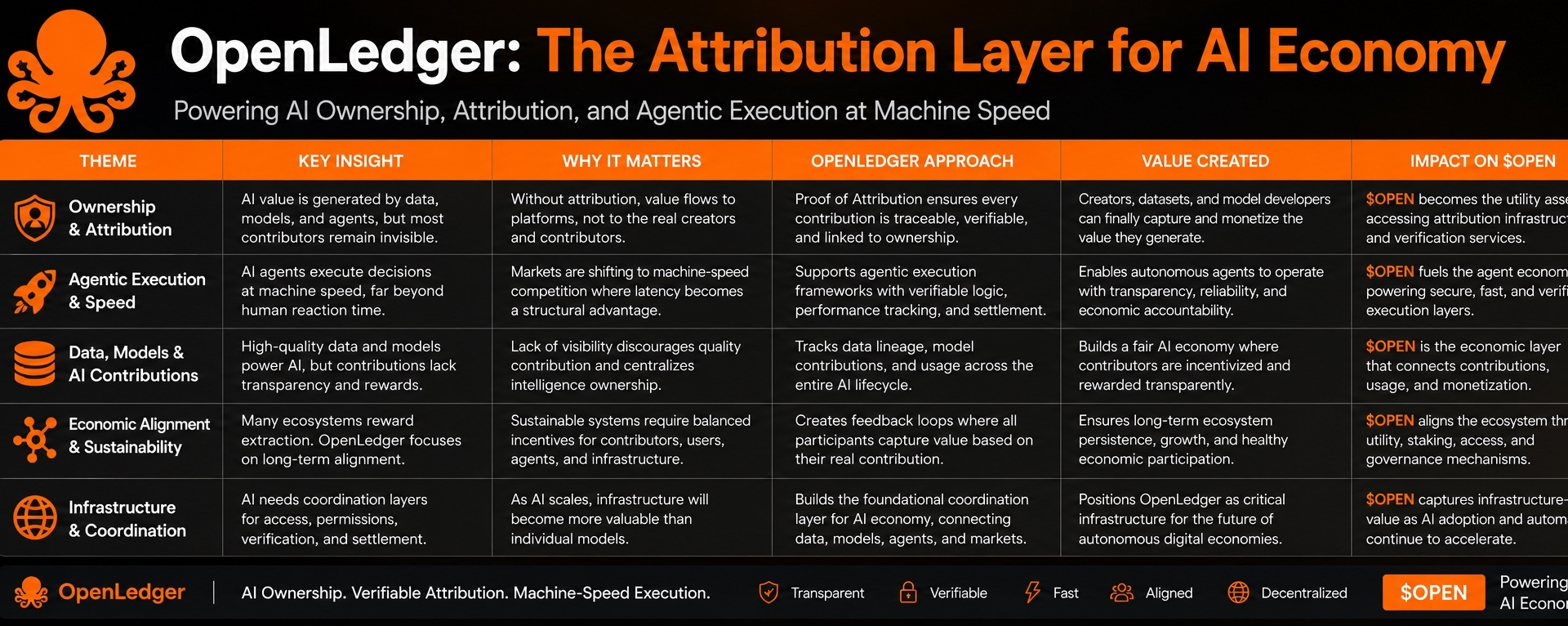
Most AI infrastructure projects focus on model performance or compute layers. OpenLedger seems to be moving toward a different direction entirely. The project is building infrastructure where datasets, models, AI agents, and execution systems can become transparent, monetizable, and verifiable onchain.
That changes the conversation completely.
Instead of treating AI like a closed black box owned entirely by platforms, OpenLedger pushes toward an economy where contributors can finally become visible participants inside the value chain.
And honestly, that may become one of the most important narratives in AI over the next few years.
The current AI economy has a hidden imbalance.
Millions of people contribute data every day without realizing how valuable that data actually is. Human behavior, feedback loops, market interactions, trading decisions, conversations, content creation, and even correction signals continuously improve machine systems.
Yet almost none of that value flows back toward contributors.
The platforms accumulate the upside.
The models accumulate intelligence.
The users remain invisible.
OpenLedger’s Proof of Attribution model feels designed to challenge that structure directly.
The concept itself is simple but economically powerful.
If data, models, or agents contribute to an outcome, attribution should exist.
If attribution exists, ownership can exist.
If ownership exists, monetization becomes possible.
That sounds theoretical at first, but it becomes extremely important once AI agents begin operating autonomously across financial systems, trading environments, and onchain coordination layers.
And that transition is already starting.
One of the latest OpenLedger discussions focused heavily on agentic execution speed.
I think many people underestimated how important that topic actually is.
Markets are slowly moving toward environments where humans no longer compete directly against humans.
Instead, machines increasingly compete against machines.
Human reaction time is simply too slow.
A trader reading information manually still needs to interpret the event, make a decision, confirm conviction, and execute.
AI systems do not experience hesitation the way humans do.
They continuously process data, evaluate probabilities, execute logic, and adapt strategies almost instantly.
That changes the structure of markets themselves.
Latency starts becoming an economic weapon.
A human reacting within 300 milliseconds might feel fast.
An autonomous AI execution system operating below 50 milliseconds exists in an entirely different environment.
And once enough market participants operate at machine speed, traditional manual trading behavior begins losing structural advantage.
This does not mean humans disappear from markets.
It means human roles change.
Humans increasingly define frameworks, incentives, constraints, and strategic direction while AI systems handle execution layers dynamically.
That shift alone could reshape DeFi infrastructure over time.
Liquidity systems may become agent-driven.
Yield optimization could become fully autonomous.
Treasury management may operate continuously.
Cross-chain capital allocation could happen algorithmically without human intervention.
Most people still think AI in crypto means chatbots and assistants.
I think the much larger transformation happens inside execution systems.
And OpenLedger appears to understand that direction early.
What makes the project more interesting is that it does not position AI as isolated software.
Instead, it treats AI as an economic coordination layer.
That difference matters.
Because once AI agents begin interacting financially, questions around ownership, attribution, verification, permissions, and incentives become unavoidable.
Who owns the execution logic?
Who receives value when an agent succeeds?
Who verifies model contribution?
Who tracks data lineage?
Who controls access to intelligence infrastructure?
Those questions become increasingly important as autonomous systems expand.
This is also why I think many AI narratives inside crypto still feel incomplete.
A lot of projects focus entirely on generation.
Very few focus deeply on attribution economics.
But attribution may eventually become more valuable than generation itself.
The internet already showed what happens when distribution scales without ownership protection.
Platforms absorbed most of the economic upside while creators competed for visibility.
AI risks repeating the same pattern on an even larger scale.
OpenLedger feels like an attempt to rebuild those economics differently before agentic systems become dominant.
And if that direction works, the implications become much bigger than speculative AI hype cycles.
Because then $OPEN may not simply represent another AI token.
It may represent access infrastructure.
That distinction matters a lot.
The market often prices AI projects based on future usage expectations.
But infrastructure scarcity tends to become much more powerful over time.
Especially when access itself becomes valuable.
I keep thinking about how financial systems evolved historically.
At first, value came from ownership of assets.
Later, value shifted toward ownership of distribution.
Then platforms controlling networks captured most upside.
AI may follow a similar progression.
The early phase rewards raw intelligence.
The later phase may reward coordination infrastructure controlling attribution, permissions, and execution environments.
That is where OpenLedger becomes interesting.
The project sits closer to infrastructure coordination than simple AI speculation.
And infrastructure narratives usually compound slowly before markets fully understand them.
Another important detail is how OpenLedger connects monetization directly into participation layers.
That part often gets overlooked.
Most ecosystems struggle because participants extract value faster than systems create it.
OpenLedger seems focused on creating feedback loops where contributors, models, agents, and infrastructure providers all remain economically connected.
That alignment matters long term.
Especially in crypto.
We already saw what happened during earlier play-to-earn cycles where emissions rewarded extraction more than retention.
Short-term participation exploded temporarily, but sustainability collapsed because systems lacked durable economic alignment.
AI ecosystems could easily repeat those same mistakes.
OpenLedger appears more focused on persistence than temporary attention.
And honestly, persistence may become one of the rarest assets in AI markets.
Because narratives move extremely fast now.
Every week introduces another model.
Another framework.
Another infrastructure protocol.
Another automation layer.
Most disappear almost immediately.
Very few establish durable positioning.
The projects that survive likely become the ones building structural coordination systems instead of temporary speculative excitement.
That is why the OpenLedger narrative feels more important than many people realize right now.
The market still talks mostly about model capability.
But the deeper economic battle may revolve around attribution, access, ownership, and autonomous execution coordination.
And once that transition fully accelerates, infrastructure layers controlling those systems could become extremely valuable.
Especially if AI agents eventually operate across financial markets at scale.
At that point, transparency matters.
Verification matters.
Economic alignment matters.
Attribution matters.
Without those systems, AI markets become increasingly opaque and centralized.
With them, entirely new digital economies become possible.
That is the larger reason I keep watching @OpenLedger closely.
Not because AI narratives are trendy.
Not because machine-speed execution sounds futuristic.
But because the project seems focused on solving economic coordination problems that most of the market still barely discusses.
And historically, the biggest infrastructure opportunities usually emerge before the broader market fully understands why they matter.
$OPEN may still be early inside that conversation.
But the direction itself feels increasingly important as autonomous systems continue expanding across crypto and financial markets.
The next AI cycle probably will not be decided only by which systems are smartest.
It may be decided by which systems control attribution, ownership, execution, and access.
That feels like a much bigger game.