
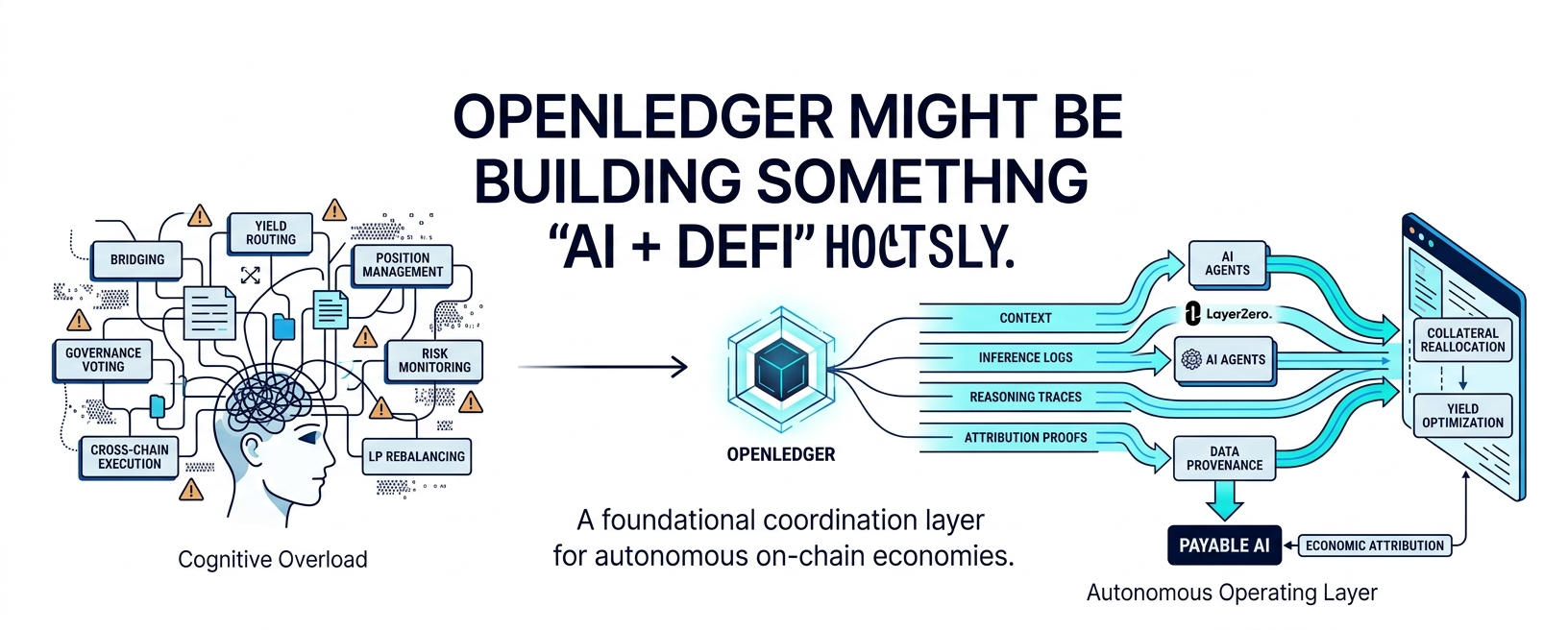


been thinking a lot about where DeFi actually breaks for normal users 🤔
and weirdly i dont think the biggest problem is liquidity anymore.
or speed.
or even regulation.
i think the deeper issue is cognitive overload.
people underestimate how complicated on-chain finance still is for anyone outside crypto-native circles.
bridging.
yield routing.
position management.
governance voting.
risk monitoring.
cross-chain execution.
LP rebalancing.
vault strategies.
the infrastructure became composable faster than humans became capable of managing the complexity manually 😂
thats partly why OpenLedger keeps catching my attention lately.
because the more i read their architecture,the less it feels like they are trying to build “another AI protocol” and the more it feels like they are trying to build an operating layer for autonomous financial coordination itself.
and thats a much bigger idea.
the scalability part is actually interesting technically.
OpenLedger is built around an OP Stack-based rollup architecture,which already gives it modular scalability characteristics instead of forcing everything through monolithic execution paths. transactions execute off-chain while settlement and finality anchor back to Ethereum. blocks are produced every ~2 seconds and data availability is pushed through EigenDA-style infrastructure.
that matters because AI-driven financial systems generate enormous amounts of state updates.
not just transactions,but inference logs,attribution proofs,agent execution traces,data provenance records and reward settlements simultaneously.
traditional DeFi systems mostly track balances and swaps.
OpenLedger is trying to track reasoning itself.
thats a fundamentally heavier computational problem.
and honestly i dont think enough people appreciate how difficult interoperability becomes once autonomous agents start operating across chains.
normal bridges move assets.
AI agents move context.
those are completely different things.
OpenLedger’s LayerZero integration hints at this directly. theyre trying to maintain attribution continuity even when execution spans multiple networks. the system attempts to preserve provenance,data lineage and reasoning accountability across chains instead of treating every chain interaction as isolated execution.
thats actually a pretty sophisticated approach to interoperability if it works consistently.
because most cross-chain systems today still feel fragmented honestly.
liquidity fragments.
state fragments.
identity fragments.
governance fragments.
even the AI layer fragments.
an autonomous agent might source data from one chain,execute trades on another,use liquidity elsewhere and settle somewhere completely different.
without unified attribution,the reasoning path basically disappears.
and once reasoning disappears,you lose trust.
thats the part OpenLedger seems obsessed with fixing.
the architecture keeps revolving around one core principle:
every intelligent action should remain explainable,traceable and economically attributable.
which is probably why they keep positioning themselves around “Payable AI” instead of generic automation narratives.
the automation side is where things become genuinely important for mass adoption though.
because if AI agents can eventually handle complex DeFi coordination invisibly in the background,then suddenly crypto stops feeling like infrastructure users need to constantly micromanage.
thats the real unlock potentially.
imagine intelligent agents automatically reallocating collateral,managing yield exposure,executing governance decisions,optimizing liquidity positions or hedging risk conditions without users manually interacting with ten different protocols every day.
not just automation.
context-aware automation.
thats a different category entirely.
and OpenLedger’s attribution system becomes extremely relevant there because autonomous finance without accountability becomes dangerous very quickly.
if an AI agent executes a bad trade,who is responsible?
the model?
the dataset?
the developer?
the inference provider?
the execution layer?
most AI systems today cant answer that cleanly.
OpenLedger is at least attempting to build infrastructure where every inference,decision path and execution trace remains provable on-chain through Proof of Attribution.
i genuinely think thats why they keep leaning into the “future of AI-powered DeFi” positioning.
not because AI sounds trendy.
because autonomous finance literally requires verifiable reasoning infrastructure if it ever wants institutional-scale trust.
otherwise youre basically asking users to hand capital allocation decisions to opaque black boxes.
and historically thats never ended well 😂
still though...i keep coming back to one unresolved question.
can attribution systems scale fast enough for real autonomous financial markets?
because once thousands of agents start interacting continuously across chains,the amount of provenance tracking,inference verification and attribution settlement becomes enormous.
the theoretical design makes sense.
but distributed intelligence systems tend to become chaotic under real-world scale conditions.
especially when latency,MEV,cross-chain synchronization and probabilistic AI reasoning all collide simultaneously.
thats the part i still cant fully model in my head honestly.
but if OpenLedger manages to solve even part of that infrastructure problem,it probably stops being “just another AI crypto project.”
it starts looking more like a foundational coordination layer for autonomous on-chain economies themselves 🤔