
I used to believe I could clearly tell when I was playing a system “the right way.” In most games, there’s a moment where effort and outcome line up neatly — where you can feel that your time, decisions, and strategy are translating directly into progress. But here, that connection never felt fully stable.
Some sessions would go smoothly, almost exactly as expected. Others felt slightly misaligned, even though I was repeating the same patterns. Nothing visibly broken, nothing obviously wrong — yet the results didn’t consistently reflect the effort I was putting in. It wasn’t failure. It was something more subtle: inconsistency without explanation.
Like most players in GameFi environments, my first instinct was to look inward. If results don’t match input, you assume inefficiency. So I refined everything — tighter loops, fewer wasted actions, more structured routines. For a while, it worked. Or at least, it felt like it did.
Then the pattern broke again.
What started to stand out wasn’t just my own experience, but the variation across players. People following disciplined, optimized strategies weren’t always progressing in the same way. Meanwhile, others with looser, less structured approaches seemed to move forward with less friction. Not necessarily faster — just… smoother.
That’s when it clicked: efficiency alone wasn’t the full equation.
Systems like this don’t behave like traditional games anymore. They resemble living economies. They don’t just reward activity — they react to behavior patterns over time. It’s not only about what actions you take, but how you repeat them, how consistently you show up, and what kind of engagement you contribute.
Inside Pixels, this becomes more noticeable the longer you stay. Rewards don’t scale in a clean, predictable line. Sometimes they feel compressed, sometimes stretched, and sometimes completely out of sync with expectations. It doesn’t feel random — it feels responsive.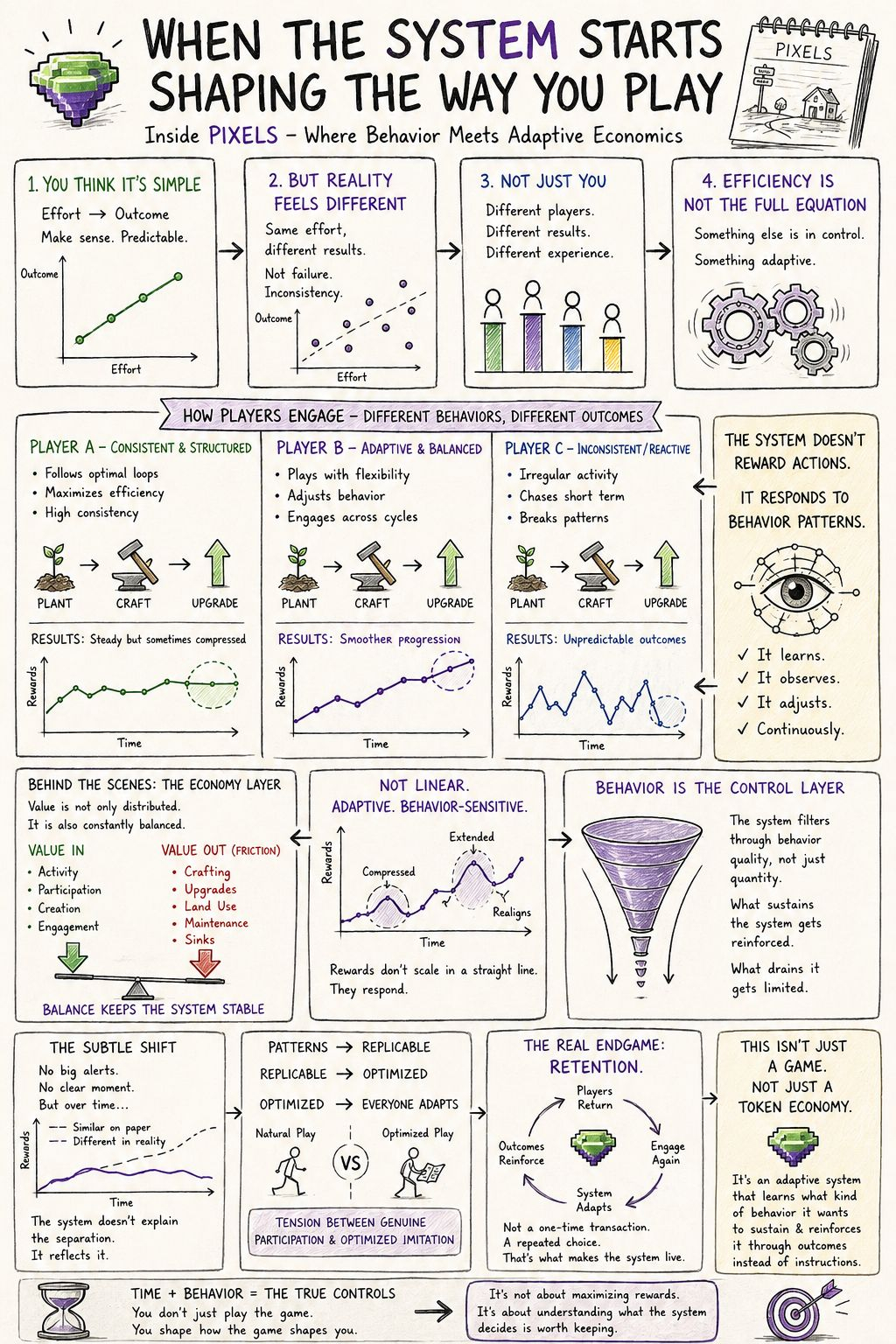
At the same time, there’s always underlying friction. Crafting, upgrades, land usage, participation — every layer quietly extracts value. You might not notice it immediately, but over time, you feel yourself becoming more deliberate, more cautious. The system isn’t just giving — it’s constantly rebalancing.
As the PIXEL economy evolves through different activity cycles and supply shifts, it naturally becomes more sensitive to how players behave. A purely linear system would be easy to exploit or drain. So instead, behavior itself becomes part of the control mechanism. Not just how much activity exists — but what type of activity sustains equilibrium.
What makes it fascinating is how subtle all of this is. There’s no clear signal telling you something has changed. No explicit rule update. But gradually, outcomes begin to diverge between players who appear identical on the surface. The system doesn’t explain the difference — it reflects it.
And yet, this structure isn’t static.
The moment patterns become visible, they become replicable. And once they’re replicable, players adapt. That creates a constant tension between authentic participation and optimized imitation — between playing naturally and playing correctly.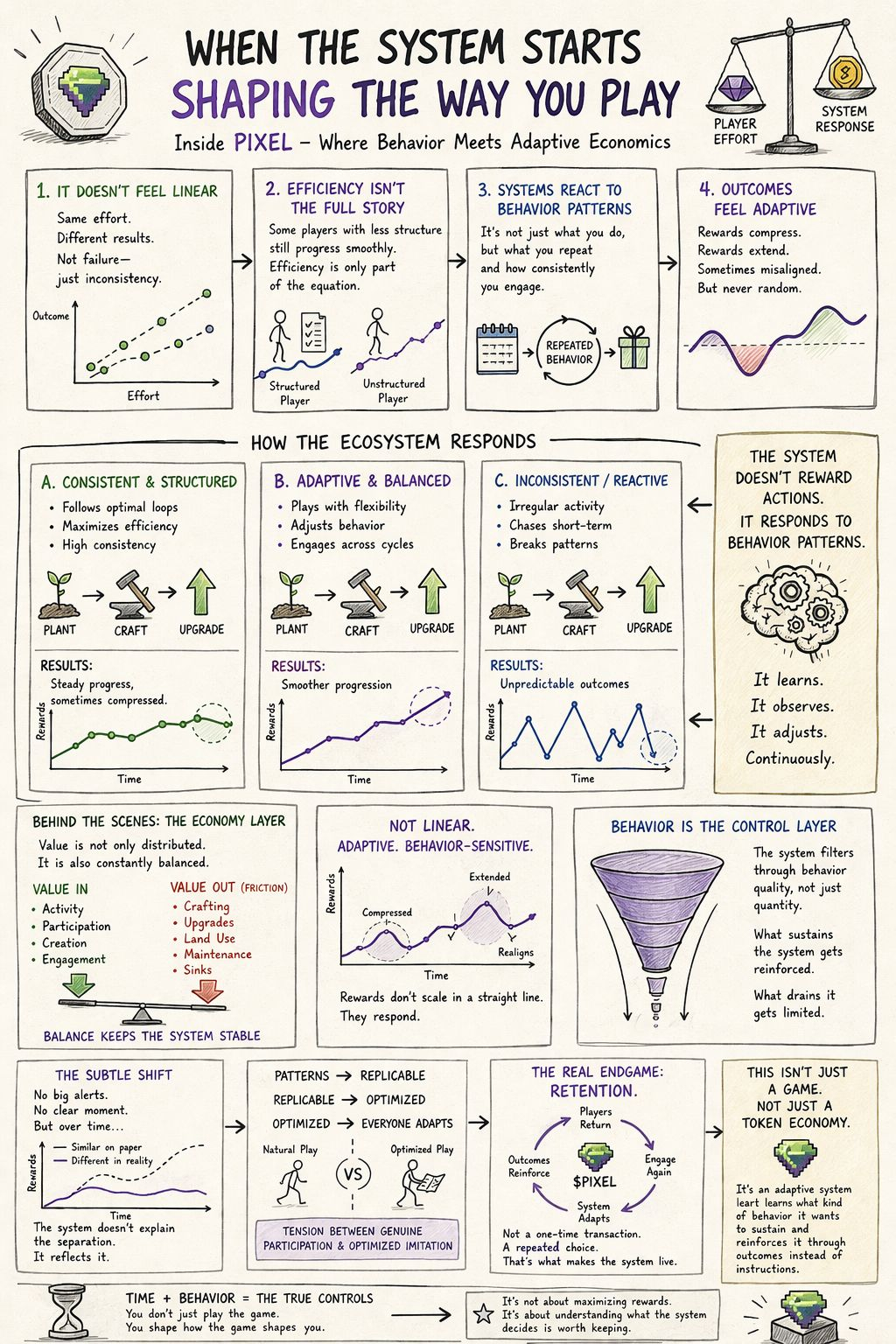
Eventually, the focus shifts.
It stops being purely about maximizing rewards.
It becomes about retention.
Because no matter how well-designed a system is, it only works if people keep coming back. Not once — but repeatedly. That’s where everything converges: not in a single outcome, but in ongoing engagement.
At that point, the loop no longer feels like a simple cycle. It feels like something more dynamic — something that observes behavior, adjusts quietly, and gradually reshapes how you interact with it.
I don’t really see Pixels as just a game anymore. Or even just a token economy. It feels closer to an adaptive system — one that identifies the kind of behavior it wants to sustain, and reinforces it through outcomes rather than instructions.
Whether this design can hold under real scale is still an open question. Systems evolve. Players evolve. And intention is rarely transparent.
For now, it feels like the design is still ahead of full clarity.
And maybe that uncertainty is intentional.
Because in the end, it’s not just about maximizing gains.
It’s about recognizing what the system chooses to preserve — and deciding whether you want to align with it.
