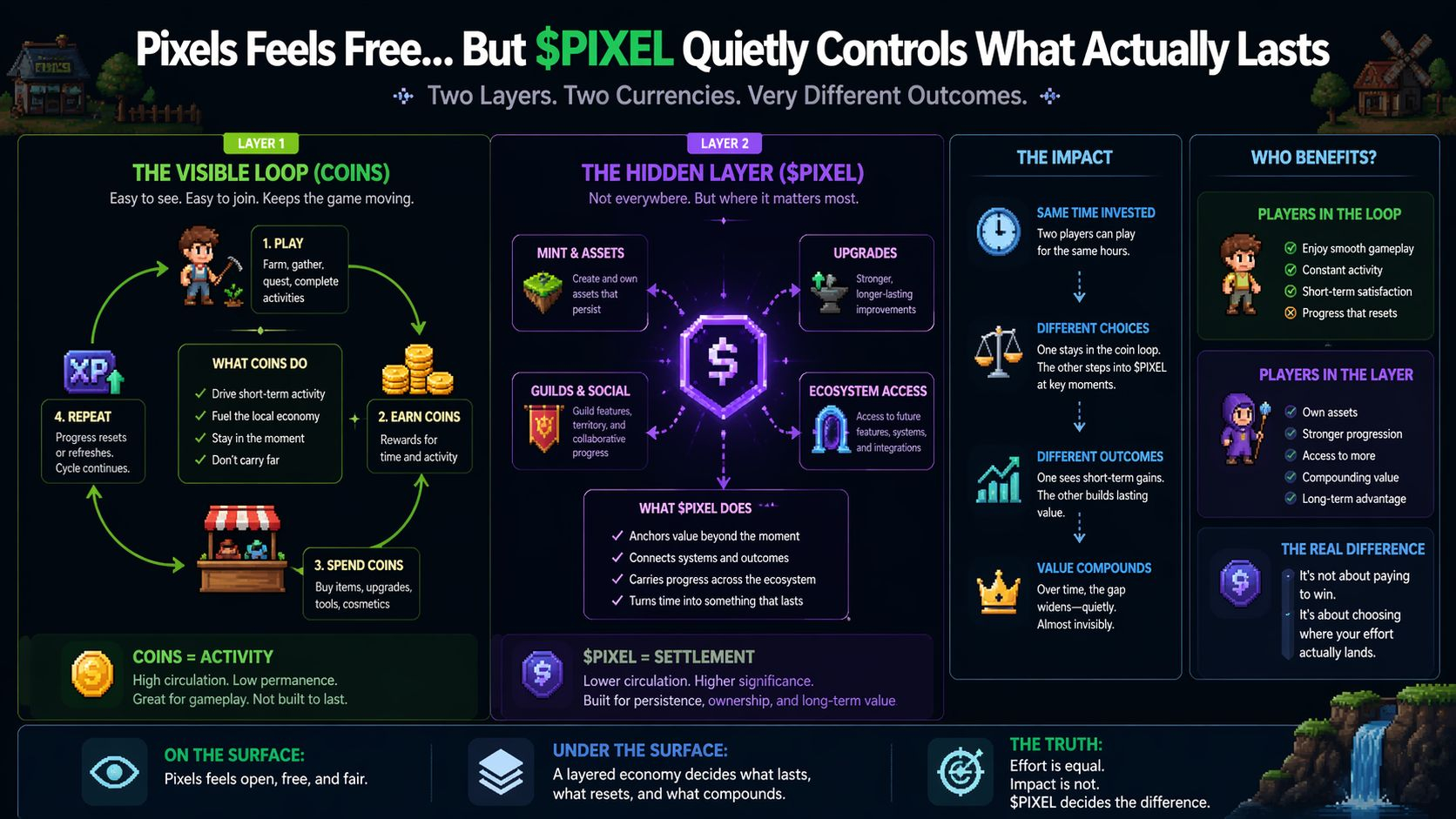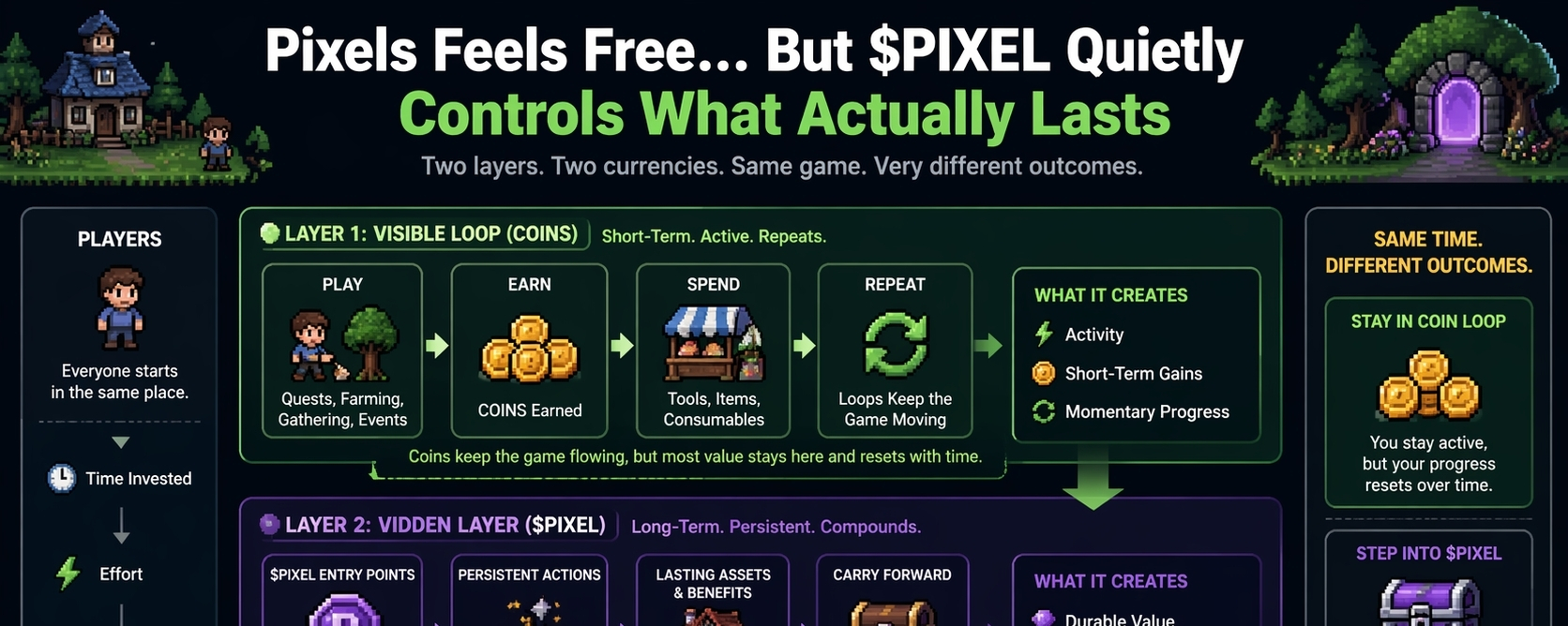

Free-to-play economies usually reveal themselves quickly. Early momentum feels generous, then friction appears, and eventually you’re nudged toward spending. It’s a familiar curve.Pixels doesn’t follow that path—at least not visibly. You can spend hours inside the game without ever touching PIXEL token. The loops feel complete. Coins circulate, progress feels real, and nothing forces a shift. It’s smooth, self-contained… almost deceptively so.
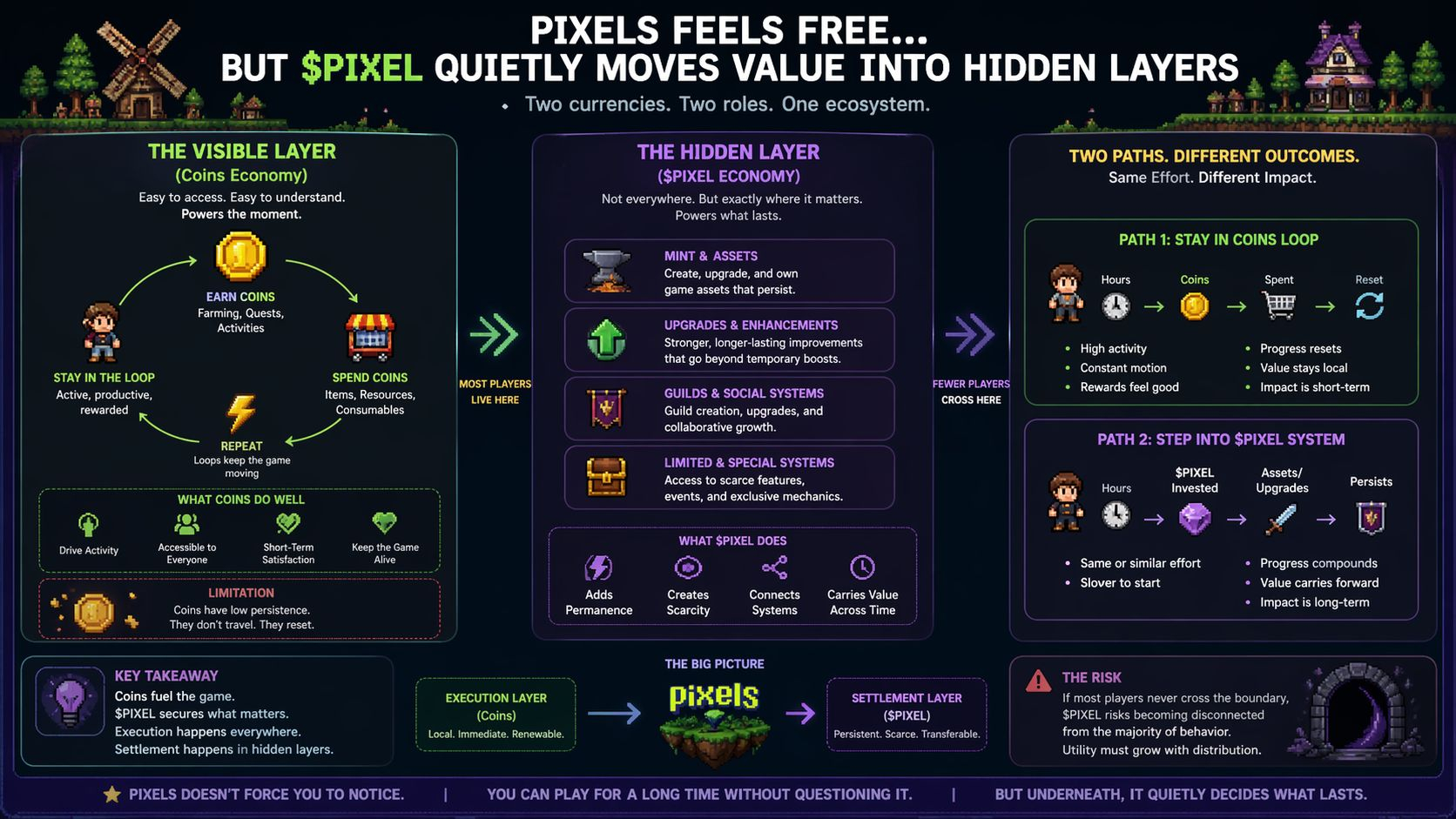
But sit with it longer, and a different pattern starts to emerge.Coins dominate the visible economy. They power activity, keep players engaged, and sustain momentum. But they don’t travel far. Their value resets quickly, tied to the present moment. Meanwhile, operates elsewhere—quietly embedded in minting, upgrades, and systems where outcomes persist.That contrast changes everything.This isn’t about speed. It’s about permanence. Where Coins keep you moving, $PIXEL decides what stays. Two players can invest identical time, yet end up in completely different positions—one cycling through activity, the other anchoring progress into something that compounds.
Theshift is subtle. Almost invisible at first.It echoes a deeper structure seen in some blockchain systems—where execution is constant, but settlement is selective. Pixels reflects that idea in a softer form. Most gameplay is execution. $PIXEL is where things settle.And that creates a quiet divide.If players don’t recognize this layer, many may never cross into it meaningfully. The experience remains enjoyable, but disconnected from the parts of the system where lasting value accumulates. Over time, that gap matters—especially as token supply continues to expand independently of player awareness.
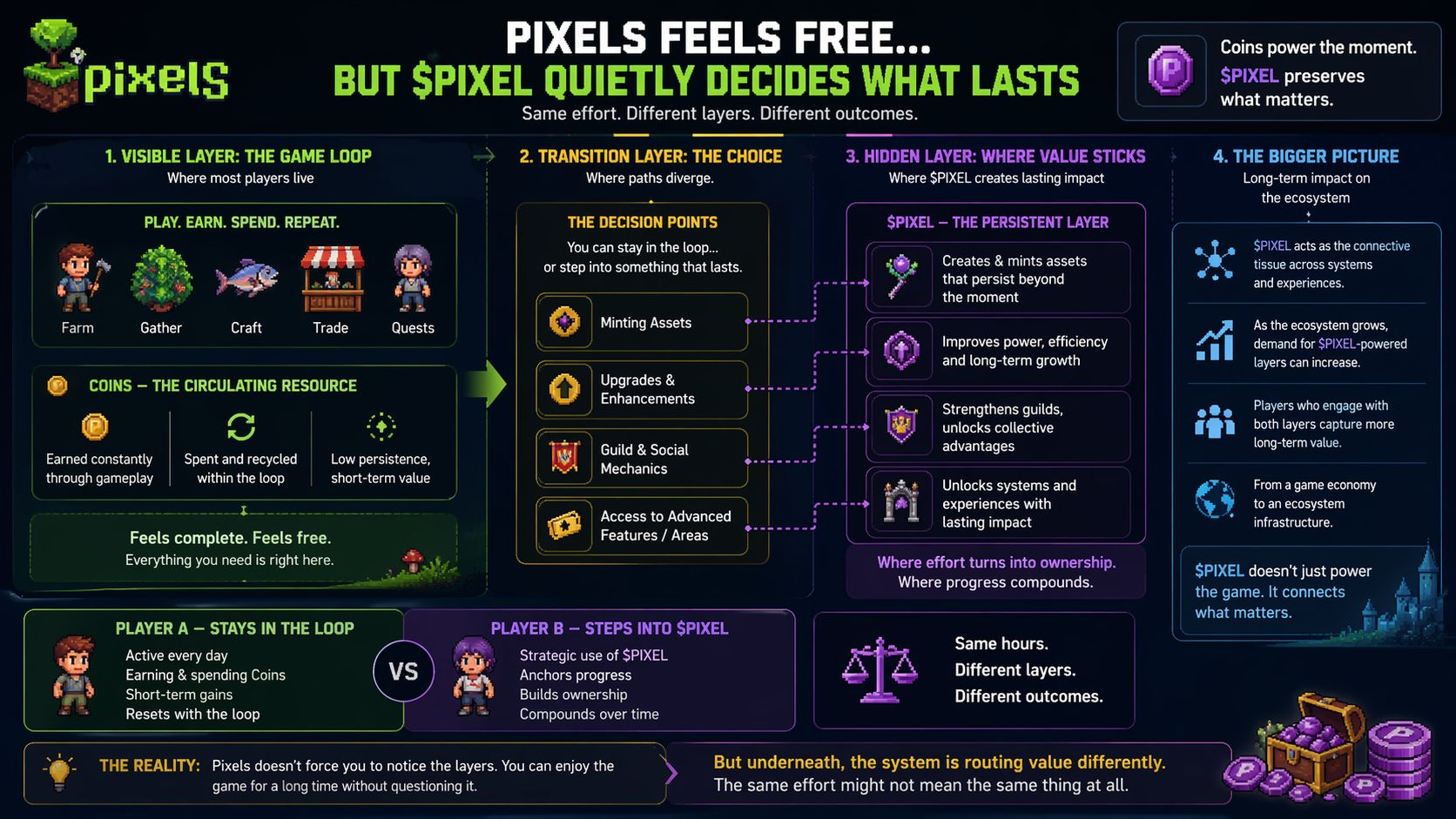
Still, there’s something undeniably compelling here.If Pixels evolves beyond a single loop, this design could scale into something bigger. Coins remain local fuel. $PIXEL becomes connective tissue—linking systems, preserving outcomes, and carrying value across time and features.That’s where it stops feeling like a simple game economy and starts resembling infrastructure.But there’s tension in that design too.
Becauseifmost players operate in the visible layer while value concentrates underneath, the system isn’t purely open—it’s selectively meaningful. Not through force, but through structure.Pixels never interrupts you to explain this.It lets you play.It lets you feel progress.And all the while, it quietly decides which parts of that progress actually matter in the long run.