
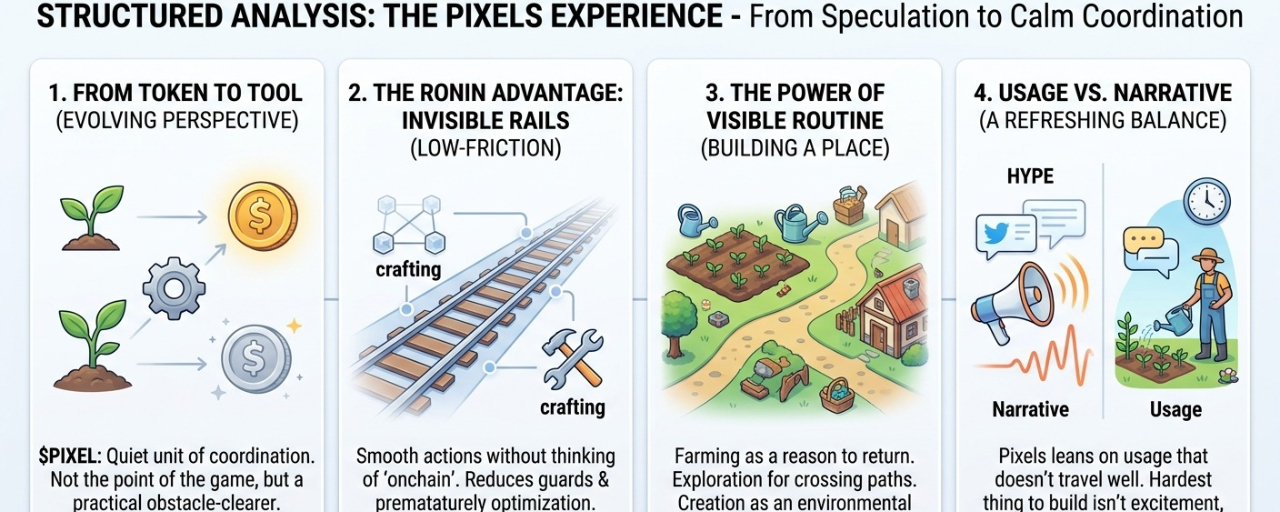
My first impression of Pixels was uncomplicated. It looked like a nice little farming game with the usual Web3 add-ons: a token, $PIXEL
and the Ronin Network badge that tells you where the rails are. I saw the open-world map and assumed it was mostly there to create the feeling of scale, not necessarily to change how you play.
1. From Token to Tool: An Evolving Perspective
I didn’t dislike it; I just didn’t expect it to matter to me. I’ve become wary of games that arrive already entangled with a token, because the token tends to become the conversation. I was paying attention to the economy, to what might be scarce, and to what might be “worth it.” It was a shallow way of looking, but also an easy one.
The perspective shift didn’t come from reading docs. It came from time. I kept logging in for short visits—five minutes, ten minutes. @Pixels didn’t punish that kind of attention; it seemed designed for it. I started to recognize the same spots where people gathered and the same names appearing around the same times.
2. The Power of Visible Routine
It wasn’t the “social” label that convinced me. It was the texture of how people behaved. The chat wasn’t dominated by talk of price. More often, someone asked where to find a resource, and someone answered quickly.
I watched players trade small amounts like they were clearing practical obstacles, not performing economic genius. Even the way people showed off their plots felt different. Less "look what I earned," and more "look what I made work."
3. The Ronin Advantage: Invisible Rails
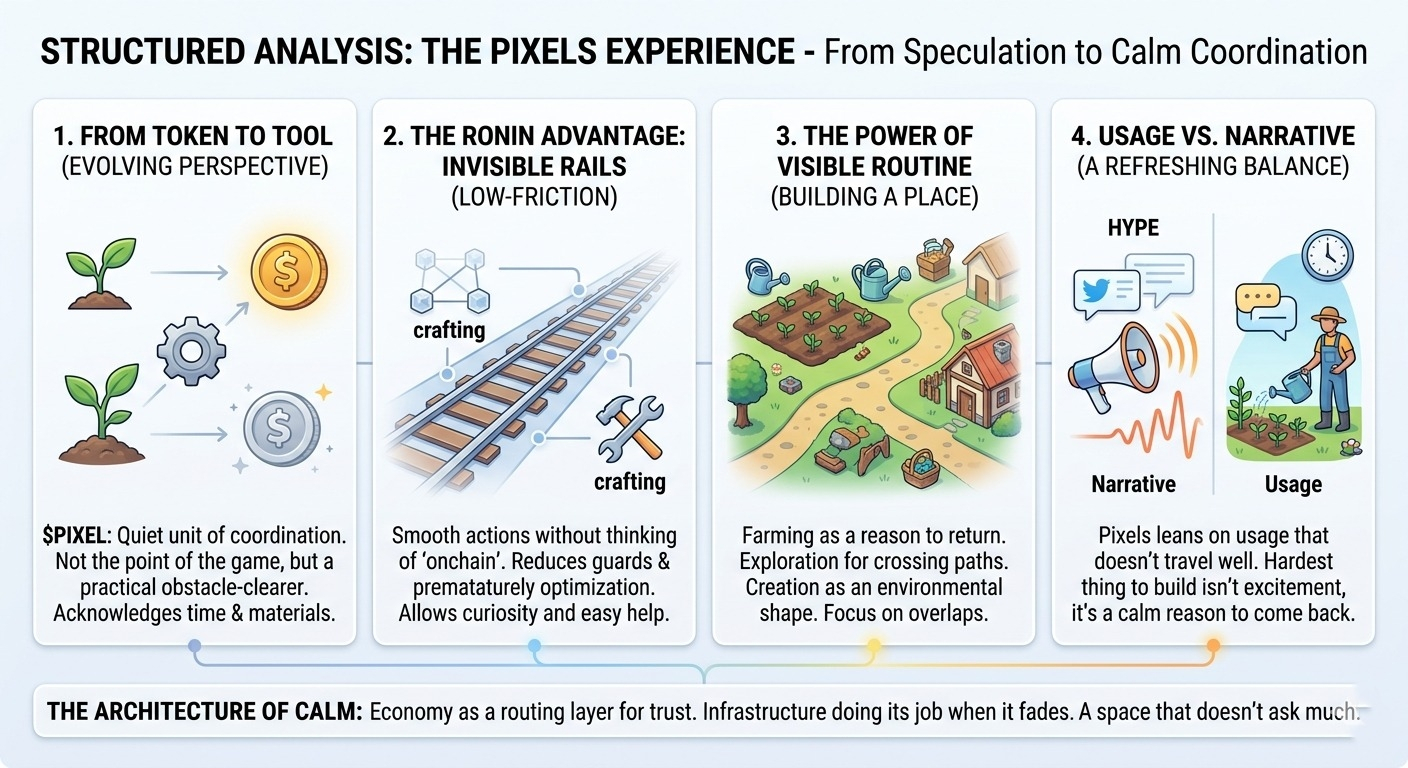
Somewhere in those repeated sessions, I noticed that $PIXEL had become quiet in my mind. It felt more like a unit of coordination than the point of the game. When $PIXEL moved between players, it resembled a simple acknowledgment that time and materials are real.
Ronin played a similar role by staying mostly invisible. The actions in Pixels happen with so little friction that I stopped thinking of them as “onchain actions.” I just thought of them as actions. Friction changes what you’re willing to do; because the rails are smooth in Pixels, I found myself being less careful and more curious.
4. Usage vs. Narrative: A Refreshing Balance
Beneath the farming and exploration, Pixels is about building a place where routine is visible.
Farming gives you a reason to return.
Exploration gives you a reason to cross paths.
Creation makes your presence stick in the environment.
The infrastructure is doing its job when it fades, and the token is doing its job when it doesn’t hijack the experience. I’m not sure where this balance goes long-term, but I keep returning to the same thought: Maybe the hardest thing to build in Web3 isn’t excitement—it’s a calm reason to come back.
What do you guys think? Is $P$PIXEL gaming token or a coordination tool? Let me know in the comments! 👇
#pixel $PIXEL #RONIN #web3gaming #BinanceSquare #CryptoGaming @Pixels
