
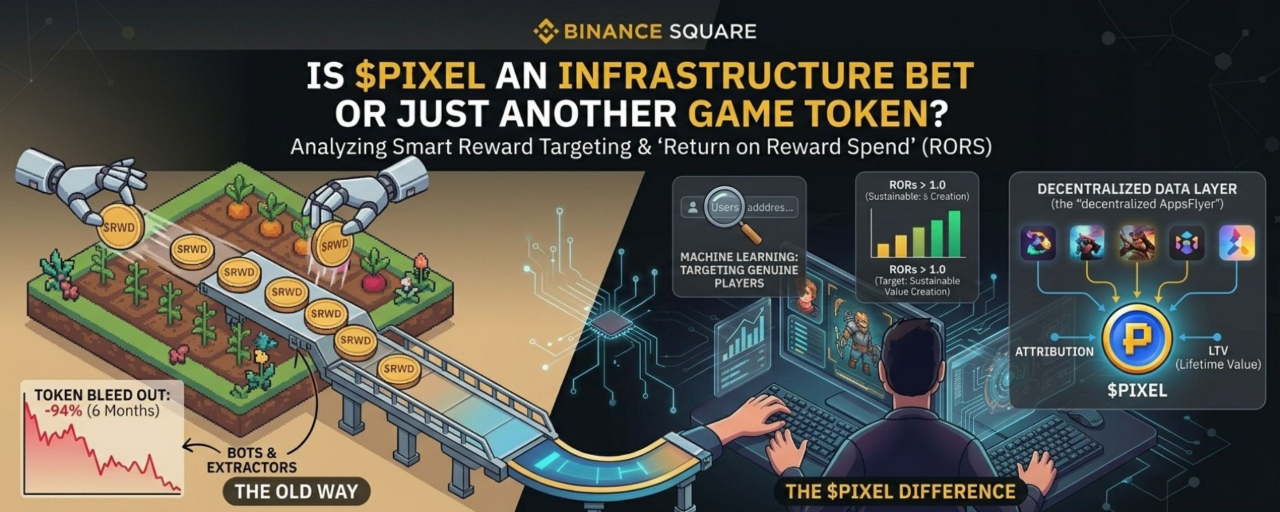
I've read enough whitepapers this year to know when a team is just copy-pasting the same playbook. Play game. Earn token. Watch the token bleed out over six months while the founders tweet about "ecosystem development." I got burned doing exactly this with a farming game in late 2023 — won't name it, but I spent three weeks optimizing my plots only to watch the reward token drop 94% in a month because literally nothing was stopping bots from printing it into oblivion. So when I cracked open the $PIXEL docs expecting the same recycled loop, the Smart Reward Targeting section stopped me cold.
Here's what that actually means, because most people skimming this won't dig into it: Pixels is using machine learning to separate genuine players from extractors — bots, mercenary wallets, the whole crowd that farms rewards with zero intention of reinvesting in the ecosystem. Instead of every click being worth the same, the system identifies which player actions actually generate long-term value and routes rewards toward those. Which is kind of wild when you sit with it, because every other game in this space is still handing out tokens like a guy at a carnival giving away stuffed animals just to look popular. Pixels is saying: no, we're targeting. We're being precise. And that precision, if it actually works, is the difference between a token with a job and a token that's just vibes.
But the piece that really made me put my phone down — the "decentralized AppsFlyer" framing. In Web2, companies like AppsFlyer are worth billions not because they make games or apps, but because they own the data layer underneath them. They know which acquisition channels produce users who actually spend versus users who ghost after day one. Pixels is trying to build that infrastructure for Web3, using something they call RORS — Return on Reward Spend — as the core metric. Prove to other developers, on-chain, exactly what a player is worth. And honestly? that's the whole game right there. If they can actually pull that off, this isn't a farming game anymore. It's infrastructure. It's the plumbing that every Web3 studio eventually has to run through.
Now. I'm not going in blind on this. The thing I'm watching closely — and the whitepaper is a little optimistic here — is the assumption that other game developers will trust Pixels' data layer enough to actually build on it. That's a massive leap. AppsFlyer took years to become the default because it was neutral, it wasn't also a competing product in the same market. Pixels is both the game and the platform, and at some point those two things might pull against each other. What happens when the data platform's incentives don't align with keeping the game fun? I don't know yet. Neither do they, I suspect.
The RORS > 1.0 target — where every token spent on rewards generates more than one token's worth of real ecosystem value back — is the right north star. Prioritizing high-quality DAU over raw user numbers might make the growth charts look ugly for a while, but it's the only path to a token that doesn't just evaporate the moment the market turns. We saw what the inflationary model produced in 2024. That wasn't a bear market problem. That was a design problem.
So here's what I actually want to know: if Pixels successfully becomes the data and growth layer for Web3 gaming, does that make $PIXEL a infrastructure bet more than a gaming bet — and are the people currently holding it even pricing that in?
@Pixels $PIXEL #pixel