There’s a quiet unease that comes with the idea of “national systems.” You log in, fill forms, wait for approvals, and somewhere behind the interface, a vast network of protocols, databases, and decisions hums along. You don’t see it. You barely think about it—until something goes wrong. A lost record, a delayed verification, a fraud alert—and suddenly, the invisible scaffolding that’s supposed to hold your country’s systems together feels fragile, almost transparent. Trust, in this sense, is not abstract. It’s a fragile muscle, exercised every day in small, often unnoticed ways.
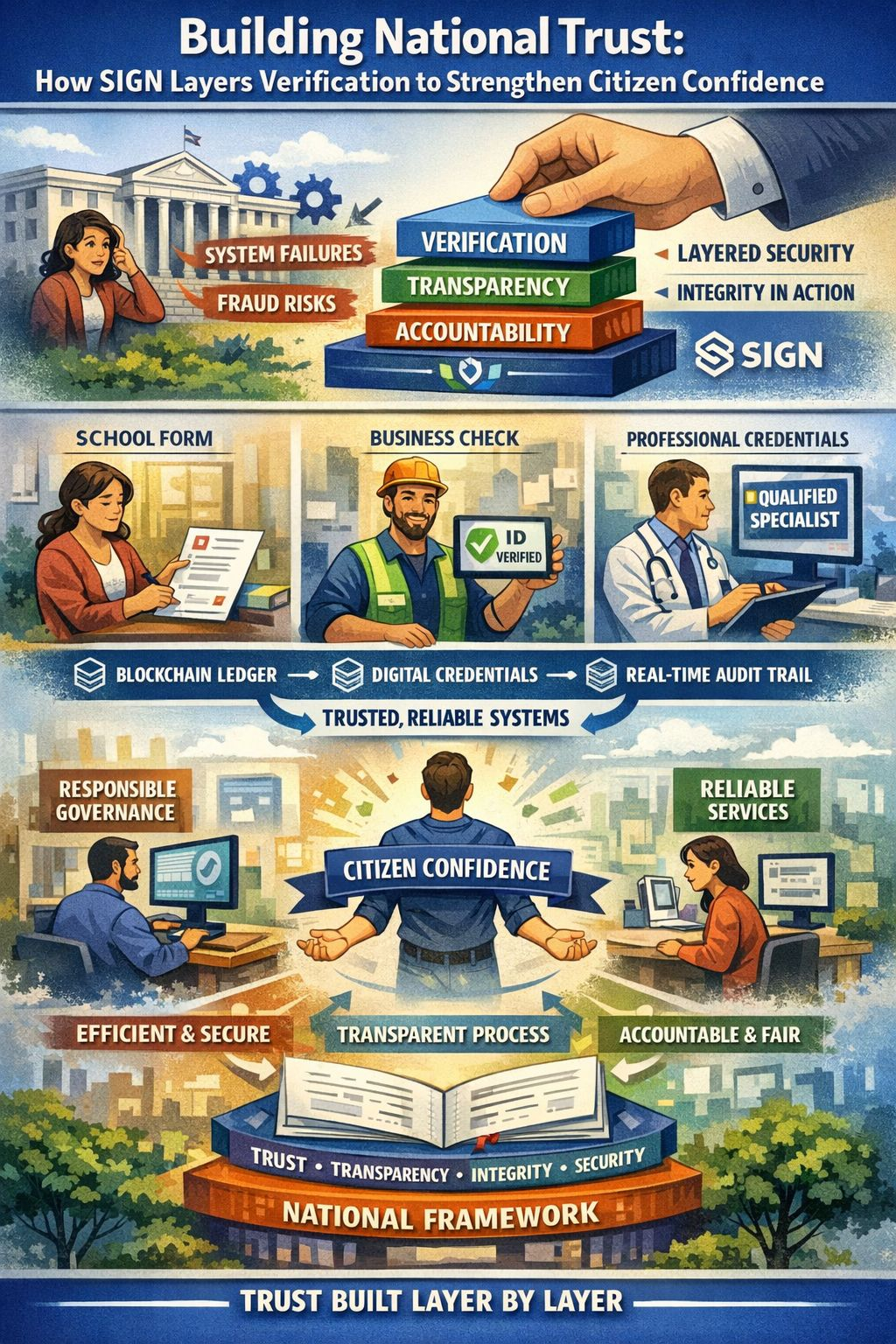
SIGN enters this conversation like a quiet architect, offering a way to build that muscle more resiliently. It’s not flashy. It doesn’t promise instant perfection. It layers trust. One layer for verification, one layer for transparency, another for accountability. Each layer doesn’t replace human oversight—it enhances it. Imagine a citizen trying to verify credentials for a public service. With SIGN, the friction disappears, but so does the lingering doubt. You know the system has a way to check itself. You sense that the integrity of the process isn’t just a claim; it’s embedded.
I think about the small moments in life when trust matters most. A parent signing a school form online. A business verifying a contractor’s credentials. A doctor confirming a specialist’s qualifications. In all of these, a tiny misstep can ripple outward. And the more digital our world becomes, the more these ripples have consequences beyond imagination. What SIGN does is subtle. It doesn’t scream security. It doesn’t plaster “verified” everywhere. It quietly stitches assurance into the background, where it matters.
There’s something almost human in how this works. Trust isn’t a monolith. It’s relational. You trust some systems because they are transparent, others because they are consistent, some because they are accountable. SIGN treats trust the same way. It doesn’t force belief—it earns it, step by step, record by record. And in doing so, it asks something of the people behind the systems too: to act responsibly, to maintain clarity, to respect the integrity of the process.
The elegance is in the simplicity. A blockchain-backed verification, a tokenized credential, a public ledger that anyone can reference. None of these are magic, but together they form something rare: a national framework that respects both the individual and the institution. When trust isn’t assumed but actively cultivated, the system itself becomes a reflection of the values it represents. Citizens begin to sense it—not in pop-ups or announcements, but in the quiet confidence of knowing that what should be verifiable, is verifiable.
I remember a conversation with someone who worked in public records. She talked about the tension between efficiency and integrity. The faster a system runs, the more tempting it is to cut corners. But corners, she said, are never free—they cost trust. SIGN doesn’t just make systems faster. It gives them the spine to move forward without sacrificing credibility. In that way, technology isn’t replacing human judgment—it’s supporting it, reinforcing it, giving it room to breathe in ways that paper, bureaucracy, or outdated digital methods never could.
And there’s beauty in that. Not the kind you capture in a photograph or quote in a report. The beauty of work done quietly, thoughtfully, and with care. The beauty of knowing that somewhere, in the background of a national system, the gears are turning in a way that respects both the citizen and the larger societal promise. The layers of trust SIGN provides are invisible, yet essential. They are the scaffolding beneath the visible structure, the subtle framework that keeps everything from collapsing under its own weight.
Building trust isn’t fast. It isn’t a headline. It doesn’t get tweeted. But it’s necessary, persistent, and real. And in an age when doubt spreads faster than certainty, creating systems that people can rely on—truly rely on—is more than a technical challenge. It’s a moral one. SIGN doesn’t just address the technical side; it confronts the human side too, acknowledging that trust is earned, nurtured, and maintained over time.
At the end of the day, national systems aren’t just databases or ledgers. They’re a mirror of society’s commitment to fairness, transparency, and care. And when that mirror reflects integrity at every level, the impact ripples quietly but powerfully through every interaction, every service, every citizen. That’s the promise of layered trust. That’s the promise SIGN is quietly making real, one verifiable step at a time.
#SignDigitalSovereignInfra @SignOfficial $SIGN