

I Almost Ignored Fogo — But Something About It Made Me Pause
I’ll be real for a moment. Every time a new Layer-1 project pops up, my first reaction isn’t excitement anymore. It’s exhaustion. The space moves fast, and every other week there’s a new chain promising to fix everything — faster speeds, better tech, a “revolutionary” future. After hearing the same pitch so many times, it all starts blending together.
That’s exactly how I felt when I first saw Fogo.
I noticed it, skimmed the description, and kept scrolling. Another chain. Another performance claim. Nothing that immediately grabbed me. But here’s the strange part — I kept coming back to it. Not because it was loud or flashy, but because it felt… grounded. And that stuck with me.
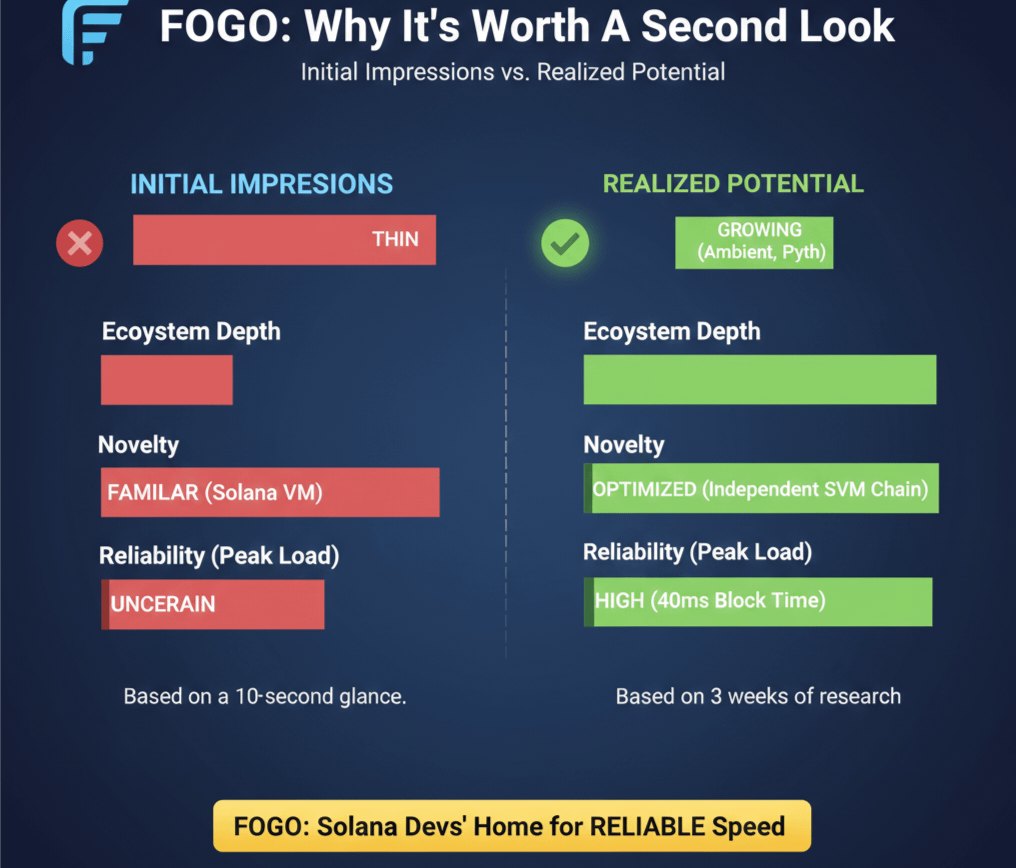
At first glance, Fogo doesn’t try to sell you a brand-new world. It feels familiar. If you’ve spent time around Solana’s ecosystem, the structure makes sense quickly. It doesn’t force you to relearn everything from scratch. Instead, it leans into what developers already know and tries to make that experience more stable.
And the more I thought about it, the more that approach started to make sense.
Most developers don’t want another complicated system to study for months. They want their current skills to work on infrastructure that doesn’t break when demand spikes. That’s not a glamorous promise, but it’s a practical one. And honestly, building something reliable is much harder than building something experimental that looks exciting on paper.
There’s also a reality many users quietly acknowledge: congestion happens. Anyone who has used high-traffic chains during peak moments has felt it. Transactions slow down, fees rise, and sometimes it feels like the network just stops listening. It’s not constant, but it’s real enough that people remember the experience.
Fogo seems built around that specific frustration.
It uses a similar technical foundation but runs independently, which means activity elsewhere doesn’t directly slow it down. In theory, that gives it the ability to stay consistent when demand gets intense. For traders and DeFi users who depend on timing, consistency matters just as much as speed.
Still, I try to stay realistic.
Speed alone doesn’t mean success. I’ve seen incredibly fast chains turn into empty spaces because they couldn’t attract liquidity. A network can be technically brilliant, but without people building and using it, it’s just potential sitting still.
And that’s where Fogo is right now — early. There are signs of life, early infrastructure forming, some serious ideas taking shape. But it’s not massive. Not yet. That’s not criticism; it’s just the stage it’s in. Every major ecosystem once looked small before it found its momentum.
So I keep asking myself a simple question: will the design and the early builders be enough to pull real activity over time?
I don’t have a confident answer. No one does.
But after spending more time observing instead of brushing it off, I can say this — Fogo feels more focused than most new Layer-1 projects I’ve seen. It’s not trying to be everything. It’s trying to be dependable. And that kind of clarity is rare.
I’m not calling it the next big thing. That would be unfair and premature.
I’m just saying it quietly earned my attention.
And in a space where I usually scroll past without a second thought, that alone means something.
