I remember the first time the idea of digital trust felt personal to me. It was watching a friend in a remote village struggle with a simple land claim endless paperwork, skeptical officials, months of waiting. That frustration sticks with you. Now imagine flipping that story: a farmer taps their phone, proves ownership instantly, and access to aid or credit follows without the usual gatekeepers. That quiet shift is what Sign the Sovereign Infrastructure for Global Nations feels like to me. Not some flashy tech demo, but a sturdy, living framework that lets real human claims and value move with dignity in a world where old systems keep cracking.
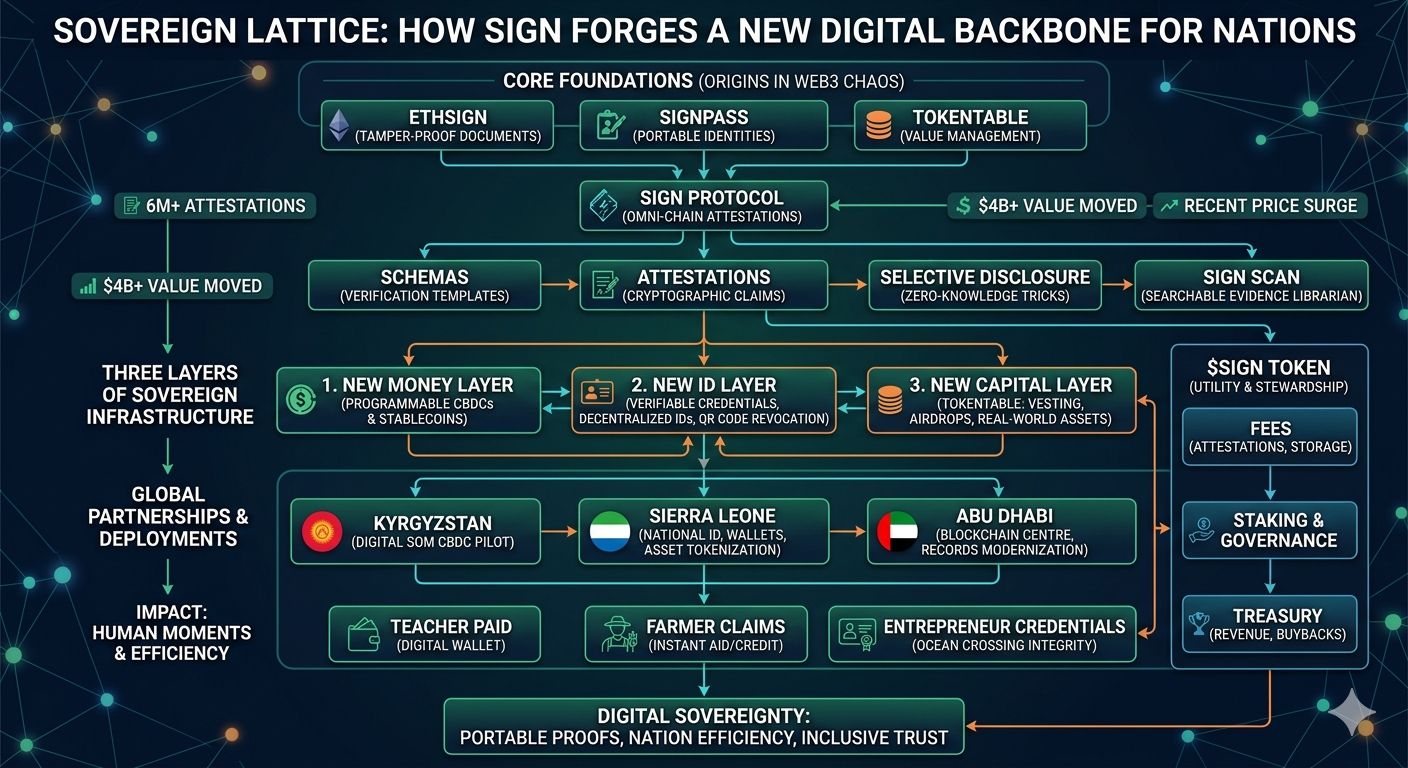
You pick up on it in the small, human moments. Picture a teacher in Sierra Leone finally getting paid through a digital wallet that actually works, or a family in Kyrgyzstan watching cross-border payments settle in seconds instead of weeks. Or an entrepreneur in Abu Dhabi issuing credentials that cross oceans without losing their integrity. Sign doesn’t come in with loud promises of revolution. It shows up like a reliable neighbor, making coordination feel possible again in places where trust has worn thin from too many broken systems.
At its core is the Sign Protocol, this omni-chain way of handling attestations that treats information like something alive rather than cold data points. It gives you schemas simple templates for what “verified,” “eligible,” or “qualified” really means then lets people create attestations that lock those claims down cryptographically. You can keep everything on-chain when openness matters, hide sensitive bits off-chain with zero-knowledge tricks when privacy is non-negotiable, or mix the two when life gets complicated. The magic is in the selective disclosure: you prove you’re old enough without handing over your full birthdate, or confirm your citizenship without spilling your entire life story. Governments get reliable audit trails they can actually trust, while regular people keep control over their own narrative. And SignScan? It pulls all those scattered proofs together so they feel searchable and usable, almost like having a helpful librarian who never sleeps.
This isn’t theory floating in the ether. By the close of 2024, the protocol had already handled over six million attestations, with plans to push well beyond that. Its partner piece, TokenTable, has quietly moved more than four billion dollars in tokenized value to over forty million wallets across everything from EVM chains to Solana, TON, and Starknet. Those figures aren’t just stats they tell stories of vesting schedules that actually honor their promises, airdrops that land with real people instead of bots, and grants that arrive exactly where they were intended. The old headaches of lawyers, messy spreadsheets, and last-minute scrambles fade away. Instead, everything reconciles deterministically, and the evidence loops right back into the protocol, creating a kind of quiet accountability that feels refreshing.
Sign started in the gritty, everyday chaos of Web3 tools like EthSign for signing documents that couldn’t be tampered with, SignPass for identities you could actually carry around, and TokenTable for wrestling tokens into the right hands without drama. But watching it mature into full sovereign infrastructure feels like something organic ripening. It layers three systems that echo how real societies tick: a new money layer for programmable CBDCs and stablecoins that respect policy needs, settle instantly, and blend public and private rails without forcing isolation; a new ID layer built on verifiable credentials and decentralized identifiers, where you can reveal just enough and revoke access cleanly, even offline via a simple QR code; and a new capital layer that turns grants, benefits, and real-world assets into something programmable yet fully accountable. TokenTable ties eligibility to those verified claims, times unlocks precisely, blocks duplicates through identity links, and spits out audit trails that read more like shared truth than bureaucratic theater.
What I love is how modular it stays. A country can run things publicly for transparency, privately for sensitive work, or in a hybrid that feels right for its context. The partnerships carry that grounded feel: working with Kyrgyzstan’s National Bank on piloting the Digital SOM CBDC, with decisions targeted for later in 2026; the memorandum with Sierra Leone’s Ministry of Communication, Technology and Innovation to build national digital identity, wallets, and asset tokenization that actually serve citizens; and the collaboration in Abu Dhabi with the Blockchain Centre to modernize records and stablecoin infrastructure. These aren’t press-release fireworks. They’re careful steps toward infrastructure that honors sovereignty while opening doors to real liquidity and inclusion.
There’s an emotional thread running through all this that’s easy to overlook when you’re staring at charts. For folks long shut out by mountains of paperwork, bad roads, or indifferent institutions, Sign whispers the possibility of belonging without having to surrender who you are. For public servants juggling fragile trust and limited resources, it offers proof that can survive political shifts or sudden disruptions. For the wider blockchain world, it marks a maturing not another gamble on hype, but a patient tool for getting things done at the scale of actual human communities. The numbers back that quiet confidence: around fifteen million dollars in revenue in 2024 from genuine usage, enough to buy Bitcoin for the treasury, reward the community, and even plan future buybacks. That kind of self-sustaining loop feels rare and honest.
Then there’s the SING token itself. It doesn’t scream for attention like some speculative frenzy. Capped at ten billion, with its launch in late April 2025 and only about twelve percent circulating at the start, it leans into community growth and real utility powering fees for attestations, verification, storage, staking, and governance decisions. Holders get a genuine say in how fees work, where treasury funds go, and how the protocol evolves. As more nations come on board, those revenue-sharing possibilities could create virtuous cycles where verified flows strengthen the very infrastructure enabling them. It feels less like extraction and more like stewardship: the token earns its place by making everything around it more reliable, more private when it needs to be, and more transparent when it must. The recent surge over a hundred percent in early March 2026 amid growing recognition of its sovereign role came with real volume and attention, even as the broader market wavered. It’s the kind of movement that feels earned rather than manufactured.
Sure, real challenges sit there. Navigating different regulations country by country isn’t simple. Scaling privacy protections when entire nations are involved takes serious thought. And there’s always competition in the identity and verification space. But the open standards, the flexible hybrid design, and the steady focus on evidence instead of control give it staying power. The fresh $25.5 million strategic round led by YZi Labs (with IDG Capital joining), building on earlier support, shows serious belief in bridging everyday tools to national-grade systems.
When I look further out, Sign nudges me toward a gentler vision of digital sovereignty. Not some fierce tug-of-war between decentralization and the state, but a thoughtful partnership: nations get efficient, tamper-resistant ways to serve their people; individuals carry portable proofs that respect their privacy; builders find solid building blocks ready for everything from AI agents to tokenized real assets or claims tied to climate realities. Picture welfare reaching the right hands in moments, not months. Remittances crossing borders with the calm finality of instant settlement. National treasuries earning yield from tokenized resources while keeping policy levers firmly in grasp. All of it grounded in attestations that feel less like rigid code and more like a collective memory something resilient, verifiable, and scaled to human life.
There’s a subtle poetry here that moves me. In times flooded with synthetic noise and tired institutions, Sign gently points back to something basic: the relief of being able to say “this is true” and have the world nod in agreement not because someone powerful said so, but because the evidence simply holds. It won’t magically heal every crack in our modern world. But it lays down tracks capable of carrying real economic, social, and civic weight without buckling.
The infrastructure isn’t some distant dream anymore. Millions of attestations already issued. Billions in value distributed with a clarity that still feels novel. Partnerships putting down roots in places that genuinely matter Sierra Leone’s push for inclusive digital services, Kyrgyzstan’s CBDC explorations, Abu Dhabi’s forward-looking blockchain initiatives. What comes next is the slower, more meaningful part: nations and communities choosing, together, how courageously to build on it. Not as outsiders looking in, but as co-creators of something that treats trust as earned, verified, and ultimately shared.
In the end, Sign lands less like another product on a crowded shelf and more like a heartfelt invitation. To step away from blind assumptions and toward solid evidence. From taking what we can get to building with alignment. From leaning on fragile institutional faith to standing on something sturdier: a lattice that lets human hopes and intentions travel farther, safer, and with more dignity than we’ve managed before. The roots have taken hold. Now it’s up to all of us governments, builders, everyday people to tend the garden and see what grows