
In 2026, storage is no longer just about "where" data sits, but the total cost of keeping it available. For enterprises managing massive AI datasets or high-resolution media, the traditional cloud model (AWS S3) has become a "Hotel California" of data: easy to check in, but incredibly expensive to leave.
Walrus, powered by the Red Stuff encoding, offers a structural alternative that targets the hidden costs of the Web2 cloud.
1. Cost Comparison: The "Hidden Toll"
While AWS S3 Standard appears affordable at roughly $23/TB per month, the sticker price is misleading for active datasets. Walrus simplifies this with a more transparent, upfront model
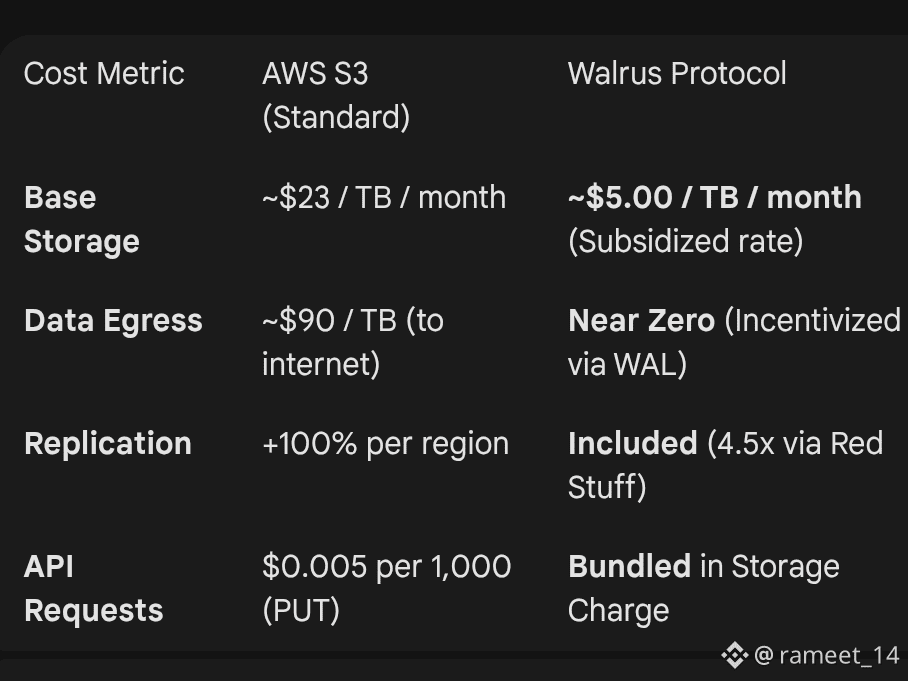
The "Egress Trap": On AWS, moving 100TB of data out of your bucket can cost more than the storage itself ($9,000+). Walrus eliminates this bottleneck, making it a "Data Liquidity" layer rather than a data silo.
2. Redundancy: Multi-AZ vs. Red StuffAWS S3 Approach: To get 99.999999999% durability, AWS stores three full copies of your data across different physical locations. You pay for the overhead of three complete files.Walrus Approach: Red Stuff uses 2D erasure coding. Instead of full copies, it stores "slivers." Because you only need a fraction of these slivers to reconstruct the file, Walrus achieves higher resiliency than a standard AWS region but with significantly lower storage overhead.
3. The Economic "Self-Healing" Advantage
One of the largest operational costs in storage is maintenance.
AWS: Thousands of engineers and proprietary software manage hardware failures behind the scenes—costs that are passed to you in your monthly bill.
Walrus: The WAL tokenomics automate this. When a node fails, the network uses the Secondary Slivers in the Red Stuff matrix to repair the data automatically. The cost of this repair is O(Sliver Size) rather than O(Full File Size). This efficiency is why Walrus can offer lower prices while remaining profitable for node operators.
4. Integration: The S3 Compatibility Bridge
The biggest hurdle to switching from AWS has traditionally been the code. However, in 2026, Walrus-native tools like Nami Cloud and SuiS3 provide a bridge.
Plug-and-Play: Developers can use existing AWS S3 SDKs but point their endpoint to a Walrus gateway.
Programmability: Unlike static S3 buckets, Walrus storage is tokenized on the Sui blockchain. This allows you to trade, sell, or programmatically grant access to data via smart contracts—something impossible in the AWS ecosystem.
Strategic Recommendation
Use AWS S3 if: You require deep integration with specific AWS services (Lambda, Athena) and have a very low data-egress requirement.
Switch to Walrus if: You are managing AI model weights, media archives, or Web3 dApp assets where you need high availability, global distribution, and predictable costs without the "Egress Tax."

