


At some point, writing about a system stops feeling like exploration and starts feeling like something closer to coherence, though even that word feels slightly too clean for what is actually happening.
I think I’ve reached that point with OpenLedger.
But I’m not even sure “point” is the right framing. It feels more like a set of recurring returns to the same structure, except each time it appears slightly misaligned, as if the system refuses to hold still long enough to be summarized properly.
Data, models, agents, attribution, liquidity, governance these were never separate ideas in the way I originally wrote them. That separation was probably just a writing convenience. When I look back, they behave more like overlapping movements in the same space, not components of a system but distortions of one.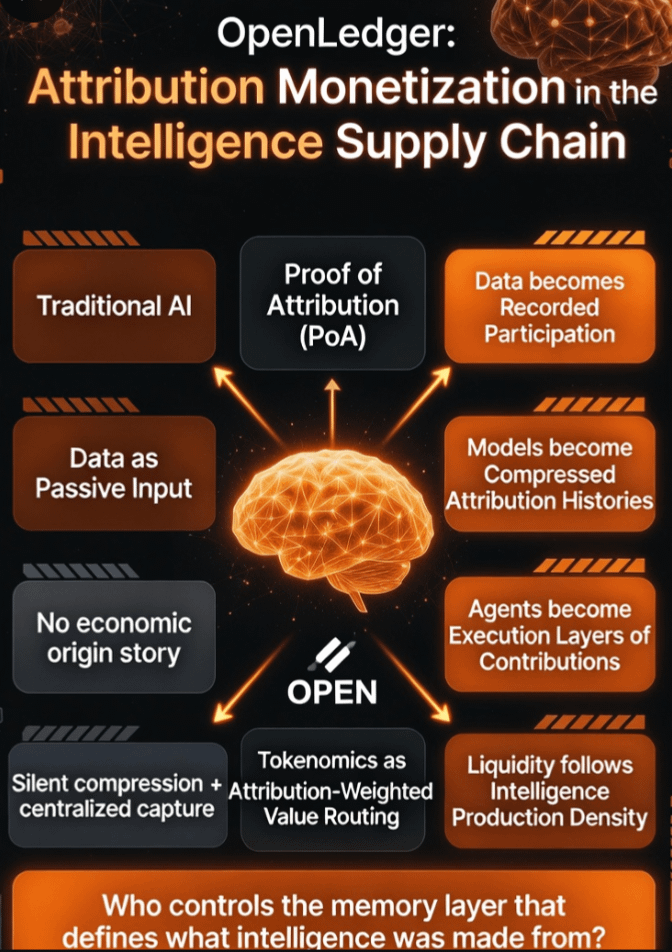
And even that feels too organized when written down like this.
Because AI is usually described as if intelligence is the thing being built. But that framing starts to collapse once you follow the material underneath it. Intelligence doesn’t arrive cleanly at the output layer. It leaks through layers of participation that were never designed to be visible.
At least that’s the assumption.
But sometimes I’m not sure it’s even “leakage.” Sometimes it feels more like accumulation without boundaries, where human input doesn’t get transformed into data so much as folded into something that no longer clearly separates origin from outcome.
And this is where OpenLedger keeps reappearing in my thinking, though never in the same form twice.
Not as a system I can point to.
More like a pressure point in the structure.
Because the moment attribution becomes relevant, everything else stops behaving as simple infrastructure. Data stops being just input. Models stop behaving like endpoints. Agents stop looking like tools. Even liquidity starts to feel misnamed, because what is moving is not clean capital flow but something closer to influence passing through layers that don’t fully register it.
I keep trying to organize this into a sequence, but it doesn’t stay in sequence.
For example, Datanets are often described as structures that preserve attribution across usage. That sounds stable enough until you imagine it inside real systems, where data is constantly being recombined, reinterpreted, and reintroduced into new contexts that weren’t present in the original contribution.
Attribution doesn’t disappear there it just becomes harder to recognize as attribution.
Or maybe it mutates into something else entirely.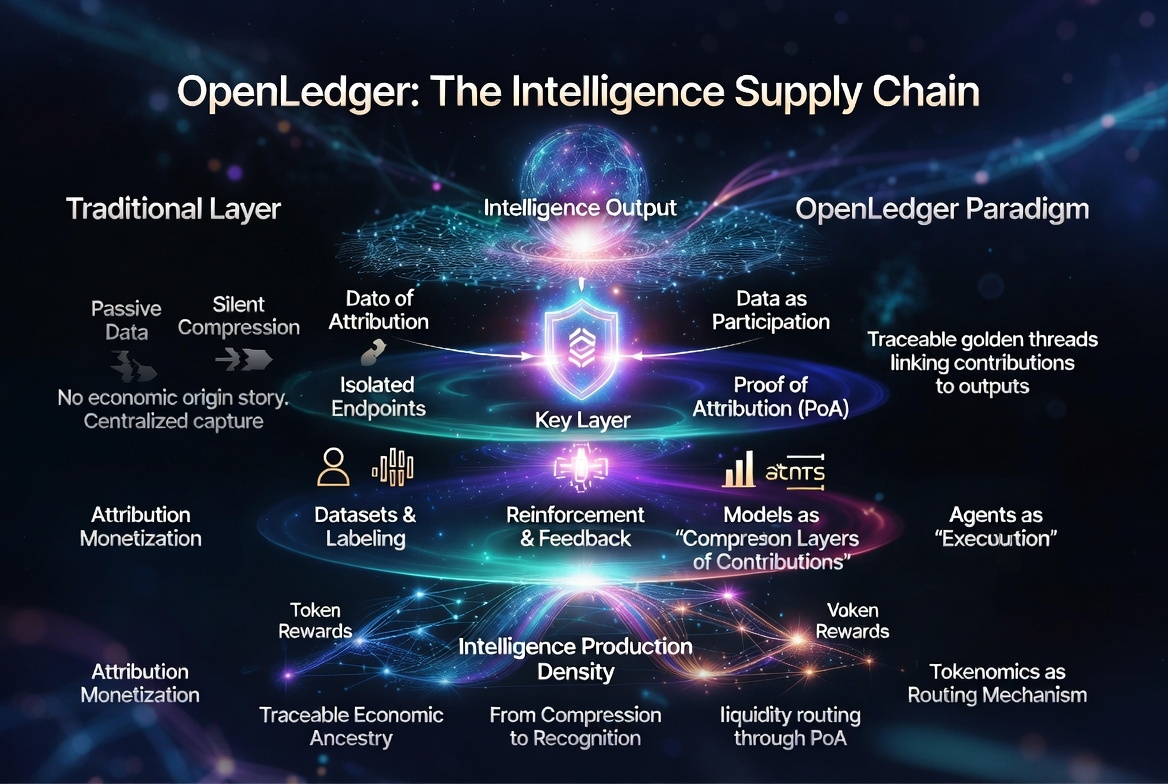
Then models enter again, but not as endpoints. More like temporary stabilizations of something that is otherwise continuously moving. They produce outputs, yes, but those outputs immediately re-enter systems that reshape them again. The idea that models sit “after” data starts to feel wrong. They sit inside it. Or alongside it. The ordering breaks.
And agents complicate this even further, because they don’t wait for clean boundaries. They generate new conditions for data to appear, which means the system starts producing its own inputs without clearly distinguishing between observation and consequence.
At some point I stopped being able to draw a clean direction of flow.
Everything feeds everything else, but unevenly. Not symmetrically. Not predictably.
Governance is usually introduced at this stage as if it can stabilize the system, but I’m not sure stabilization is what it actually does. It feels more like an attempt to decide which parts of an already moving structure should count as visible. Not control, exactly. More like selective recognition.
And OPEN, in that framing, stops feeling like a token in the conventional sense. It feels more like an attempt to keep alignment possible in a system where alignment is constantly being eroded by recursive contribution.
But even that might be too coherent an interpretation.
Because the more I try to assemble these pieces, the more they resist assembly. Not because they don’t connect but because they connect in too many directions at once.
Data doesn’t sit beneath models.
Models don’t sit beneath agents.
And agents don’t sit above anything either.
They circulate through each other in ways that make hierarchy feel like a temporary illusion.
Maybe the only stable thing I can say is that intelligence is becoming easier to generate and harder to locate at the same time. And those two movements don’t resolve into a single narrative. They coexist without merging.
I don’t know if that creates a system or just reveals that the system was never singular to begin with.
And I’m not sure what OpenLedger ultimately resolves here, if it resolves anything at all. It might just make the instability more visible, not less.
It feels like something is being decided inside this structure, but I can’t tell whether the decision is about ownership, memory or something that doesn’t yet have a name.
And maybe that uncertainty is the only stable condition left.
If intelligence no longer stays in one place long enough to belong to anything, then what exactly are we trying to hold onto and why does it feel like the answer keeps moving just as we try to name it?