
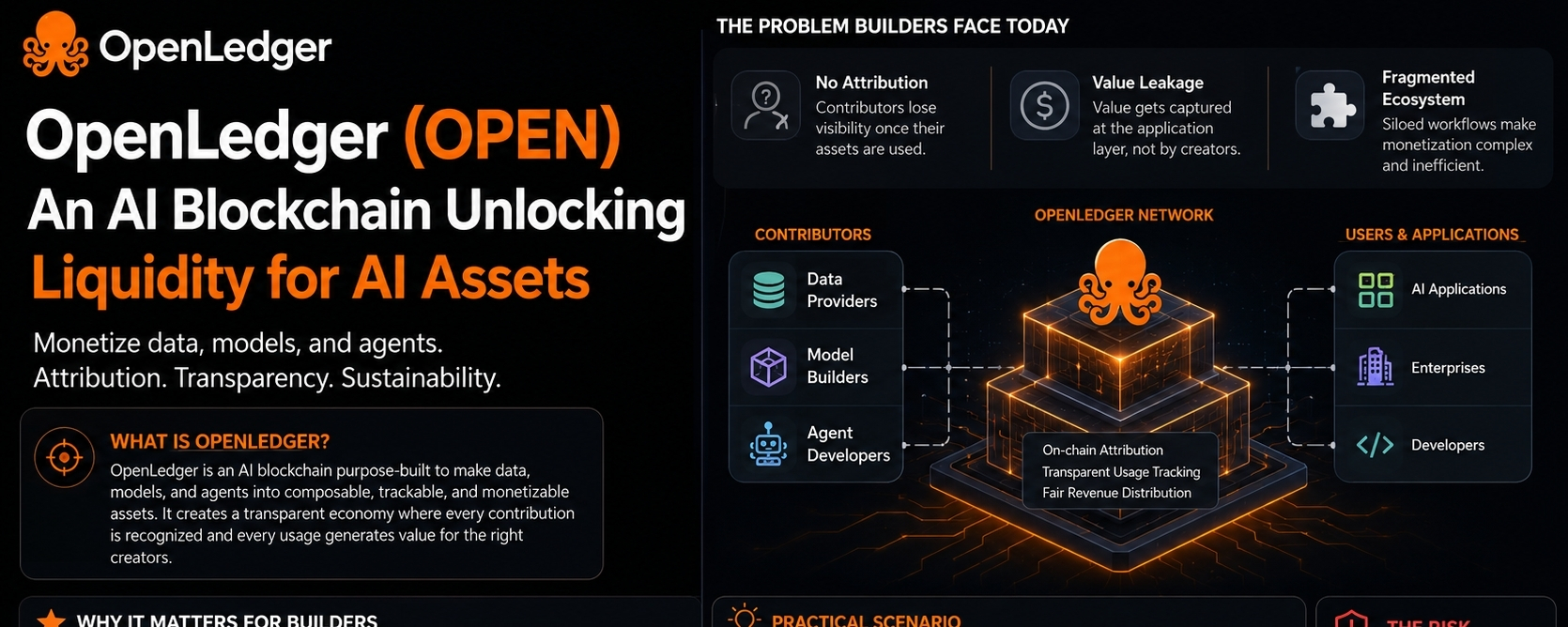
AI builders have a problem that rarely gets enough attention.
Most AI products depend on data, models, and increasingly on specialized agents. Yet the people who create these resources often struggle to capture value from them. A developer may spend months collecting domain-specific data, fine-tuning a model, or building an agent workflow, only to discover that monetization is still fragmented and difficult.
This is the builder-side tension that stands out to me when looking at OpenLedger.
Many people see OpenLedger only as another AI-focused blockchain. That interpretation misses the more interesting question: how do builders get paid for the resources that make AI systems useful in the first place?
The real challenge is not creating another model.
The challenge is creating a system where data contributors, model builders, and agent developers can participate in the same value flow without relying on isolated agreements, centralized platforms, or custom integrations every time they want to distribute their work.
Today, the workflow is often inefficient.
A builder creates a dataset and tries to find buyers.
A model developer trains on data from multiple sources and has difficulty tracking who contributed what.
An agent creator builds automation on top of existing models but has limited ways to share revenue with upstream contributors.
Each layer creates value, but attribution and monetization become disconnected. As AI stacks become more complex, that coordination problem gets worse.
This is where OpenLedger's mechanism becomes interesting.
Instead of treating AI assets as isolated components, OpenLedger attempts to make data, models, and agents part of a shared economic framework. The idea is that contributors can register, track, and monetize these assets through blockchain-based infrastructure designed specifically for AI activity.
The important point is not the blockchain itself.
The important point is creating an ownership and attribution layer that sits underneath AI development.
If that layer works as intended, builders spend less time negotiating custom arrangements and more time building resources that can be discovered, integrated, and compensated through a common system.
That reduces a specific form of friction.
Builders no longer need to think only about creating finished AI applications.
They can focus on creating valuable components.
A niche dataset, a specialized model, or a highly effective agent can become a standalone asset rather than a hidden piece of infrastructure buried inside a larger product.
This matters because AI development is becoming increasingly modular.
Very few teams build everything from scratch anymore.
Most products combine external data, third-party models, agent frameworks, and proprietary logic. As that trend continues, attribution becomes a larger issue than many builders realize.
The adoption pressure point is straightforward.
Builders must actually choose to register and distribute their assets through the network.
Technology alone does not solve attribution problems.
The network becomes useful only when enough data providers, model creators, and agent developers participate in the same system. Without meaningful participation, builders still face the same discovery and monetization challenges that exist today.
Consider a practical example.
A small team builds an AI agent focused on legal document analysis.
The agent depends on specialized legal datasets and fine-tuned models created by other contributors.
In a traditional setup, tracking value across those layers can become complicated. Licensing agreements, usage reporting, and revenue allocation often require separate processes.
OpenLedger's approach attempts to place those components inside a framework where contributions can be identified and linked to economic activity. Instead of every team reinventing attribution systems, they can potentially rely on shared infrastructure.
For builders, that is the core idea worth paying attention to.
Not faster transactions.
Not token narratives.
The possibility of creating a more structured market around AI building blocks.
There is still a risk.
Even if the infrastructure is technically sound, builder behavior is difficult to change. Developers already have established workflows, existing cloud providers, and familiar distribution channels. If participation remains limited, the attribution layer becomes less valuable because the assets builders want are not available inside the network.
That is the challenge OpenLedger ultimately faces.
My main thesis is simple: OpenLedger is best understood not as another AI blockchain, but as an attempt to solve the monetization and attribution problem surrounding AI components. If AI development continues moving toward modular data, models, and agents, then the projects that make ownership and value distribution easier may become increasingly relevant to builders. The success of that vision, however, depends less on technology and more on whether builders decide the coordination layer is worth using.
