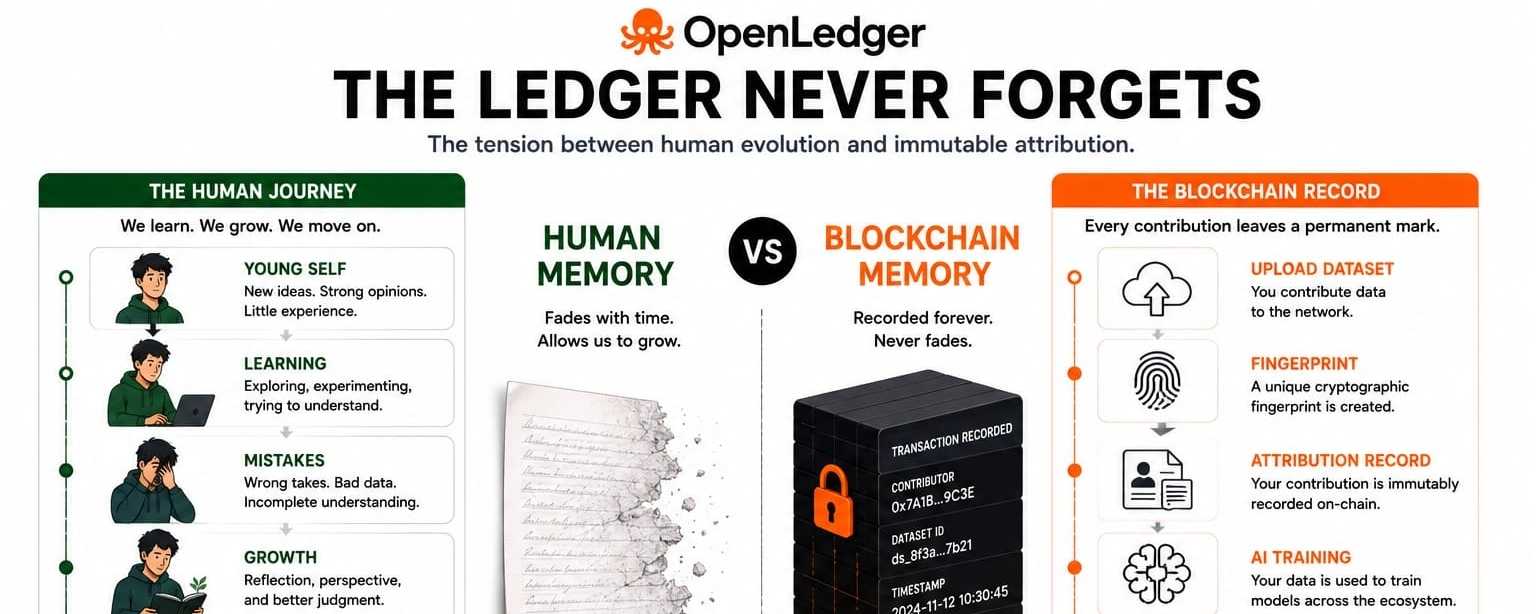
@OpenLedger I have a folder on my old hard drive filled with things I wrote in my early twenties. Blog posts, forum rants, a few embarrassingly confident takes on topics I barely understood. Every few years I open it, cringe, and quietly thank the universe that the internet has a short memory. Links rot. Forums shut down. Bad opinions sink beneath the algorithmic tide. The past fades, and we get to grow beyond it. That quiet mercy is something I've taken for granted.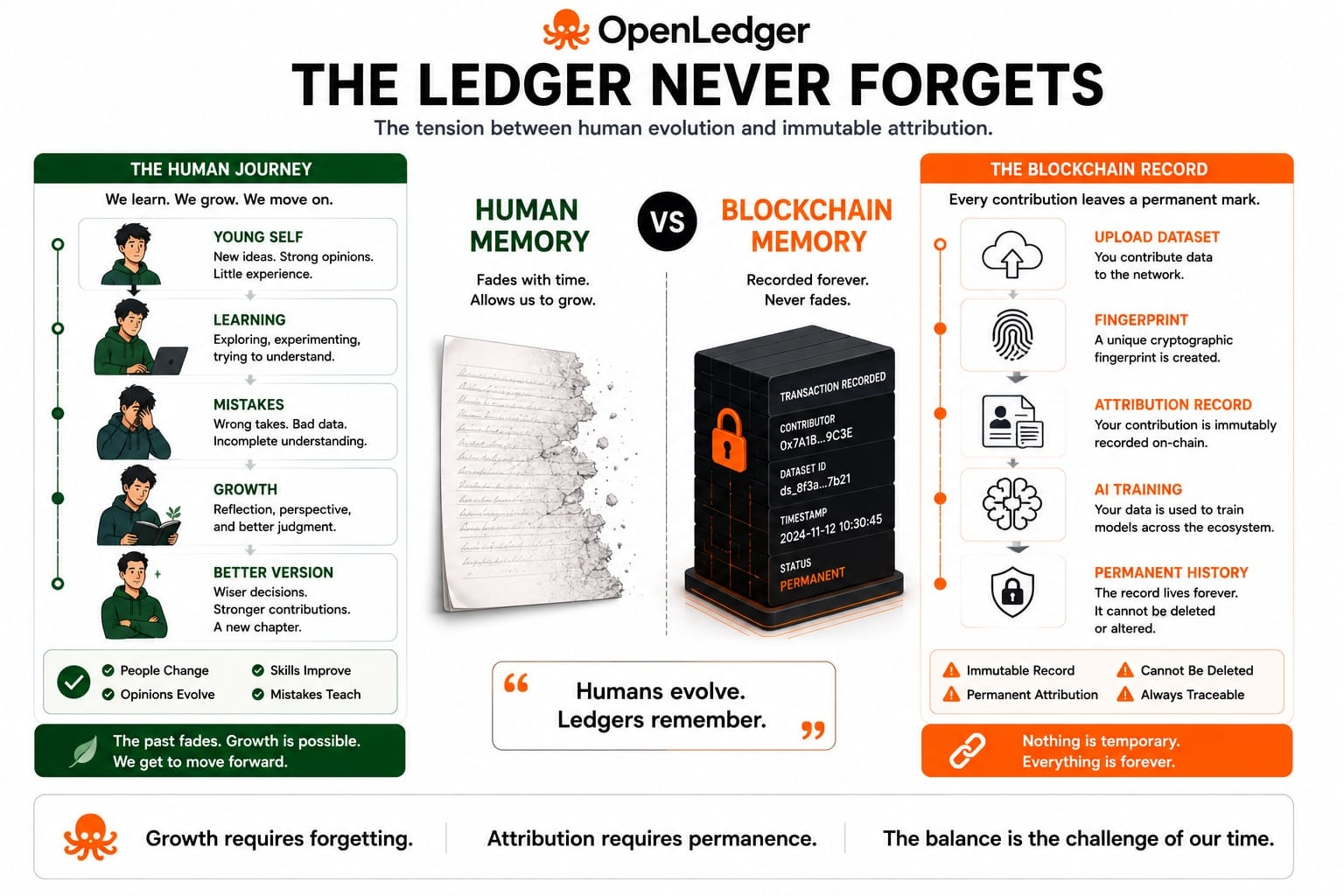
Then I started thinking about OpenLedger's Proof of Attribution. Not as a royalty system or a data quality tool we've covered those. But as something more unsettling: an indelible record of every contribution you ever make, permanently etched into an immutable ledger. Your dataset of handwritten recipes, sure. But also that hot take you dashed off without thinking. That mislabeled image. That "temporary" dataset you curated when you were still learning and got half the tags wrong. In a world where all AI training data carries a fingerprint, nothing is temporary. Everything becomes a permanent exhibit in the museum of your digital self.
The tension between blockchain immutability and the human right to evolve is rarely discussed in crypto circles. GDPR gave us the right to erasure a legal acknowledgment that people deserve to move on from their past data. But what happens when a Datanet contributor wants to revoke a dataset, and it's already been fingerprinted, used in a training run, and woven into the attribution trail of a dozen downstream models? The cryptographic record can't be deleted. The models can't be untrained retroactively. The receipt stays forever, pointing back to you, long after you've become someone who wouldn't recognize your former self.
I'm not suggesting OpenLedger is building a dystopia. The immutability that troubles me is also the foundation of trust for the entire system. Contributors need to know their work can't be erased by bad actors. Enterprises need auditable, tamper-proof trails for compliance. But there's a line between accountability and entrapment, and I'm not sure the project has fully grappled with where it falls.
I imagine a future where every AI output comes with a provenance tab you can click like an ingredient label. And under "training data," you see a list of contributors, their wallet addresses, their reputations. For the person who uploaded that brilliant medical dataset, it's a badge of honor. For the person whose old, flawed data contributed to a model's bias, it's a scarlet letter they can never remove. Both are attribution. One feels like justice, the other like punishment for being human.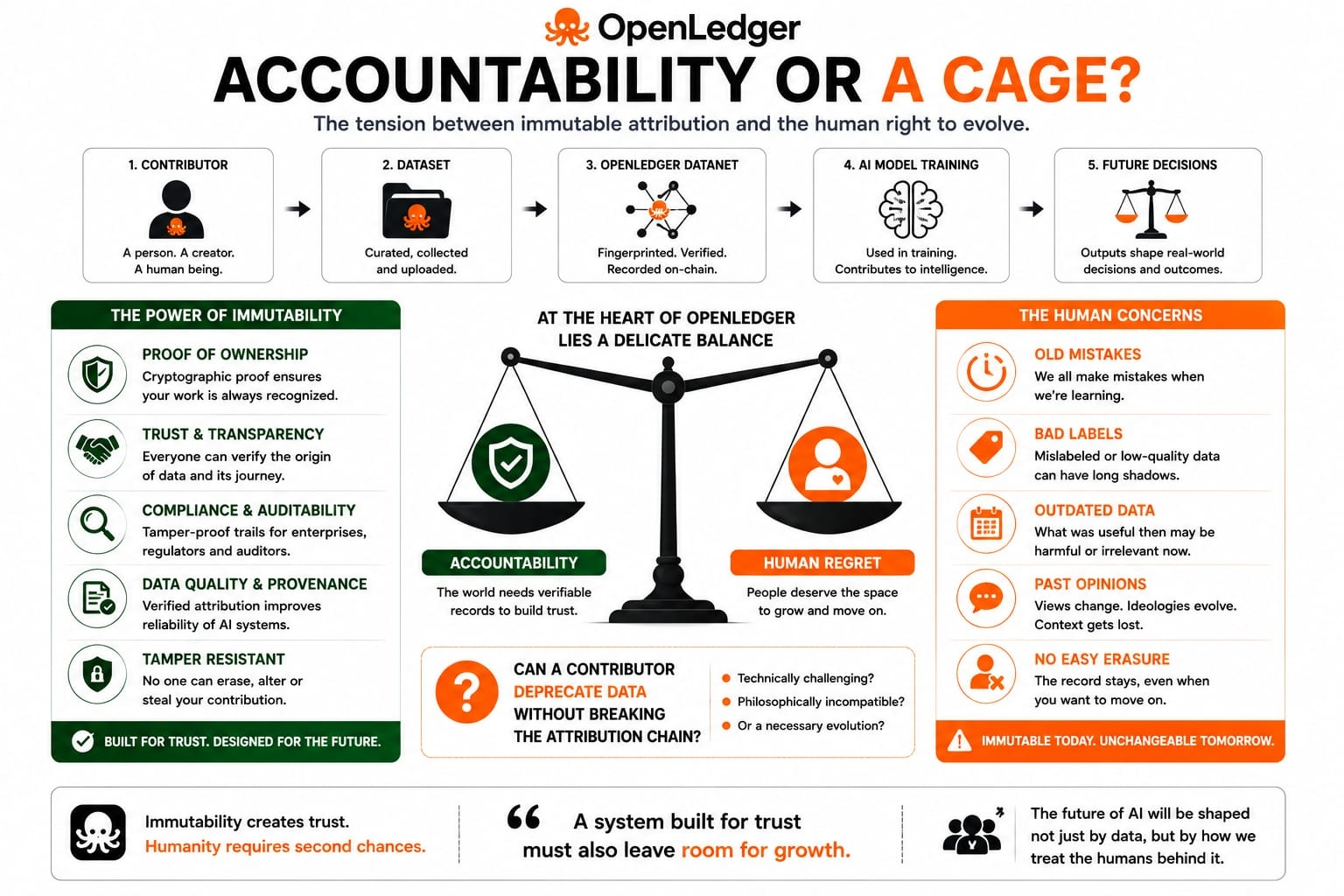
OpenLedger's 2026 roadmap mentions decentralized governance and sequencer networks, but I haven't seen anything about a "right to delist" a way for contributors to mark data as deprecated without breaking the attribution chain. Maybe it's technically impossible. Maybe it's philosophically incompatible with the whole vision. But as someone who still cringes at my early blog posts, I can't shake the feeling that any system built for human contributors needs to leave room for human regret. Immutability is a feature. It's also, sometimes, a cage.