
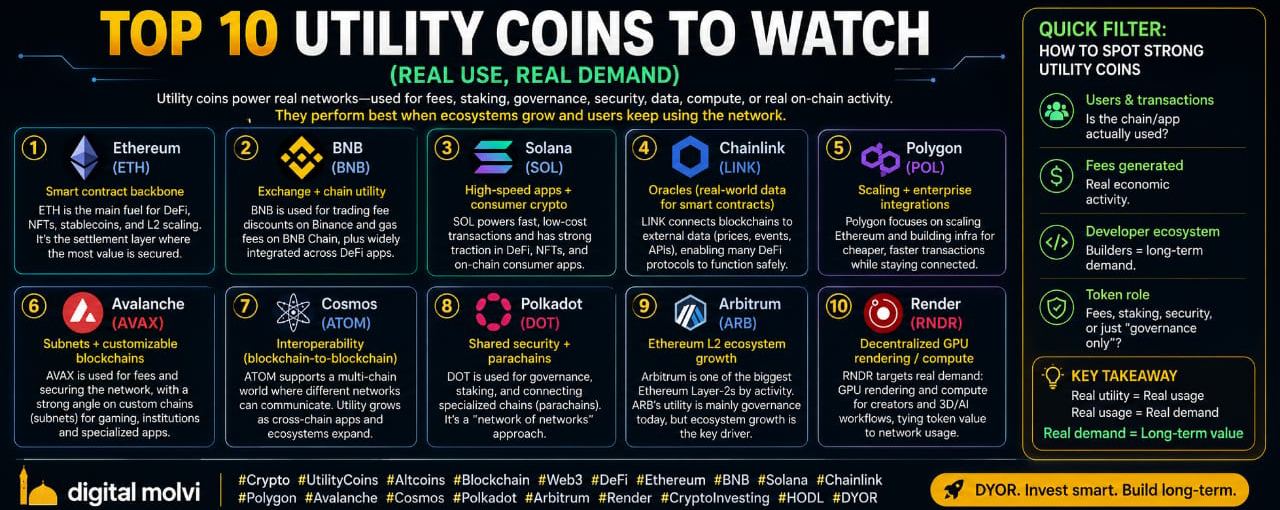
Utility coins are crypto assets that power actual networks—used for fees, staking, governance, security, data, compute, or real on-chain activity. Unlike pure hype plays, utility coins tend to perform best when their ecosystems grow and users keep paying to use the chain/app.
Here are 10 utility-focused coins worth watching, grouped by what they’re useful for:
1) Ethereum (ETH) — Smart contract backbone
ETH is the main fuel for DeFi, NFTs, stablecoins, and L2 scaling. Its utility comes from being the settlement layer where the most value is secured.
2) BNB (BNB) — Exchange + chain utility
BNB is used for trading fee discounts on Binance and gas fees on BNB Chain, plus it’s widely integrated across DeFi apps in that ecosystem.
3) Solana (SOL) — High-speed apps + consumer crypto
SOL powers fast, low-cost transactions and has strong traction in DeFi, NFTs, and on-chain consumer apps.
4) Chainlink (LINK) — Oracles (real-world data for smart contracts)
LINK is critical infrastructure: it connects blockchains to external data (prices, events, APIs), enabling many DeFi protocols to function safely.
5) Polygon (POL / formerly MATIC) — Scaling + enterprise integrations
Polygon focuses on scaling Ethereum and building infrastructure for apps that need cheaper, faster transactions while staying connected to Ethereum’s ecosystem.
6) Avalanche (AVAX) — Subnets + customizable blockchains
AVAX is used for fees and securing the network, with a strong angle on custom chains (subnets) for gaming, institutions, and specialized apps.
7) Cosmos (ATOM) — Interoperability (blockchain-to-blockchain)
ATOM supports a multi-chain world where different networks can communicate. Utility grows as cross-chain apps and ecosystems expand.
8) Polkadot (DOT) — Shared security + parachains
DOT is used for governance, staking, and connecting specialized chains (parachains). It’s a “network of networks” approach.
9) Arbitrum (ARB) — Ethereum L2 ecosystem growth
Arbitrum is one of the biggest Ethereum Layer-2s by activity. ARB’s utility is mainly governance today, but the ecosystem growth is the key driver.
10) Render (RNDR) — Decentralized GPU rendering / compute
RNDR targets real demand: GPU rendering and compute for creators and 3D/AI workflows, tying token value to network usage.
Quick Filter: How to Spot Strong Utility Coins
Before buying any “utility” coin, check:
Users & transactions (is the chain/app actually used?)
Fees generated (real economic activity)
Developer ecosystem (builders = long-term demand)
Token role (fees, staking, security, or just “governance only”?)
#digitalmolvi #BinanceSquare #crypto #UtilityCoins #altcoins


