

Scale
I've spent enough years building backend systems for live-service games to develop a healthy distrust of anything that sounds too clean.
Whenever a project describes itself as an AI blockchain, alarm bells start ringing in my head. Not because the idea is bad. Usually because the reality is nowhere near as simple as the marketing deck makes it look.
OpenLedger is an interesting example.
On the surface, the pitch sounds straightforward. People contribute data, models create value, agents perform work, and somehow the blockchain makes sure everyone gets paid fairly. Nice story. Easy to understand.
The reality is much messier.
What OpenLedger is actually trying to solve isn't an AI problem. It's an attribution problem. And those are nasty.
If a dataset contributes to a model, and that model contributes to an agent, and that agent creates economic value somewhere downstream, who deserves credit? More importantly, who deserves money? Those are the kinds of questions that sound simple until you're the poor engineer trying to build a system that answers them consistently for millions of transactions.
That's where things get ugly.
A lot of people seem to assume that because OpenLedger is a blockchain project, everything should happen on-chain. I've seen this thinking before. It usually comes from people who have never had to keep a production system alive under real traffic.
Let's be honest. Running every AI operation through blockchain consensus would be a disaster.
Model inference is expensive. Training is expensive. Data processing is expensive. If every meaningful operation had to wait for blockchain finality, users would abandon the platform before the loading spinner finished spinning.
Nobody wants that.
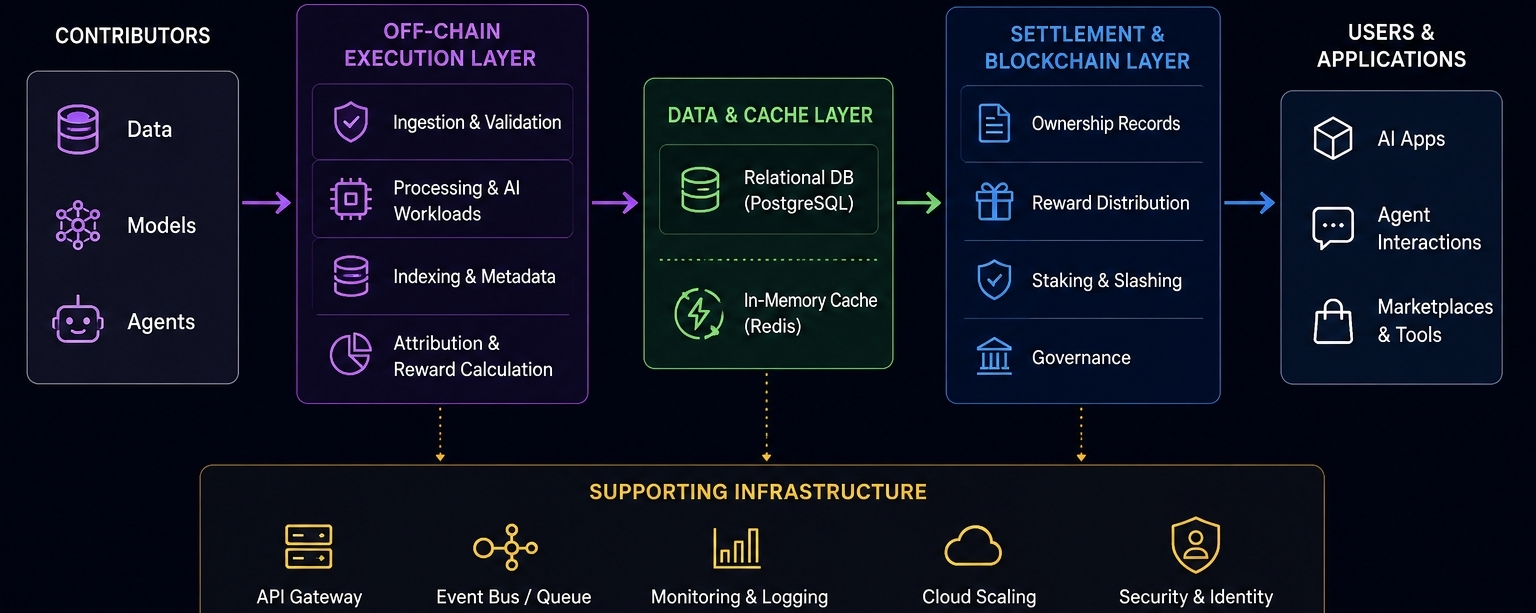
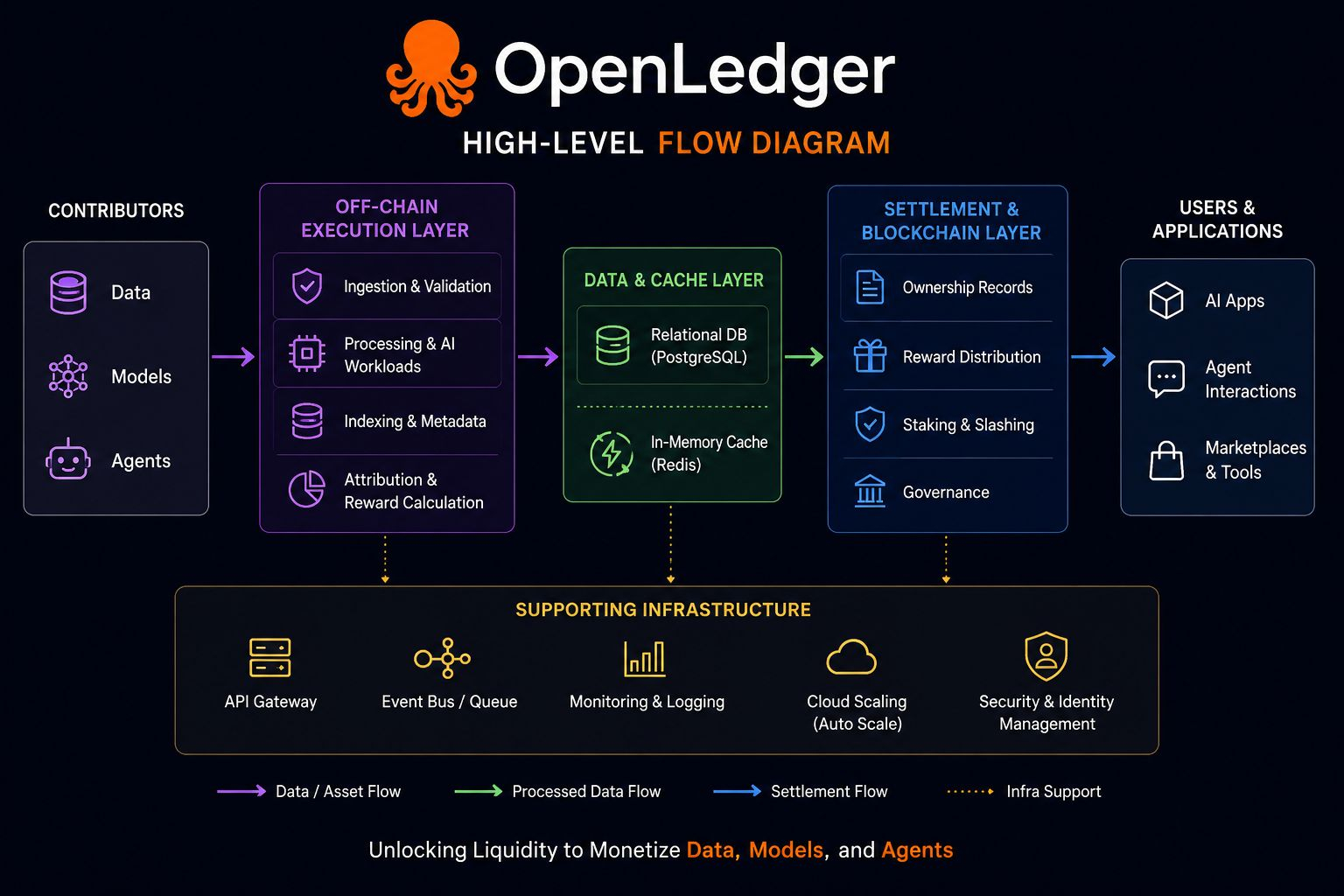
What I suspect sits underneath OpenLedger is something that looks surprisingly familiar to anyone who's worked on large-scale distributed systems. Strip away the token layer and you'll probably find a collection of services, queues, databases, caches, monitoring dashboards, autoscaling groups, and enough operational complexity to keep a backend team awake at night.
Because that's how these systems survive.
Take something as simple as uploading a dataset. People imagine one transaction. What actually happens is a chain reaction. Validation services wake up. Metadata gets indexed. Attribution systems start calculating ownership relationships. Reward engines need to determine economic value. Settlement systems eventually push information toward the blockchain.
Every one of those steps creates dependencies.
Every dependency becomes a potential failure point.
Every failure point eventually fails. Usually at 3 AM.
I've lost count of how many incidents I've debugged where one overloaded service quietly backed up a queue until half the platform started behaving like it was underwater. That's why mature systems lean so heavily on event-driven architecture. Not because architects love drawing fancy diagrams. Because tightly coupled systems become operational nightmares.
The moment traffic spikes, everything catches fire together.
Decoupled services at least give you room to breathe.
The data layer introduces another set of headaches. AI platforms generate different kinds of data, and they all behave differently.
Financial records, ownership histories, reward distributions — those want consistency. Relational databases are still hard to beat there. They're boring. That's a compliment.
Then you have operational data. Session state. Agent memory. Reputation scores. Frequently accessed metadata. Stuff that users expect instantly.
That information doesn't belong buried in disk-based storage if you're chasing responsiveness. This is where Redis and similar in-memory systems start carrying a lot of weight.
People love talking about scaling compute clusters. Databases are usually where the real pain starts.
I've watched systems spend months optimizing application code while the actual bottleneck was a storage layer begging for mercy under read pressure.
The latency problem is even more interesting.
Users expect AI to feel immediate. Blockchain networks absolutely do not.
Those two expectations collide head-on.
If OpenLedger required blockchain confirmation before every meaningful interaction completed, the experience would be awful. There isn't really another way to phrase it. Users don't care about consensus mechanisms. They care about getting a response before they lose interest.
So the obvious solution is separating execution from settlement.
The AI work happens immediately. Attribution gets calculated afterward. Economic settlement follows later.
From the user's perspective, everything feels fast.
Behind the scenes, there's an entire machinery working overtime to preserve accountability.
That's the part nobody talks about enough.
Because every architectural decision here is really a trade-off disguised as a feature.
The decentralization conversation is a good example. People often frame it as if systems are either centralized or decentralized. Reality doesn't work that way.
Most successful platforms sit somewhere in the middle.
And honestly, I think that's fine.
Trust-sensitive operations belong on-chain. Ownership records. Reward distribution. Governance. Economic settlement. Those are exactly the places where transparency matters.
AI inference doesn't belong there.
Search doesn't belong there.
Dataset retrieval doesn't belong there.
Trying to force those workloads onto blockchain infrastructure feels like using a cargo ship to deliver pizza. Technically possible. Completely ridiculous.
The cloud exists for a reason.
So does blockchain.
The trick is understanding where each one adds value.
What often gets overlooked is the API layer quietly holding everything together. Once enough services exist, communication becomes its own engineering discipline. Authentication services need data from account systems. Attribution engines need metadata. Settlement layers need ownership information. Everything talks to everything else.
And once external developers start building on top of the platform, those APIs stop being internal plumbing.
They become products.
I've seen technically brilliant systems lose adoption because integration was painful. Meanwhile, less sophisticated competitors won simply because developers could get something working before lunch.
Technology rarely wins on elegance alone.
Then there's the question every architect eventually asks.
What happens when things break?
Because they will.
Traffic spikes happen. Databases get saturated. Cache clusters fall over. Blockchain networks become congested. Someone deploys a change they shouldn't have deployed. A dependency goes down unexpectedly.
The interesting systems aren't the ones that avoid failure.
Those don't exist.
The interesting systems are the ones that fail gracefully.
If reward settlement slows down for an hour, can agent execution continue?
If indexing falls behind, can ownership tracking remain accurate?
If one service dies, does the rest of the platform survive?
Those questions matter far more than whatever throughput number ends up in a whitepaper.
And eventually every scaling discussion comes back to economics.
Adding more servers is easy. Cloud providers will happily sell you more infrastructure.
The hard part is maintaining incentive structures that still make sense when participation explodes.
That's where a lot of ambitious platforms stumble. The technology scales. The economics don't.
Which is probably why OpenLedger caught my attention in the first place. Not because it's combining AI and blockchain. Everyone seems to be doing that lately.
What's interesting is that it's trying to solve a problem that sits underneath both technologies. The question isn't how to build smarter models. The question is how to build a system that can measure contribution, distribute value, and remain operational when the nice architectural diagrams meet real-world complexity.
Because that's always the moment that matters.
Everything looks decentralized, scalable, and elegant on a slide deck.
Production has a way of introducing reality.
