
I opened it late, already tired, already in that mood where every new crypto announcement feels like it is asking for more belief than I have left to give.
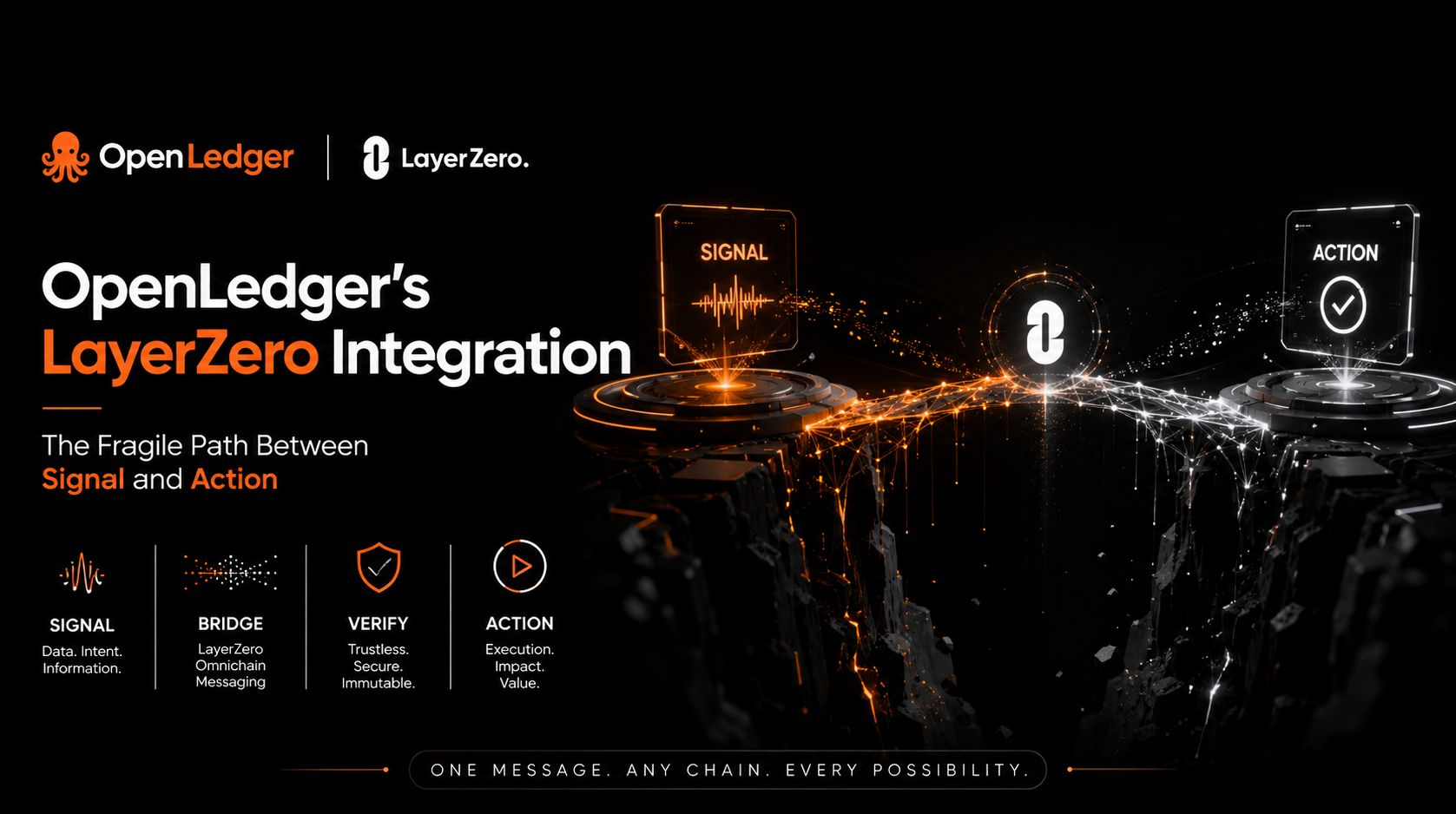
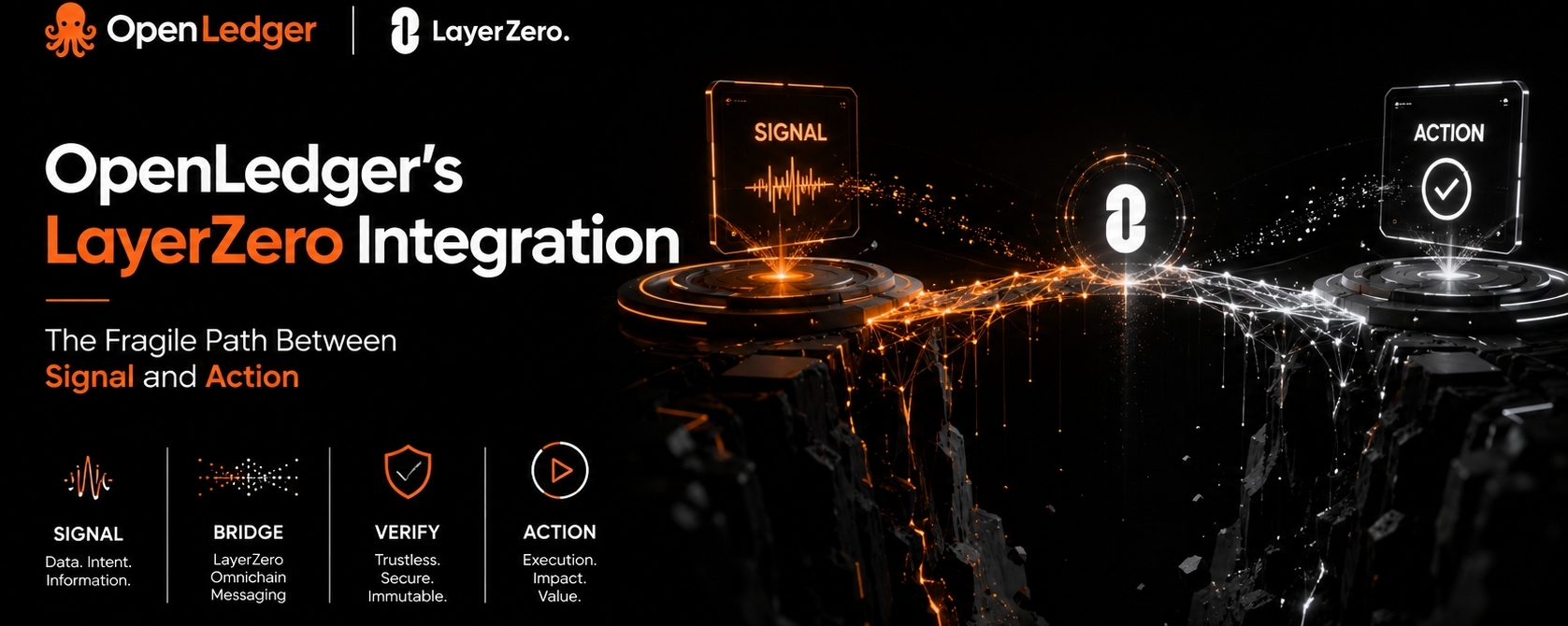
OpenLedger using LayerZero. Signals and actions no longer stuck to one chain.
A few years ago, I might have read that differently. Faster, maybe. With more willingness. Now I pause. Not because the idea is weak, but because the market has made me careful. It keeps recycling the same promise with different names. More interoperability. More freedom. More seamless movement. More future. Every cycle finds a cleaner way to say the old thing, and every cycle leaves behind some forgotten infrastructure that was supposed to change everything.
So I did not feel hype first. I felt resistance.
But then I kept thinking about it.
Because underneath the familiar language, there is a real problem here. Signals are easy to talk about. Actions are harder. An AI system can notice something useful. A model can produce a recommendation. An agent can detect an opportunity. But if that signal is trapped inside one chain while the actual action needs to happen somewhere else, intelligence becomes stranded. It knows something, but it cannot reach far enough to do anything with it.
That part feels less like marketing and more like reality.
Most people in the market do not care about this layer until it fails. They care about the visible thing. The token. The chart. The announcement. The quick angle. But the boring parts decide whether anything survives. Routing decides. Timing decides. Message delivery decides. Accounting decides. Small delays decide. The spaces between “something happened” and “something acted on it” decide more than people want to admit.
That is what made this OpenLedger and LayerZero move stay in my head.
It is not really about making another cross-chain claim. It is about trying to build a flow where information and execution are not forced to live in the same place. A signal can come from one environment. An action can happen in another. Agents can begin to behave less like they belong to a chain and more like they belong to a task.
I like that idea, but I do not fully trust it yet.
I have seen too many clean systems become strange once money touches them. Everything looks elegant before stress arrives. Then fees rise. Liquidity moves. Users panic. Incentives bend. Someone finds a weakness in timing. Someone else depends on a message arriving smoothly, until the one moment it does not. Infrastructure never gets tested properly in calm conditions. It gets tested when people are impatient, afraid, overleveraged, and trying to exit faster than the system was designed to handle.
That is where the truth usually appears.
LayerZero, in this case, feels less like the main character and more like the pipe behind the wall. Nobody praises the pipe when water flows. They only notice it when something leaks. But that is exactly why it matters. If OpenLedger wants agents, signals, and actions to move across different environments, the pipe becomes part of the product, even if the market barely looks at it.
And maybe that is the part I find most interesting. The future people describe for autonomous agents sounds smooth, but the infrastructure underneath is still fragmented. Liquidity is in different places. State is in different places. Users are in different places. Trust is in different places. Attention is scattered everywhere. A system that wants to act intelligently across all of that needs more than a good model. It needs coordination that does not collapse under pressure.
Still, I cannot pretend this is solved just because the architecture makes sense.
A good design can still fail to attract usage. A useful layer can remain invisible for too long. A protocol can solve a problem before the market is ready to care about that problem. Or worse, it can solve part of the problem and introduce a new kind of fragility somewhere else.
That is the tension I keep sitting with.
OpenLedger using LayerZero feels like a quiet bet that agents will not stay confined to one chain forever. They will need to read signals wherever they appear and act wherever execution makes sense. That sounds obvious when written plainly, but crypto has a way of making obvious things painfully difficult in practice.
So I am not calling it revolutionary. I do not have the energy for that word anymore.
I am just watching it as one of those small infrastructure decisions that may matter more later than it does today. The kind of thing people ignore while the market is loud, then suddenly rediscover when scale, volatility, and human behavior start pressing against the system.
Maybe it becomes real infrastructure. Maybe it becomes another clean idea that looked better before the market touched it.
For now, I am left somewhere in between. Interested, but guarded. Curious, but not sold. Watching the machinery under the narrative, because that is usually where the real story hides.
@OpenLedger #OpenLedger #OpenLedger # $OPEN