
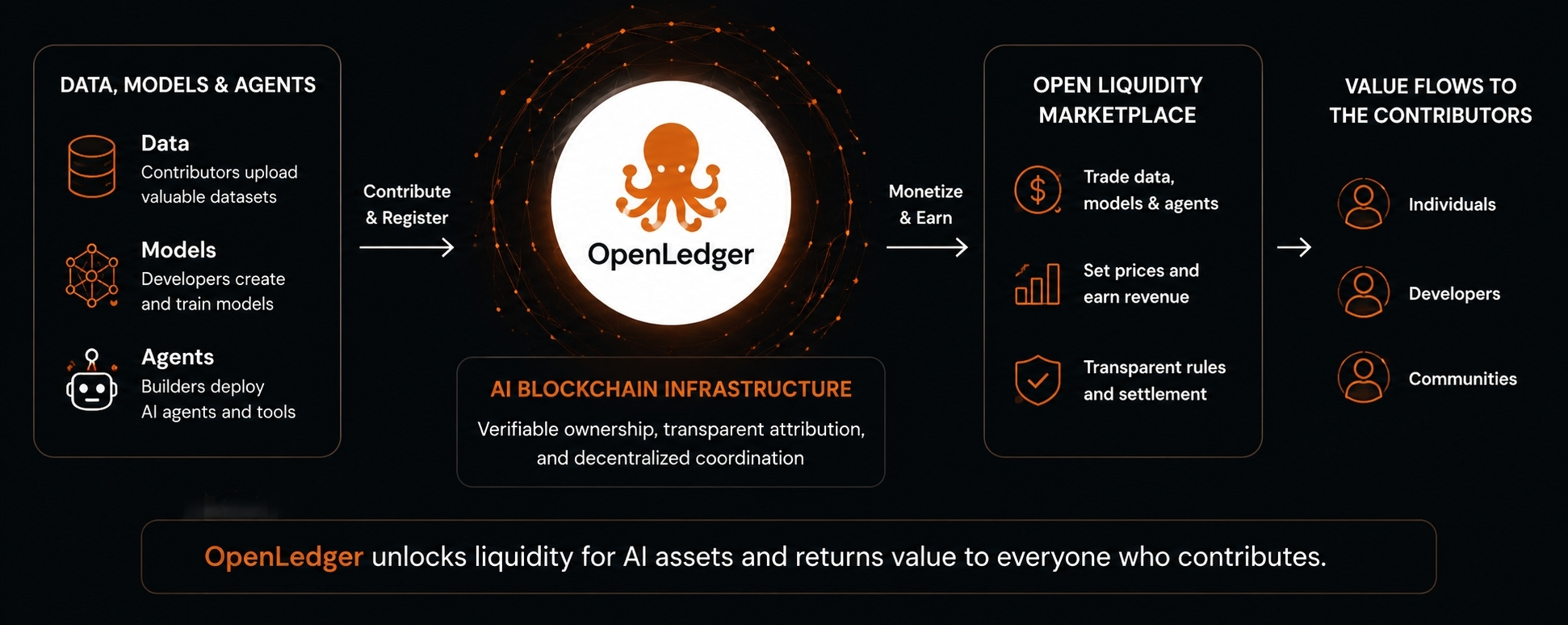
OpenLedger has been sitting in the back of my mind for a while now, mostly because I keep noticing how the market reacts anytime AI and blockchain get mentioned together. The reaction is almost automatic at this point. People hear “AI infrastructure” and immediately start pricing in a future that does not exist yet. I understand why it happens. AI is growing fast, crypto is still searching for its next long-term direction, and projects like OpenLedger naturally attract attention because they sit in the middle of both worlds.
Still, I’ve been around long enough to know that attention alone means very little.
What keeps me watching OpenLedger is not the excitement around it, but the problem it’s trying to solve. The idea of giving value back to the people contributing data, building models, or creating AI agents makes sense to me. Right now, most of that value gets absorbed by large centralized systems. Users contribute information constantly, models improve from it, companies monetize it, and very little flows back to the people helping create the ecosystem in the first place.
That imbalance is becoming harder to ignore.
OpenLedger seems to be built around the idea that data, models, and AI activity should behave more like assets inside an open economy instead of remaining locked inside closed platforms. On paper, that sounds logical. Blockchain technology is naturally good at tracking ownership, distributing incentives, and recording contribution. The concept itself is not difficult to understand.
The difficult part is making it work beyond theory.
That’s the part I keep coming back to whenever I look deeper into the project.
Crypto has a habit of making every infrastructure idea sound revolutionary during the early stages. Everything feels important while the market is paying attention. Communities grow quickly, timelines move fast, and people start speaking about adoption as if it’s already guaranteed. Then eventually the excitement cools down, and that’s usually when reality begins testing the system underneath.
I’ve watched too many projects look powerful during hype and fragile during silence.
That’s why I’m more interested in whether OpenLedger can create real activity instead of temporary speculation. Because speculation is easy in this market. People will buy almost any narrative if the timing feels right. Real usage is different. Real usage stays even when incentives become smaller and social media stops paying attention.
Attention is easy to manufacture. Usage is not.
That line keeps proving itself over and over again in crypto.
The thing I keep questioning with OpenLedger is whether the ecosystem can sustain participation naturally over time. If contributors are rewarded for providing valuable data or building useful models, the system has to make economic sense long term. Otherwise it risks becoming another network where activity only exists while rewards are inflated.
That problem has destroyed more crypto narratives than people like to admit.
The market usually talks about technology first, but incentives quietly decide everything underneath. If incentives are weak, users disappear. If incentives are artificial, activity becomes temporary. If token utility depends mostly on speculation, the entire structure becomes vulnerable once momentum slows down.
And momentum always slows down eventually.
That doesn’t mean OpenLedger cannot succeed. It just means the project still has to prove it can survive outside the excitement phase that surrounds AI-related crypto projects right now. AI is the strongest narrative in tech at the moment, and because of that, almost every blockchain project connected to AI receives attention faster than it receives scrutiny.
I think that creates both opportunity and risk.
The opportunity is obvious. If OpenLedger manages to build infrastructure that developers, contributors, and AI systems genuinely rely on, it could eventually matter far more than most short-term market participants realize today. Open systems around AI coordination, ownership, and monetization may become increasingly important over time.
But the risk is just as real.
Decentralized systems are difficult to scale smoothly. Coordination becomes messy. Quality control becomes complicated. Governance introduces friction. Most users say they care about decentralization until convenience becomes more important, which usually happens faster than expected.
That’s something crypto continues learning the hard way.
People romanticize decentralization during bullish periods, but users usually stay where products actually work. OpenLedger eventually has to prove that decentralization creates practical advantages, not just philosophical ones. Otherwise the market will move on the second a newer narrative appears.
And the market always moves on eventually.
I’m also careful about confusing visibility with durability. A project trending for months does not automatically mean it has long-term value. Crypto often rewards projects long before their infrastructure is mature enough to justify the valuation around them. Sometimes the loudest ecosystems end up fading quietly once incentives weaken.
Most projects look stronger during announcements than during silence.
Silence is where the real test begins.
That’s why I keep paying attention to execution more than promises. Can OpenLedger continue building when the market becomes less emotional? Can it attract developers who care about the infrastructure itself rather than short-term token speculation? Can it create actual demand around the network instead of temporary activity designed to boost metrics?
Those answers take time.
And time usually reveals more than hype ever does.
I’m not fully convinced yet, but I’m not dismissing it either. The problem OpenLedger is targeting feels real enough that it deserves attention. AI systems are becoming more valuable every year, and questions around ownership, contribution, and monetization are only getting bigger. Whether blockchain becomes the best solution for those problems is still uncertain.
But uncertainty is normal in crypto.
The projects that matter long term are rarely the ones shouting the loudest in the beginning. Usually they are the ones still quietly building after the market stops celebrating them.