
I’ve been watching the way people talk about AI lately, and something about it feels different now. A few years ago, the conversations felt imaginative. Messy. Experimental. People talked about what machines might create, how they might change art or work or daily life. Now the tone feels colder somehow. More financial. Models are discussed like assets. Data is treated like fuel. Even autonomous agents — software that can act and make decisions on their own — are starting to sound less like tools and more like workers entering an economy.
And maybe that shift was always coming.
I keep noticing how quickly technology turns into infrastructure once money starts flowing through it. The internet did it. Social media did it. Crypto certainly did it. AI seems to be reaching that stage now too, where the excitement around intelligence is slowly blending into conversations about ownership, coordination, and monetization.
That’s partly why OpenLedger caught my attention.
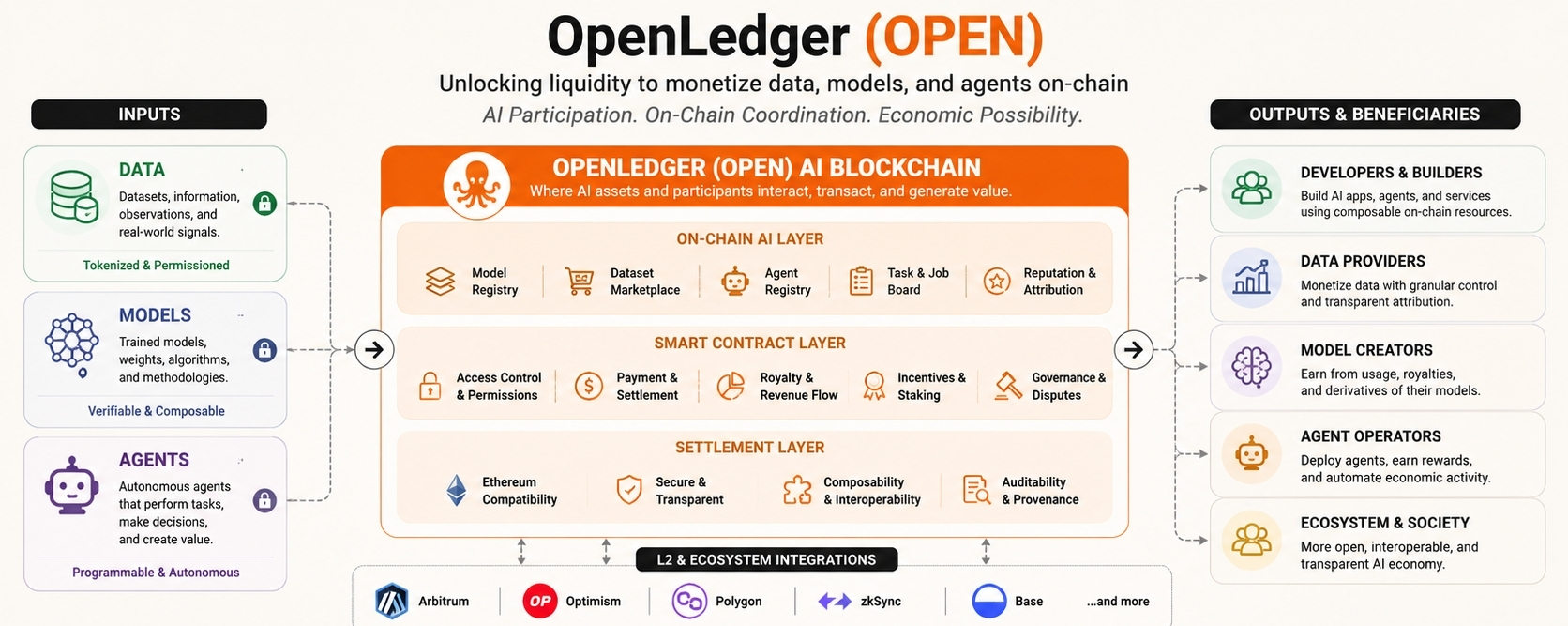
Not in the loud way many crypto projects try to demand attention, but in a quieter way. It feels less like a product and more like an attempt to prepare for a future where AI systems don’t just exist online — they actively participate there. OpenLedger positions itself as infrastructure for monetizing data, models, and autonomous agents, which sounds technical at first, but the idea underneath it is actually pretty simple: create an environment where AI can interact, transact, and generate value directly on-chain.
The more I thought about it, the more interesting that became.
Because once AI starts participating economically, everything around it changes.
OpenLedger is built with Ethereum compatibility, which makes sense. Most projects trying to survive long term no longer want to exist in isolation. They want connectivity. Wallet integration, smart contracts, Layer 2 compatibility — these things are becoming standard foundations rather than exciting features. OpenLedger seems aware of that reality. Instead of trying to reinvent everything, it appears more focused on fitting into the systems people already use.
There’s something practical about that approach.
But there’s also something strange happening underneath it.
The project talks a lot about unlocking liquidity around AI assets, and I understand why. Liquidity sounds positive. It suggests movement, openness, opportunity. Yet I can’t help thinking about what happens when intelligence itself becomes something designed for continuous exchange.
Data becomes an asset.
Models become revenue-generating systems.
Autonomous agents become participants competing inside digital economies.
At some point, the language shifts from creativity to productivity.
And maybe that’s what makes me slightly uneasy about the broader direction of all this — not just OpenLedger, but the entire space around AI and blockchain right now. Everything increasingly feels optimized for efficiency. Faster transactions. Smarter automation. More scalable coordination. The systems become smoother every year, but I’m not always sure smoother systems create better outcomes for people.
There’s also a contradiction sitting at the center of projects like this.
Blockchain culture has always carried the idea of decentralization — distributing power away from large institutions and giving people more control over systems they rely on. AI, meanwhile, has largely moved in the opposite direction. The most advanced models usually come from companies with enormous resources, massive compute infrastructure, and access to data most people could never realistically gather themselves.
So when a project like OpenLedger tries to combine decentralized infrastructure with AI economies, I find myself wondering whether those ideas naturally fit together or whether they’re quietly pulling against each other.
Can intelligence really become decentralized when building powerful AI still requires massive concentration of resources?
Or does decentralization simply become a layer built on top of systems that remain unequal underneath?
I don’t think there’s an obvious answer yet.
And honestly, I don’t think OpenLedger pretends there is either. It feels more like an experiment in building rails for a world that may already be forming on its own. AI agents are becoming more autonomous. Models are increasingly interacting with applications, services, and financial systems without much direct human involvement. Eventually, infrastructure will emerge to support that behavior at scale.
OpenLedger seems to believe that future arrives sooner rather than later.
Maybe it’s right.
What I keep returning to, though, is the human side of all this. Technology conversations often become so abstract that people disappear from them entirely. We talk about ecosystems, liquidity, scalability, optimization — but underneath those words are real behaviors, real attention, real labor, real dependence.
If data becomes valuable, people themselves become sources of production.
If autonomous agents become economically useful, human work starts competing with systems that never sleep.
If everything becomes measurable and monetizable, what happens to the parts of human life that aren’t efficient?
Those questions feel bigger than OpenLedger itself, but projects like this bring them closer to the surface.
And to be fair, there’s another side to it too. Centralized AI systems already control enormous amounts of information and influence. Most people interact with models they do not own, cannot inspect, and have no say in shaping. In that environment, open infrastructure may genuinely matter. Transparent smart contracts, interoperable systems, and decentralized coordination could create alternatives to a future controlled entirely by a handful of companies.
That possibility is real.
Still, I can’t shake the feeling that technology often promises openness while quietly rebuilding new forms of dependence underneath. Markets tend to absorb everything eventually. Once intelligence becomes tied to incentives, efficiency starts shaping behavior in ways that are difficult to reverse.
Maybe OpenLedger helps create healthier AI ecosystems.
Maybe it simply accelerates the financialization of intelligence.
Right now, it’s impossible to know.
That uncertainty is probably the most honest response anyone can have at this stage.
I don’t see OpenLedger as a revolution. I see it more as a reflection of where the world already seems to be heading — toward systems where AI, finance, automation, and digital identity become increasingly difficult to separate from one another.
And watching that happen feels both impressive and slightly uncomfortable at the same time.
Not because the technology is inherently bad, but because every system eventually shapes the people living inside it.
I think we’re still figuring out what kind of people these systems are quietly asking us to become.