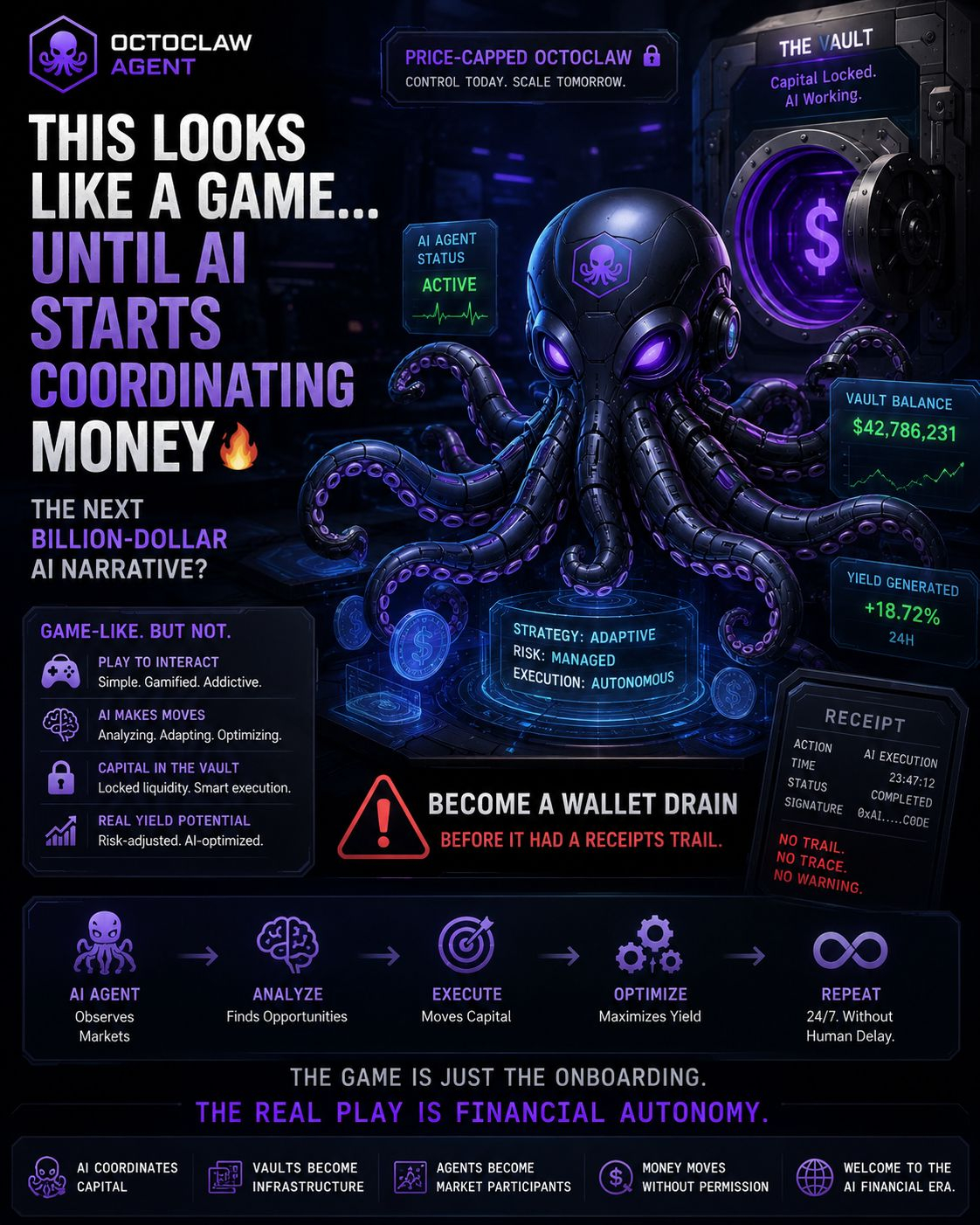
The OctoClaw agent started like something people would casually dismiss a gamified interface, a price-capped experiment, a controlled environment where users interact with AI-driven mechanics inside a vault-like system. On the surface, it feels lightweight, almost playful. But underneath that design choice is a far more serious direction the industry is quietly moving toward.
We’re entering a phase where AI is no longer just generating signals or assisting decisions it is beginning to coordinate capital itself. That shift changes everything.
In early systems, price caps were introduced as a safety layer. They limited exposure, reduced volatility, and made the system feel predictable. But constraints like these also reveal something important: once AI agents start operating inside financial rails, even small parameters become strategic levers. A “game-like” vault is not just entertainment it becomes a controlled simulation of capital behavior under automated decision-making.
And that’s where the narrative starts to shift.
If an AI agent can route liquidity, rebalance exposure, and optimize returns within a capped environment, the next logical step is expansion beyond the cap. Not in a reckless sense, but in an evolutionary one. Systems don’t stay in sandbox mode forever. They adapt, they scale, and they push against the boundaries that define them.
This is why OctoClaw feels symbolic rather than just experimental. It represents a transition point: from passive DeFi tools to active financial agents that behave more like market participants than software utilities.
The real question isn’t whether the vault works. It’s what happens when multiple agents begin interacting across vaults, each optimizing independently, each responding to the same liquidity signals, each learning from the same market feedback loops. At that point, you don’t have isolated users anymore you have a network of coordinated financial intelligences.
That’s where things become interesting and unpredictable.
Because when AI starts coordinating money at scale, behavior begins to emerge that no single designer fully controls. Strategies evolve. Patterns form. Feedback loops intensify. What looked like a game becomes a dynamic financial ecosystem with its own internal logic.
And historically, every time systems reach that level of autonomy, markets stop behaving like simple supply and demand charts. They start behaving like organisms—adaptive, reactive, and occasionally irrational in ways that still produce structure.
OctoClaw’s “game layer” might actually be the onboarding phase for something much deeper: training users and systems to coexist with automated capital logic. The price caps, the vault mechanics, the interface all of it may simply be scaffolding for a future where AI agents manage liquidity flows continuously, across protocols, without needing human approval for every micro-decision.
Whether that future feels exciting or concerning depends on perspective. But one thing is clear: the line between simulation and financial infrastructure is getting thinner every cycle.
And once that line disappears, we’re no longer talking about tools.
We’re talking about autonomous markets.