
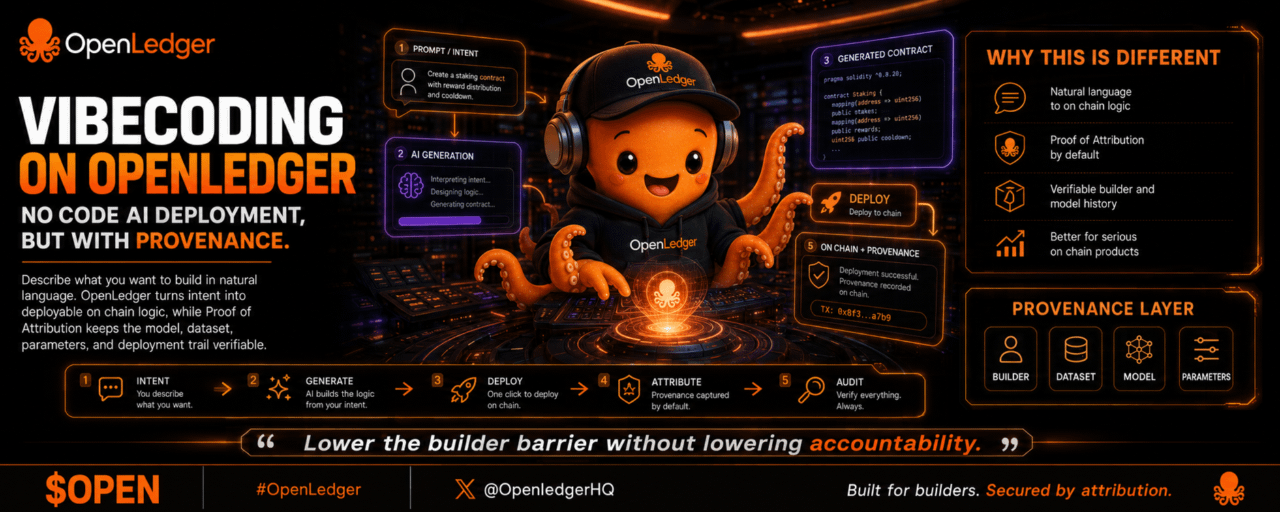

Most people assume that no-code development environments for blockchain produce either toy projects or dangerously unaudited contracts. I'm not sure that framing fits what @OpenLedger is doing with vibecoding, and the distinction matters.
The "vibecoding" concept borrowed from the broader software development conversation of the past year — the idea that natural language prompting can handle the syntactic complexity of code while the developer focuses on intent and architecture. In standard software development, the results are inconsistent. LLMs writing code without deep context produce code that works in demo conditions and breaks under edge cases, security scrutiny, or production load.
The reason vibecoding on OpenLedger is structurally different from the general case is the attribution layer embedded underneath every deployment. In the standard vibecoding scenario, you get code generated by a model from a training dataset of unknown provenance, deployed into an environment with no ongoing connection to its creation history. When it breaks or produces unexpected behavior, the debugging chain is: you, the LLM, trial and error.
When you vibe code on OpenLedger, the model generating your contract logic is connected to its training data through the Proof of Attribution chain. The specific dataset and fine-tuning parameters that produced the model's behavior are on-chain records. The deployment itself adds a provenance record. If the contract produces unexpected behavior and you need to understand why the model reasoned the way it did, you have a traceable path back through the model's construction.
This is more significant for on-chain deployments than for traditional software because on-chain contracts are immutable after deployment and directly control financial assets. The auditability of the model that generated a smart contract is not an academic concern — it has real consequences for security review processes and for assigning accountability when things go wrong.
I spent part of late 2024 watching how professional smart contract auditors were approaching LLM-generated contracts. The consensus was that LLM-generated code wasn't inherently more or less secure than human-written code, but it was harder to audit because the reasoning behind non-obvious design choices was inaccessible. The developer often couldn't explain why the model had made a particular structural decision because they hadn't made that decision themselves.
ModelFactory, the no-code fine-tuning dashboard in the OpenLedger ecosystem, extends this argument into the AI model layer itself. If you're building a specialized model for a specific domain — financial data analysis, medical record processing, legal document review — the vibecoding workflow on OpenLedger lets you fine-tune the model on your domain's data through ModelFactory's interface, deploy the resulting model with full provenance, and then use that model for deployment code generation within the same ecosystem.
The coordination insight here is about what becomes possible when the tool layer for building AI-powered on-chain applications is genuinely accessible to people without deep technical backgrounds. The current DeFi ecosystem's complexity is partially a function of the tooling barrier — the people who can build on-chain applications are a much smaller population than the people who have ideas for what to build. As vibecoding lowers that barrier while the attribution layer provides the auditability that makes lowered-barrier deployment responsible rather than reckless, the potential contributor and developer population for the OpenLedger ecosystem expands significantly.
Whether the models generated through this workflow are actually good enough for production deployment — or whether they mostly serve the prototyping use case where human auditors still review and approve before mainnet deployment — is a question the ecosystem is going to answer empirically over the next twelve to eighteen months.
The design is thoughtful. The execution is the variable.